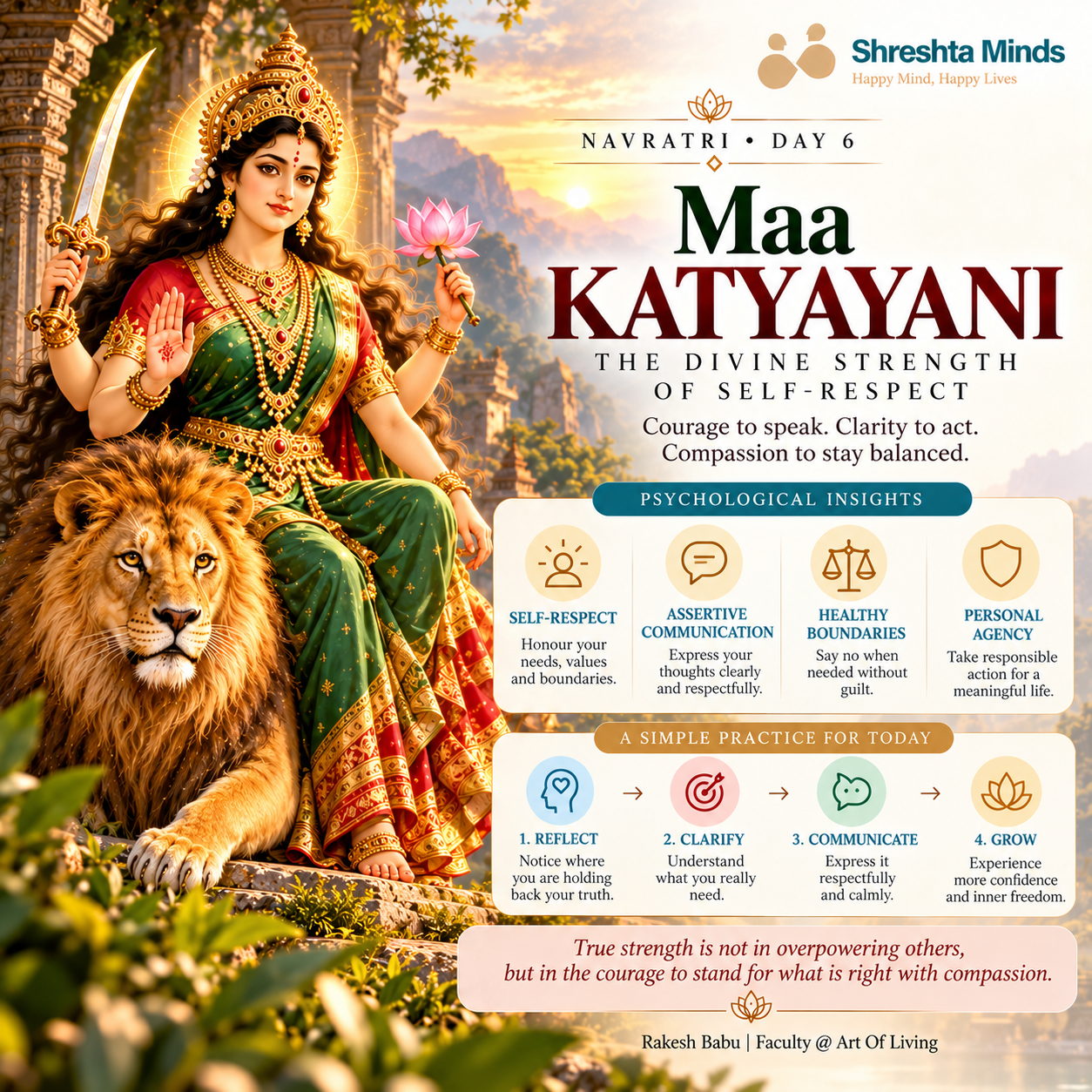
Psychology of Maa Katyayani
Navratri Day 6 | Learning to Honour Your Voice
Have you ever said “yes” when every part of you wanted to say “no”? Is there any instance where you remain silent to avoid disappointing someone, only to feel frustrated with yourself later?
Many of us do this—not because we lack opinions, but because we want to be accepted, avoid conflict or keep others happy. Over time, repeatedly ignoring our own needs can leave us feeling disconnected from ourselves.
On the sixth day of Navratri, we worship Maa Katyayani, the sixth form of Goddess Durga, traditionally associated with divine power and the destruction of evil. Her formidable form invites us to reflect on a different dimension of mental wellness: the ability to stand for what is right without losing respect for ourselves or others.
In psychology, this ability is closely related to assertiveness—expressing our thoughts, needs, feelings and opinions clearly and respectfully. It is different from aggression, which disregards the rights of others, and passivity, which may involve repeatedly sacrificing our own needs to avoid disagreement.
Consider a familiar situation. A colleague keeps assigning you additional work when your schedule is already full.
You could agree reluctantly and become resentful, respond aggressively and damage the relationship, or communicate assertively: “I understand this is important, but I cannot take on another task today. Let us discuss what should be prioritised.”
The third response protects both your dignity and the possibility of a constructive relationship.
Science and Practice identifies assertiveness training as a useful evidence-based psychological intervention across several clinical contexts. It highlights the importance of developing communication skills rather than expecting people to change simply by thinking positively.
This is where Maa Katyayani’s spiritual symbolism becomes personally meaningful. Her divine strength can inspire us to examine where we need greater honesty, self-respect and accountability.
The connection is reflective rather than a claim that worship itself automatically develops these psychological skills.
Assertiveness does not mean winning every argument, proving that we are right or refusing to compromise.
It means recognising that our needs matter while acknowledging that other people’s needs matter too. Sometimes it requires saying no.
Sometimes it means admitting a mistake, asking for fair treatment or expressing an uncomfortable truth with kindness.
A small practice for today: Identify one situation in which you have been withholding an honest response. Write down what you genuinely feel, what you need and how you can communicate it respectfully.
Practise expressing your position without blaming, threatening or apologising unnecessarily for having a reasonable need.
Remember, self-respect is not measured by how many people agree with you. It is reflected in whether your actions remain aligned with your values, even when approval is uncertain.
As we offer our prayers to Maa Katyayani, let us also reflect on the strength required to live truthfully.
May our devotion inspire not only reverence for divine Shakti but also the wisdom to use our own voice responsibly.
Sometimes, the most meaningful change begins when we stop asking, “Will everyone be pleased with me?” and start asking, “Am I responding with honesty, fairness and self-respect?”
Rakesh Babu
Psychologist | Faculty @ The Art Of Living


SSS
🙏