The 4D Mindful Productivity Framework for a Peaceful Life

4D Mindful Productivity Framework!

Have you ever finished a busy day feeling exhausted, yet wondered what you had actually accomplished?

Sometimes, the problem is not the amount of work we have. It is how we decide what deserves our time, energy and attention.

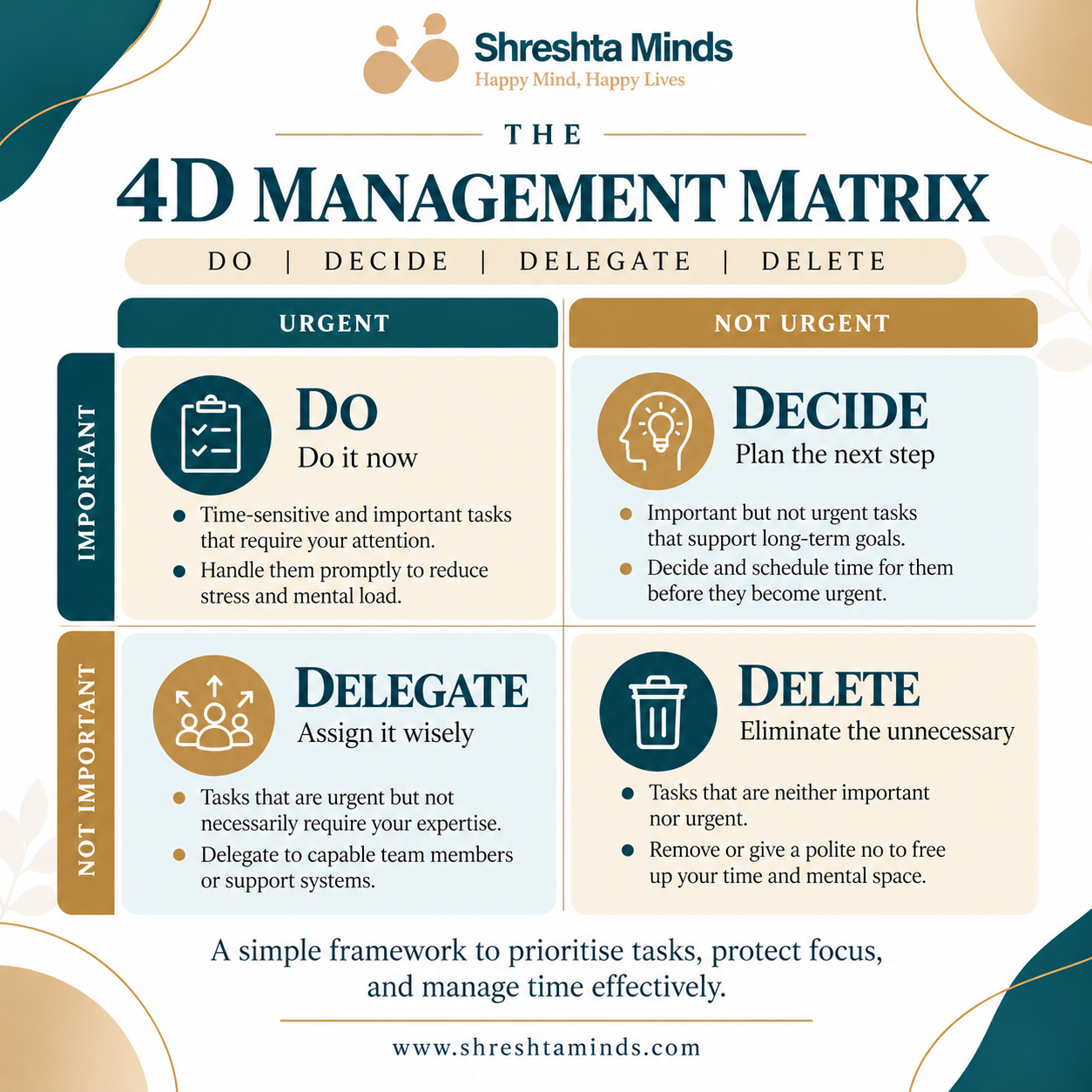
As a psychologist, I believe productivity should not come at the cost of our mental peace. This is why I find the 4D Mindful Productivity Framework — Do, Decide, Delegate and Delete a useful way to approach our daily responsibilities.

1. DO — Urgent and Important

Some things genuinely need our immediate attention. Address them promptly instead of allowing them to accumulate. Taking action on what matters can reduce avoidable stress and give us a sense of control.

2. DECIDE — Important but Not Urgent

This is where we often neglect ourselves. Planning, learning, exercising, nurturing relationships and taking care of our mental health rarely demand immediate attention, but they shape our future. Schedule time for them before life’s demands push them aside.

3. DELEGATE — Urgent but Not Important Enough for You to Handle Personally

Not everything requires your direct involvement. Share responsibilities when appropriate. Learning to trust others, ask for support and respect your own limits can help prevent unnecessary overload.

4. DELETE — Neither Urgent nor Important

Some commitments, distractions and expectations consume our time without adding meaningful value. Learn to let go of what is unnecessary. Saying no to the right things sometimes means saying yes to your own well-being.

Here is a simple practice: whenever you feel overwhelmed, pause and ask yourself, Is this urgent? Is this important? What is the wisest action I can take?

Remember, not every urgent matter is important, and not everything important is urgent.

The real benefit of this framework lies in creating space for what truly matters—not just completing more tasks, but living with greater intention.

A peaceful life does not require us to escape our responsibilities. It requires us to manage them without losing ourselves in the process.

My perspective is simple: productivity is meaningful when it helps us work with clarity, live with balance and sleep with a peaceful mind.

— Rakesh Babu
Psychologist | Neuro Potential Strategist
Shreshta Minds — Empowering Minds. Transforming Lives.

Navratri: A 9-Day Inner Journey

Psychology of the Nine Days of Navratri

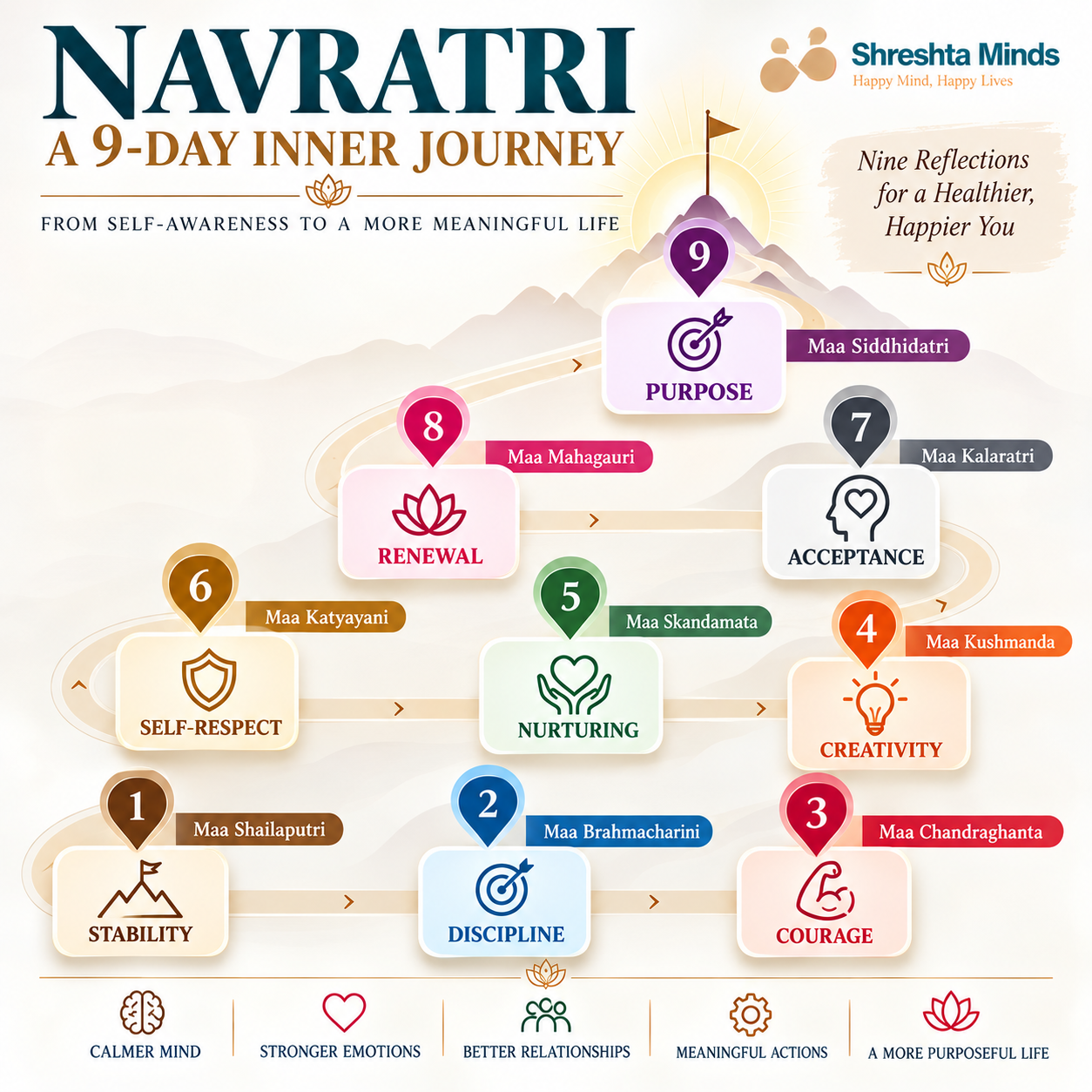
What if the nine days of Navratri could become a journey of transforming not just our prayers, but also our thoughts, emotions, relationships and actions?

Through the symbolism of the nine forms of the Divine Mother, we can reflect on nine qualities that help us grow psychologically, philosophically and personally.

Day 1 — Maa Shailaputri: Stability

Every meaningful change begins with a strong inner foundation. Emotional stability helps us face life’s uncertainties without losing ourselves.

Read Significance of Day 1: CLICK HERE

Day 2 — Maa Brahmacharini: Discipline

Awareness shows us what needs to change; discipline helps us act on it consistently. Small, purposeful actions turn intentions into habits.

Read Significance of Day 2: CLICK HERE

Day 3 — Maa Chandraghanta: Courage

Courage is not the absence of fear, but the willingness to act wisely despite it. When fear stops controlling our choices, new possibilities emerge.

Read Significance of Day 3: CLICK HERE

Day 4 — Maa Kushmanda: Creativity

We may not control every circumstance, but we can influence how we respond. Creativity helps us discover possibilities and take meaningful action.

Read Significance of Day 4: CLICK HERE

Day 5 — Maa Skandamata: Nurturing

Healthy relationships grow through empathy, care and emotional connection. When we learn to understand others without controlling them, relationships become stronger.

Read Significance of Day 5: CLICK HERE

Day 6 — Maa Katyayani: Self-Respect

Self-respect enables us to express our needs and establish healthy boundaries. True assertiveness protects our dignity while respecting the dignity of others.

Read Significance of Day 6: CLICK HERE

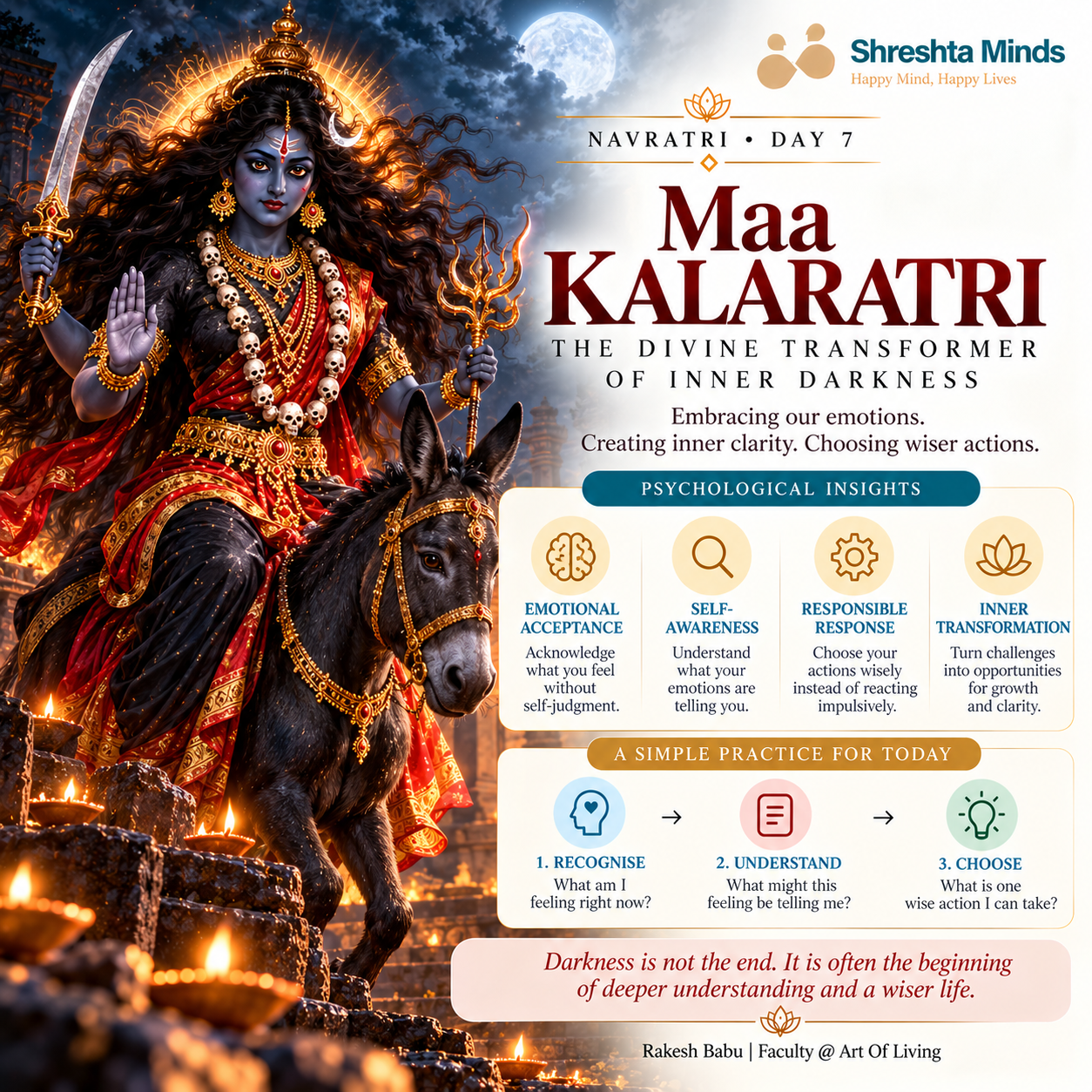
Day 7 — Maa Kalaratri: Acceptance

Growth begins when we face our inner struggles honestly instead of avoiding them. Accepting an emotion does not mean surrendering to it; it means understanding it before responding.

Read Significance of Day 7: CLICK HERE

Day 8 — Maa Mahagauri: Renewal

Self-forgiveness allows us to learn from our mistakes without letting them define us. We cannot rewrite the past, but we can choose a wiser next step.

Read Significance of Day 8: CLICK HERE

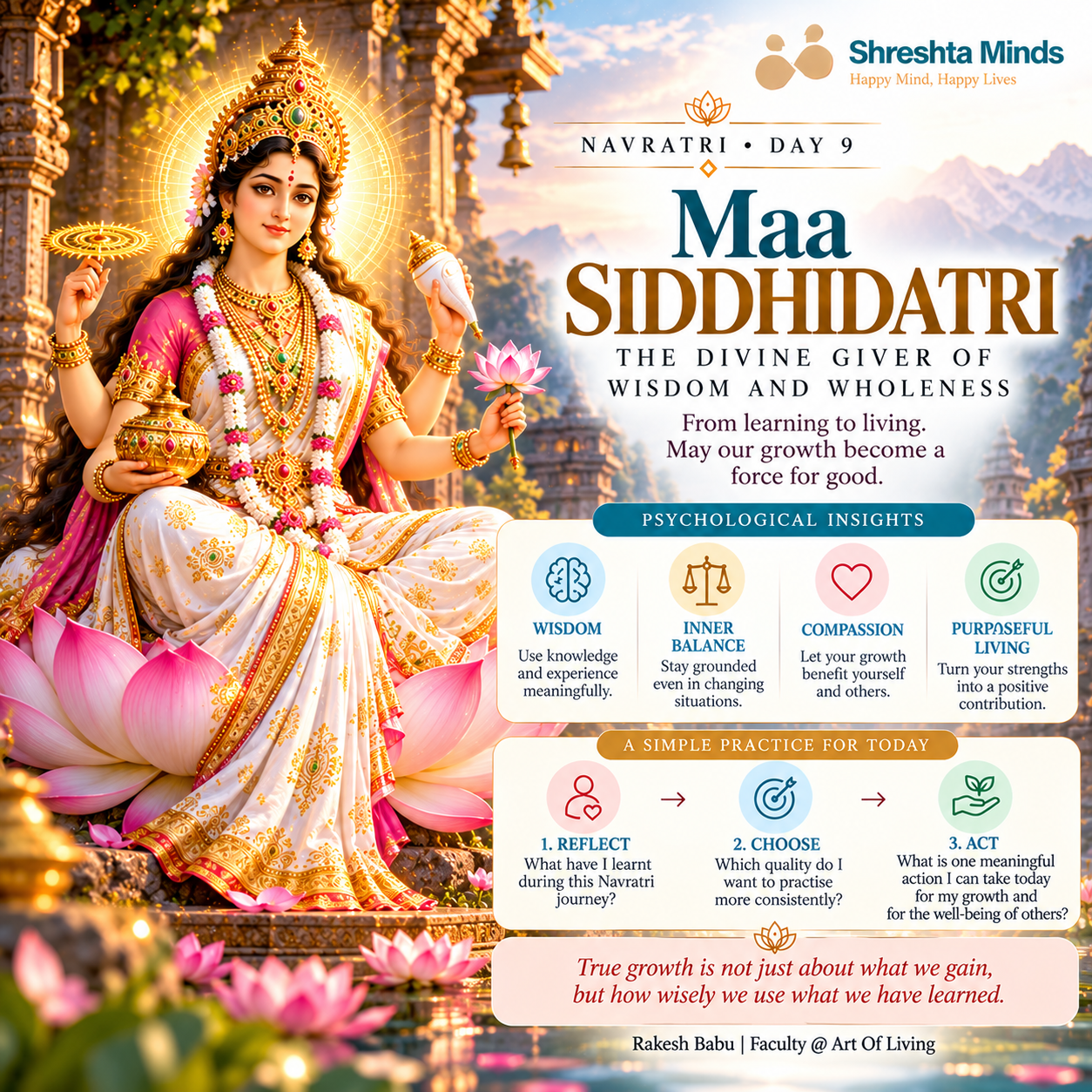
Day 9 — Maa Siddhidatri: Purpose

Wisdom emerges when what we understand becomes the way we live. A purposeful life brings our values, decisions and actions into greater alignment.

Read Significance of Day 9: CLICK HERE

The Journey Beyond Nine Days

The nine reflections form a meaningful progression: Stability → Discipline → Courage → Creativity → Nurturing → Self-Respect → Acceptance → Renewal → Purpose.

Together, they remind us that personal growth is not about becoming perfect; it is about becoming more aware, responsible and intentional in the way we live.

The spiritual symbolism of Navratri offers a framework for reflection, while psychology helps us translate these reflections into everyday practices. Real transformation takes time, consistency and conscious effort.

The true measure of this nine-day journey is not merely what we celebrate, but what we practise when the celebrations end.

A calmer mind. Stronger emotions. Better relationships. Meaningful actions. A more purposeful life.

That is the inner journey Navratri invites us to begin.

Written by Rakesh Babu | Rakesh Writes

Know Yourself. Grow N Glow.

www.shreshtaminds.com

Maa Shailaputri: The Psychology of Inner Stability

Psychology of Maa Shailaputri

Navratri Day 1 | Building a Strong Foundation Within

Have you ever noticed how a small problem can disturb your entire day when your mind is already unsettled?

A delayed response, an unexpected expense, a disagreement with someone close to us — sometimes, the situation itself is not as difficult as the state of mind with which we face it.

This brings us to an important question: How strong is the foundation on which we are building our lives?

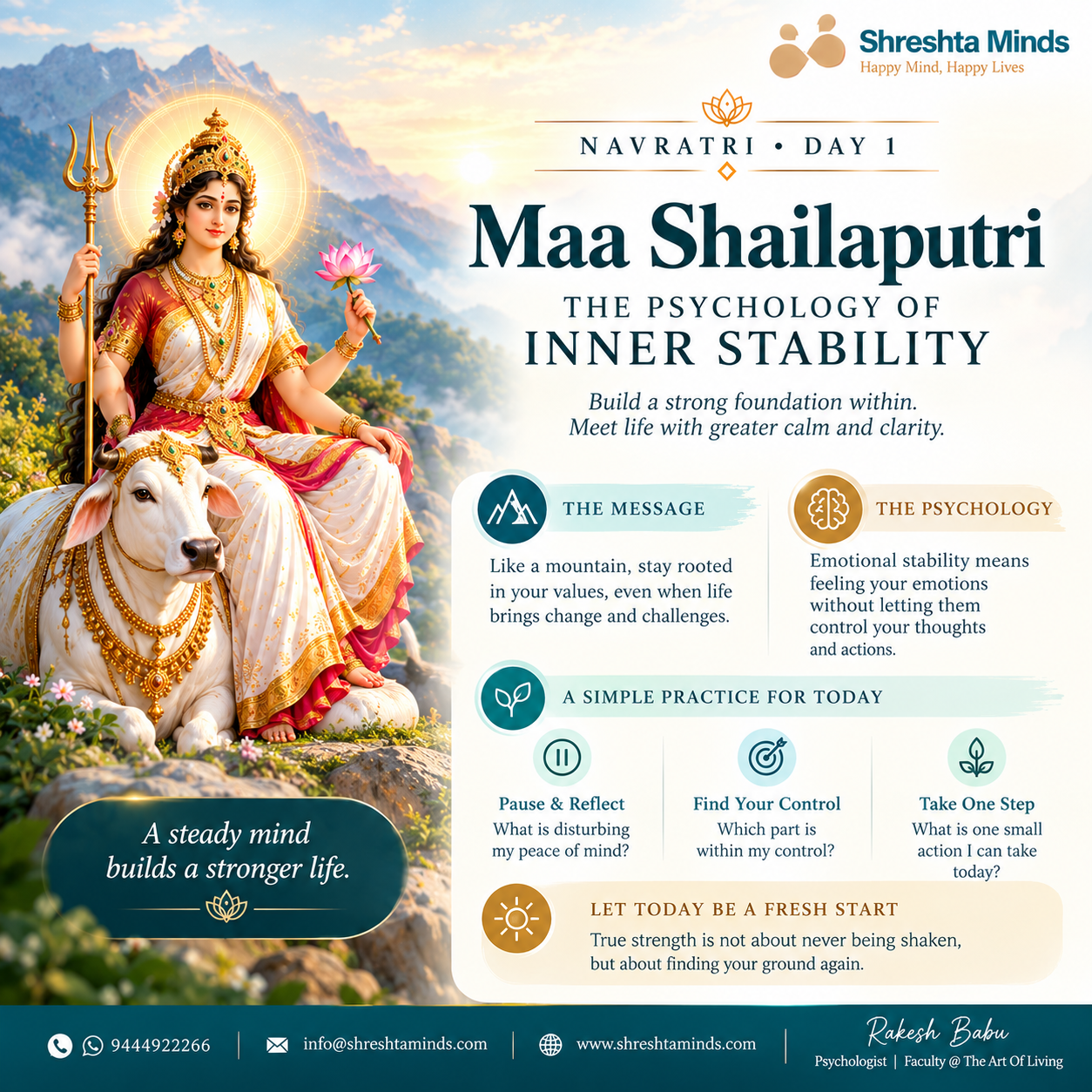
On the first day of Navratri, we worship Maa Shailaputri, the daughter of the mountains. A mountain stands firm through changing seasons, strong winds and heavy rains. It does not need to control the weather to remain rooted.

There is a beautiful lesson here for our mental well-being.

Before We Grow, We Need to Feel Grounded

In psychology, emotional stability does not mean that we never experience fear, sadness, anger or uncertainty. It means that we gradually develop the ability to experience these emotions without allowing every passing situation to control our thoughts and actions.

Think about a tree. Its branches may reach towards the sky, but its strength also depends on what lies beneath the soil.

Similarly, our ambitions, relationships and achievements need a foundation of psychological safety, self-awareness and a sense of stability.

When we constantly worry about what others think, react to every criticism, or depend entirely on external approval, even small challenges can feel overwhelming.

But when we understand ourselves better, recognise what is within our control and learn to pause before reacting, we begin to respond to life with greater clarity.

This is not about becoming emotionless. It is about becoming more centred.

What Maa Shailaputri Can Teach Us

The name Shailaputri connects the Goddess with the mountains. In our spiritual reflection, the mountain becomes a symbol of groundedness, strength and steadiness.

We cannot always choose the circumstances around us. We cannot prevent every disappointment or guarantee that people will understand us.

But we can gradually build a stronger relationship with ourselves.

When life becomes uncertain, ask yourself:

What can I do right now to bring a little more stability into this situation?

Perhaps you need to take a breath before responding, spend time in nature, speak honestly with someone you trust, or focus on the one practical step that is possible today.

Small actions may not change everything around us, but they can help us meet our circumstances differently.

A Simple Practice for Today

Take three quiet minutes today and reflect on these questions:

  • What is currently disturbing my peace of mind?
  • Which part of this situation is within my control?
  • What is one small action I can take to feel more grounded?

Do not force yourself to find immediate answers. Sometimes, simply recognising what is troubling us is the beginning of a more thoughtful response.

If you can, spend a few minutes outdoors. Notice the ground beneath your feet, the movement of the trees and the natural rhythm around you. Let this become a reminder to return your attention to the present moment.

Let the Journey Begin Within

We often begin a new journey by setting goals, making promises and planning what we want to achieve.

Perhaps this Navratri, we can begin differently.

Before asking how much more we can accomplish, let us ask how well we are standing within ourselves.

May Maa Shailaputri inspire us to cultivate inner steadiness, face uncertainty with greater awareness, and build a foundation that supports not only our success, but also our peace of mind.

A strong life is not one in which nothing ever shakes us. It is one in which we learn how to find our ground again.

With devotion and reflection,

Rakesh Babu
Psychologist | Faculty @ The Art Of Living

www.shreshtaminds.com

Maa Siddhidatri: The Psychology of Wisdom, Wholeness and Purpose

Psychology of Maa Siddhidatri

Navratri Day 9 | When personal growth becomes meaningful living

Every journey teaches us something. But the real question is: What do we do with what we have learned?

We may gain knowledge, develop skills, overcome difficulties and achieve our goals. Yet, if these experiences do not make us wiser, more compassionate and more responsible, have we truly grown?

On the ninth and final day of Navratri, we worship Maa Siddhidatri, traditionally revered as the Goddess who bestows siddhis — spiritual attainments and accomplishments. Her significance offers a beautiful reflection on the culmination of a journey: the movement from learning towards wisdom.

Beyond Achievement: The Psychology of Wholeness

In psychology, personal growth is not simply about becoming more successful. It also involves understanding ourselves, making thoughtful decisions, building meaningful relationships and using our abilities constructively.

Think about someone who has developed excellent communication skills. Those skills become truly valuable when used to resolve conflicts, encourage others or communicate an uncomfortable truth with kindness.

Knowledge gives us information. Experience gives us lessons. But wisdom helps us decide how to use both.

This is where we can reflect on Maa Siddhidatri’s spiritual symbolism. Her form reminds devotees of spiritual accomplishment. As a psychological reflection, it invites us to ask whether our own growth is bringing greater clarity, balance and purpose into our lives.

The Final Day Is Not the End

Over these nine days, we have reflected on inner stability, discipline, courage, creativity, nurturing, self-respect, emotional acceptance and self-forgiveness.

Each theme offers a lesson. But the real transformation happens when these lessons begin to influence our everyday choices.

Can we remain grounded when life becomes uncertain? Can we act with discipline when motivation fades? Can we respect others while standing up for ourselves? Can we acknowledge our mistakes without losing the willingness to improve?

These are not qualities we master overnight. They are capacities we strengthen through daily practice.

And perhaps that is the deeper meaning of completing a spiritual journey: not merely reaching its final day, but carrying its lessons into the days that follow.

A Reflection for Today

Take a moment and ask yourself:

  • What have these nine days helped me recognise about myself?
  • Which quality do I need to practise more consistently?
  • How can I use my strengths to make a positive difference in someone’s life?

Choose one answer and turn it into one practical action today.

You do not need to transform your entire life in a single moment. Begin with one thoughtful decision, one sincere conversation or one act of kindness.

As we seek the blessings of Maa Siddhidatri, may we remember that achievement is meaningful when guided by wisdom, strength when balanced with compassion, and knowledge when translated into responsible action.

The true measure of growth is not merely how much we have gained, but how wisely we live with what we have learned.

May the nine days of Navratri conclude not just with devotion, but with a renewed commitment to live consciously, grow sincerely and serve humanity with humility.

With devotion and reflection,

Rakesh Babu
Psychologist | Faculty @ The Art Of Living

www.shreshtaminds.com

Maa Mahagauri: The Psychology of Self-Forgiveness and New Beginnings

Psychology of Maa Mahagauri

Navratri Day 8 | A reflection on inner renewal and the beauty of beginning again

Have you ever made a mistake years ago and yet found yourself thinking about it as though it happened yesterday?

Perhaps you regret a decision, a relationship you could not save, an opportunity you missed, or words you wish you had never spoken.

Life moves forward, but sometimes our mind keeps returning to the past.

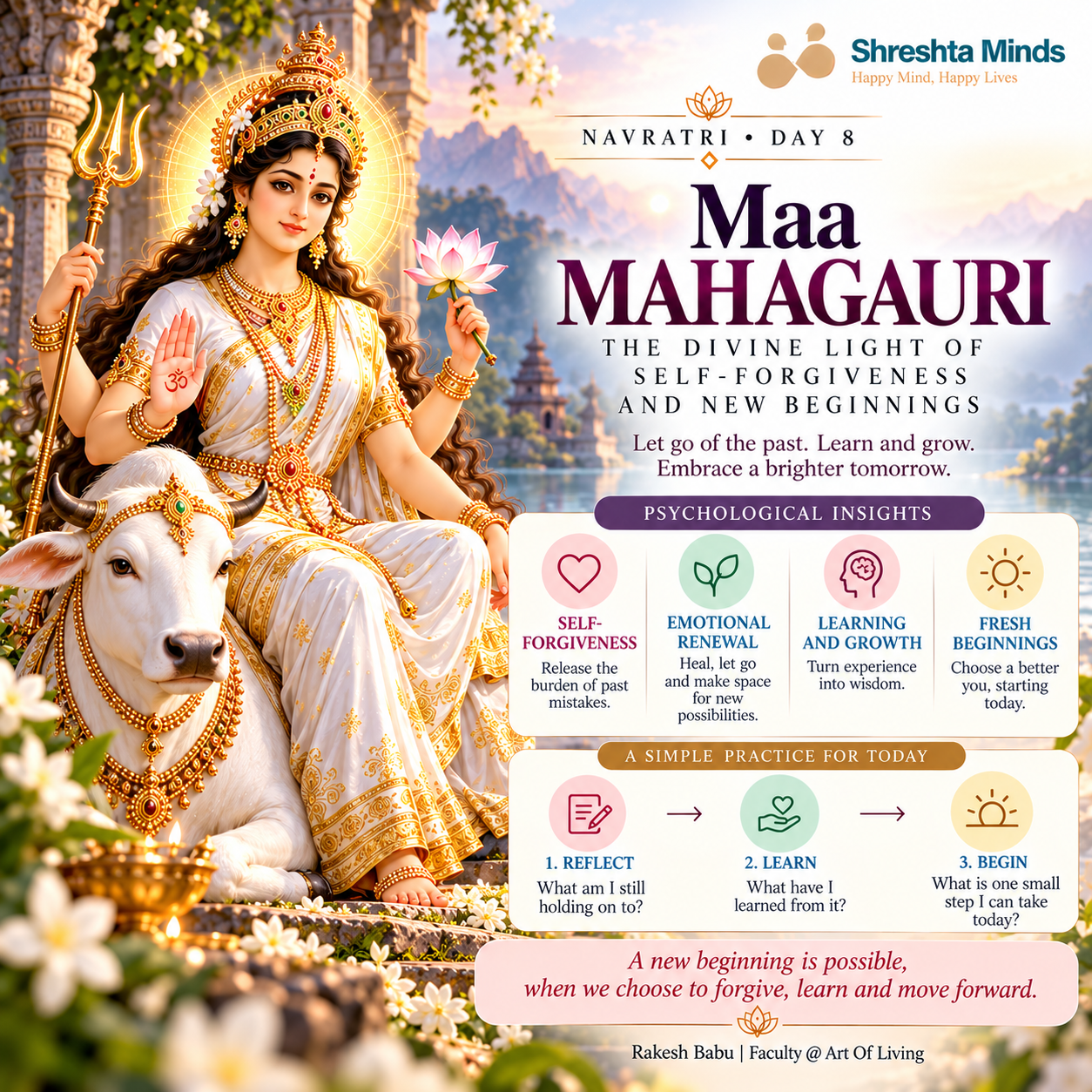
On the eighth day of Navratri, we worship Maa Mahagauri, whose serene and radiant form is traditionally associated with purity, peace, and spiritual renewal.

Her symbolism offers us a meaningful question:

What if a new beginning does not require us to erase our past but to stop allowing it to define our present?

The Psychology of Beginning Again

We all make mistakes. We misunderstand people, react impulsively, make poor decisions, and sometimes fail despite our best efforts.

Learning from these experiences is important. But repeatedly punishing ourselves for them does not necessarily help us grow.

Psychology distinguishes between taking responsibility for a mistake and turning that mistake into a negative judgement about our entire identity.

“I made a mistake” leaves room for learning. Feeling that, “I am a failure” turns one experience into a definition of who we are.

Self-forgiveness does not mean pretending that nothing happened or escaping responsibility. It means acknowledging the mistake, repairing what we can, learning from the experience, and allowing ourselves to move forward.

This is where spiritual reflection and psychological growth can meet: not in the pursuit of an imaginary, flawless self, but in the willingness to become wiser.

You Are Allowed to Begin Again

Think of a person who has neglected their health, damaged a relationship through anger, or abandoned a meaningful goal.

They can spend years regretting what happened. Or they can use that regret as a starting point for change.

A sincere apology can begin repairing a relationship. One small daily habit can restore consistency. Asking for help can become the first step towards healing.

The past cannot always be changed. But our relationship with the past—and the choices we make today—can change.

Maa Mahagauri’s symbolism may remind us that renewal is not about proving that we have never been imperfect. It is about choosing clarity, sincerity, and constructive action from this moment onwards.

A Simple Practice for Today

Take a few quiet minutes and ask yourself:

  • What am I still blaming myself for?
  • Did I learn anything from that experience?
  • What is one small action I can take today to move forward?

If someone was hurt, consider making amends. When you commit a mistake, learn from it. If a chapter has ended, give yourself permission to build a new one.

You do not have to solve your entire life today. One honest step is enough to begin.

Let Today Be a Fresh Beginning

We often wait for the perfect time, the perfect circumstances, or a perfect version of ourselves before we begin again.

But life rarely offers such conditions.

Perhaps the real beauty of renewal is this: we can acknowledge yesterday without surrendering tomorrow to it.

As we seek the blessings of Maa Mahagauri, may we cultivate a gentler relationship with ourselves, the wisdom to learn from our experiences, and the strength to take the next right step.

You are not required to remain the person you were during your most difficult chapter. Learn from it. Make peace with what you can. And give yourself the opportunity to grow.

With devotion and reflection,

Rakesh Babu
Psychologist | Faculty @ The Art Of Living

Maa Kalaratri: The Psychology of Embracing Our Inner Darkness

Psychology of Maa Kalaratri

Navratri Day 7 | A spiritual reflection on emotional acceptance, self-awareness and inner transformation

Have you ever smiled in front of everyone while carrying something heavy inside? In any other situation, have you ever said, “I am fine,” not because you were fine, but because explaining what you felt seemed more exhausting than hiding it?

Most of us have done this at some point in our lives.

We learn to celebrate happiness, display confidence and appreciate success. But when sadness, jealousy, disappointment, guilt or emotional exhaustion visits us, we often try to push these feelings away.

What we do? We label them as weakness, pretend they do not exist, or distract ourselves until they become difficult to ignore.

But what if the emotions we try so hard to hide are asking us to understand something important about ourselves?

The Divine Meaning of Maa Kalaratri

On the seventh day of Navratri, devotees worship Maa Kalaratri, a powerful and fearsome manifestation of Goddess Durga.

Her dark appearance and fierce form are traditionally associated with the destruction of darkness and the removal of negative forces.

At first glance, her form may appear frightening. Yet, within the devotional understanding of the Goddess, her fierce appearance represents a deeper promise: darkness does not always mean danger, and what appears terrifying may also carry the possibility of transformation.

There is a beautiful psychological reflection here.

Sometimes, the darkness we need to understand is not outside us. It is within our own unexamined thoughts, suppressed emotions, repeated reactions and unresolved disappointments.

Maa Kalaratri invites us to reflect on a difficult but necessary question:

Can we look honestly at ourselves without becoming our own enemy?

The Psychology of Our Inner Darkness

In everyday life, we often divide emotions into two categories: good emotions that we welcome and bad emotions that we want to eliminate.

Happiness is acceptable. Anger is uncomfortable. Confidence is celebrated. Jealousy is hidden. Gratitude is encouraged. Disappointment is sometimes treated as personal failure.

But human emotions are more complex than this.

Feeling jealous does not automatically make someone a bad person. Similarly, feeling angry does not mean a person must behave aggressively.

Disappointment does not mean life has failed. Even experiencing guilt can become an opportunity to recognise a mistake and make amends.

The important question is not simply, “Why am I feeling this?”

It is also, “What am I going to do with this feeling?”

Psychology offers a useful distinction between experiencing an emotion and acting on it. We may not always choose the emotion that arises, but we can gradually learn to respond to it more thoughtfully.

Research found that accepting rather than judging negative thoughts and emotions was associated with better psychological health.

This does not mean that acceptance solves every problem. It suggests that constantly condemning ourselves for what we feel may add another layer of distress to an already difficult experience.

Sometimes, peace begins when we stop fighting the fact that we are human.

Acceptance Is Not Approval

This is where an important distinction must be made.

Accepting anger does not mean justifying hurtful behaviour. And, accepting sadness does not mean giving up on life.

Similarly, accepting disappointment does not mean abandoning our goals. And accepting a difficult situation does not mean tolerating injustice or harm.

However, acceptance simply means acknowledging what is happening within us before deciding what to do next.

Imagine that a colleague receives the recognition you had hoped for. You feel disappointed and perhaps a little jealous.

You could pretend that you feel nothing. Criticising the colleague to make yourself feel better. Or you could pause and acknowledge the truth:

“I am disappointed because this opportunity mattered to me. What can I learn from this experience, and what constructive step can I take next?”

The emotion has not made the decision for you. You have created space to respond with awareness.

That small space between feeling and action can change the direction of a conversation, a relationship and sometimes an entire day.

When Self-Awareness Becomes a Form of Worship

Spirituality often encourages us to look beyond appearances and examine the quality of our inner life.

Psychology, in its own way, also encourages us to observe our thoughts, understand our emotional patterns and recognise how they influence behaviour.

These are not identical approaches, but they can offer complementary perspectives.

For a devotee, Maa Kalaratri may symbolise the divine power that dispels darkness.

As a personal reflection, we can allow that symbolism to remind us to examine the darkness created by resentment, denial, self-deception or unacknowledged pain.

Not to judge ourselves and label ourselves as damaged.

But to understand ourselves more honestly.

The person who recognises their anger can learn to express it responsibly. Those who acknowledge their insecurity can begin developing confidence. Anyone who accepts a mistake can take responsibility and repair the harm.

Awareness does not magically remove every difficulty. It gives us a clearer starting point from which to work.

Perhaps one of the most meaningful spiritual practices is not merely asking for our difficulties to disappear but developing the willingness to meet ourselves truthfully.

A Small Practice for Today

Take five quiet minutes today. You do not need a special setting or a complicated technique.

Ask yourself these three questions:

1. What am I feeling right now?

Name the emotion as honestly as you can. It may be sadness, irritation, loneliness, gratitude or even confusion.

2. What might this feeling be telling me?

Is there a need you have ignored? A disappointment you have not acknowledged? A conversation you need to have? Or is this simply an uncomfortable emotion that needs time to pass?

You do not need to find a perfect answer.

3. What is one wise action I can take?

Perhaps it is apologising, setting a healthy boundary, asking for help, resting, having an honest conversation or letting go of a thought that is not helping you.

Remember, the purpose is not to analyse every emotion endlessly. It is to acknowledge what you feel and choose your next step with greater clarity.

If an emotion feels overwhelming, persists for a long time or interferes with daily life, seeking support from a qualified mental health professional is also a meaningful act of self-care.

The Light That Begins Within

We often imagine transformation as becoming a completely different person — someone who never gets angry, never feels insecure, never makes mistakes and never struggles.

But perhaps genuine growth is more realistic than that.

It is becoming someone who recognises anger before it becomes cruelty, acknowledges insecurity without surrendering to it, accepts mistakes without losing self-respect, and faces uncomfortable truths without running away.

Maa Kalaratri’s fierce form offers a powerful devotional reminder that darkness need not have the final word.

And in our everyday lives, the same symbolism can inspire a simple practice: stop hiding from every uncomfortable feeling. Understand it. Learn from it. Choose your response.

You do not have to be free from every difficult emotion to move towards a wiser life. Sometimes, the transformation begins when you stop being afraid of what you feel and start becoming responsible for what you do with it.

May this seventh day of Navratri inspire us to look within with honesty, meet ourselves with compassion, and transform awareness into meaningful action.

With devotion and reflection,

Rakesh Babu
Psychologist | Faculty @ The Art Of Living

www.shreshtaminds.com

Maa Katyayani: The Psychology of Self-Respect, Assertiveness and Personal Agency

Psychology of Maa Katyayani

Navratri Day 6 | Learning to Honour Your Voice

Have you ever said “yes” when every part of you wanted to say “no”? Is there any instance where you remain silent to avoid disappointing someone, only to feel frustrated with yourself later?

Many of us do this—not because we lack opinions, but because we want to be accepted, avoid conflict or keep others happy. Over time, repeatedly ignoring our own needs can leave us feeling disconnected from ourselves.

On the sixth day of Navratri, we worship Maa Katyayani, the sixth form of Goddess Durga, traditionally associated with divine power and the destruction of evil. Her formidable form invites us to reflect on a different dimension of mental wellness: the ability to stand for what is right without losing respect for ourselves or others.

In psychology, this ability is closely related to assertiveness—expressing our thoughts, needs, feelings and opinions clearly and respectfully. It is different from aggression, which disregards the rights of others, and passivity, which may involve repeatedly sacrificing our own needs to avoid disagreement.

Consider a familiar situation. A colleague keeps assigning you additional work when your schedule is already full.

You could agree reluctantly and become resentful, respond aggressively and damage the relationship, or communicate assertively: “I understand this is important, but I cannot take on another task today. Let us discuss what should be prioritised.”

The third response protects both your dignity and the possibility of a constructive relationship.

Science and Practice identifies assertiveness training as a useful evidence-based psychological intervention across several clinical contexts. It highlights the importance of developing communication skills rather than expecting people to change simply by thinking positively.

This is where Maa Katyayani’s spiritual symbolism becomes personally meaningful. Her divine strength can inspire us to examine where we need greater honesty, self-respect and accountability.

The connection is reflective rather than a claim that worship itself automatically develops these psychological skills.

Assertiveness does not mean winning every argument, proving that we are right or refusing to compromise.

It means recognising that our needs matter while acknowledging that other people’s needs matter too. Sometimes it requires saying no.

Sometimes it means admitting a mistake, asking for fair treatment or expressing an uncomfortable truth with kindness.

A small practice for today: Identify one situation in which you have been withholding an honest response. Write down what you genuinely feel, what you need and how you can communicate it respectfully.

Practise expressing your position without blaming, threatening or apologising unnecessarily for having a reasonable need.

Remember, self-respect is not measured by how many people agree with you. It is reflected in whether your actions remain aligned with your values, even when approval is uncertain.

As we offer our prayers to Maa Katyayani, let us also reflect on the strength required to live truthfully.

May our devotion inspire not only reverence for divine Shakti but also the wisdom to use our own voice responsibly.

Sometimes, the most meaningful change begins when we stop asking, “Will everyone be pleased with me?” and start asking, “Am I responding with honesty, fairness and self-respect?”


Rakesh Babu

Psychologist | Faculty @ The Art Of Living

www.shreshtaminds.com

When One Impression Colours the Whole Person

First Impression Bias

Have you ever liked someone almost instantly because of the way they spoke, carried themselves, or presented themselves?

It happens to all of us.

Our minds are constantly trying to make sense of people, and sometimes one noticeable quality becomes the basis for everything else we think about them.

A confident person may appear more capable. A well-dressed person may seem more successful. A charismatic leader may immediately appear more competent.

But do we really know that?

Not necessarily. We may simply be allowing one positive quality to influence our judgement of qualities we haven’t actually observed.

This can quietly affect important decisions—whom we hire, whom we trust, whom we admire, and even whom we choose to build relationships with.

The interesting thing is that we usually don’t realise it is happening. We genuinely feel that we are judging the person objectively.

The same thing can happen in the opposite direction. One unpleasant experience or negative characteristic can make us see the entire person negatively.

But people are rarely that simple.

Someone can be confident but not competent. Someone can be charming but not trustworthy. And someone who is quiet or reserved may have exceptional abilities that simply aren’t visible at first.

This is why a first impression should be a starting point, not a final conclusion.

Perhaps, before judging someone, we should pause and ask ourselves: “What do I actually know about this person, and what am I simply assuming?”

That small pause can make our judgements fairer, our decisions wiser, and our relationships more genuine.

Because sometimes, the person we think we see is only the person our mind has created from one small part of the picture.

Look beyond the first impression. See the whole person.


In Love & Gratitude, Rakesh Babu

Psychologist | www.shreshtaminds.com

When Emotions Take Over, Don’t Let Them Take You Away From Yourself

Emotional imbalance does not always come from emotional turbulence.

Sometimes, it comes from being emotionally overwhelmed—even by positive emotions.

In both situations, we can temporarily lose touch with ourselves.

We may forget our patterns, our strengths, our talents, and even our past experiences. For a few moments, the situation feels bigger than our ability to handle it.

The first thing to do is simple: stay calm for a few minutes.
Don’t react immediately when your emotions are taking over.

  • Give yourself some space to breathe, pause, and settle down.
  • Once you are calmer, try to regain some emotional and cognitive balance.
  • A balanced mind can see possibilities that an overwhelmed mind cannot.

Then ask yourself, “What are the possible ways I can sort this out?”

Because sometimes, the problem itself carries a clue to its solution.

The problem may be pointing towards a pattern that needs to change, a choice that needs to be made, or a perspective that needs to shift.

In that sense, the problem is not always just an obstacle; sometimes, it is also the key.

When we think deeply and calmly, our thinking can reorganize and become more flexible.

This is where our brain’s natural capacity to adapt and learn can support us.

And remember, you don’t have to solve everything by yourself.

If you cannot find a way forward with your own abilities, seek support from an expert.

Sometimes, another person simply sees what we could not see because we were too close to the situation.

Until that point, there is much within our hands: calm down, regain balance, and think.

And if nothing works, that’s okay—sometimes a fresh pair of eyes is all we need to find our way again.


In Love & Gratitude, Rakesh Babu | www.shreshtaminds.com
From Capacities to Capabilities

What we have is potential. What we do with it is capability.

There was a young man who was often told, “You have great potential.”

He was intelligent. He learnt quickly. He had ideas others admired. He could see possibilities that many people missed.

But there was one problem.

Years passed, and very little changed.

His ideas remained ideas.
His knowledge remained knowledge.
His talent remained largely unused.

One day, someone who knew him well asked a simple question:

“You have so much. But what are you doing with what you have?”

The question stayed with him.

Because perhaps, for the first time, he realised something uncomfortable:

Having potential and using potential are not the same thing.

Capacity is not capability

All of us are born with capacities.

The capacity to learn.
The capacity to think.
The capacity to feel.
The capacity to create.
The capacity to adapt.
The capacity to love.
The capacity to lead.

Some of us may have more capacity in certain areas than others.

But capacity, by itself, is only possibility.

A person may have the capacity to communicate but struggle to have a meaningful conversation.

A person may have the capacity to lead but struggle to understand people.

A person may have the capacity to love but not know how to express it.

A person may have the capacity to learn but never apply what they learn.

A person may have the capacity to dream but never take the first step.

That is where capability begins.

Capacity is what we possess.
Capability is what we develop from what we possess.

The gap between “I can” and “I can do”

Think about a child learning to ride a bicycle.

The child may have the physical capacity to ride.

But capacity does not automatically produce balance.

The child falls.

Tries again.

Falls again.

Adjusts.

Practices.

Learns.

Eventually, something changes.

What was once only a possibility becomes an ability that can actually be used.

That is capability.

The same thing happens throughout life.

We don’t become capable merely because we have potential.

We become capable when potential meets practice, awareness, experience and action.

The psychology behind capability

There is a deeper psychological shift here.

Capability is not simply about knowing what to do.

It is about being able to translate what we know into action—especially when reality becomes difficult.

Someone may know how to communicate and still avoid a difficult conversation.

Someone may understand emotional regulation and still lose control when anger takes over.

Someone may know how to lead and become defensive when challenged.

Someone may know exactly what they should do and still hesitate because of fear, uncertainty or self-doubt.

This is why capability involves more than knowledge.

It involves agency—the willingness to act.

It involves self-belief—the growing sense that “I can handle this”.

It involves practice—the repeated experience of trying, failing, adjusting and trying again.

And it involves adaptability—the ability to change our response when the situation changes.

In that sense:

Capability is potential that remains available when reality becomes difficult.

Anyone can appear capable when everything is going according to plan.

The real test comes when the plan fails.

When someone disagrees.

When we are criticised.

When emotions are high.

When the outcome is uncertain.

A person may have the capacity for patience.

Capability is being patient when provoked.

A person may have the capacity for empathy.

Capability is remaining curious when someone hurts us.

A person may have the capacity for leadership.

Capability is leading when others are anxious.

That is where psychology meets potential.

We sometimes confuse knowing with becoming

This happens everywhere.

We attend courses.
We read books.
We listen to podcasts.
We watch inspiring videos.
We collect certificates.
We acquire information.

And we feel that we are growing.

But information is not transformation.

Knowing how to communicate is different from communicating with sensitivity.

Knowing about emotional regulation is different from regulating ourselves when we are angry.

Knowing about leadership is different from remaining calm when people disagree with us.

Knowing about relationships is different from becoming a better partner.

Knowledge can increase our capacity.

Practice turns capacity into capability.

And repeated practice does something even deeper.

It gradually changes our confidence in ourselves.

Every time we face something difficult, respond a little better, learn from it and try again, we build evidence:

“I can handle this.”

That is how capability becomes more reliable.

Eventually, we stop merely saying, “I am trying to become better at this.”

We begin to experience the following:

“This is who I am becoming.”

Capability slowly becomes part of identity.

But there is another question

Even capability is not the destination.

Imagine someone who becomes extremely capable.

They can build businesses.
They can influence people.
They can solve complex problems.
They can achieve impressive goals.

But then comes a deeper question:

For what purpose?

Because capability without direction can make us efficient—but not necessarily meaningful.

We can become very good at climbing the ladder and still discover that it was leaning against the wrong wall.

This is where purpose enters the journey.

Capacity gives us possibility.
Capability gives us effectiveness.
Purpose gives us direction.

And when capability is aligned with purpose, something beautiful happens.

Our abilities begin to become useful not only to us but also to others.

From potential to contribution

Perhaps this is the real journey of human development.

Not merely.

“How much do I have?”

But:

“What can I do with what I have?”

And eventually:

“Who can benefit from what I have developed?”

Your intelligence can become a solution.

Your experience can become guidance.

Your pain can become empathy.

Your learning can become wisdom.

Your leadership can become service.

Your success can create opportunities for others.

Your life experiences can become a source of strength for someone who is still struggling.

This is where capability becomes contribution.

And contribution gives potential a deeper meaning.

Perhaps we are asking the wrong question

We often ask children:

“What are you good at?”

We ask young people:

“What career do you want?”

We ask professionals:

“What skills do you have?”

All these questions are useful.

But perhaps we need another question:

“What are you becoming capable of doing with what you already have?”

Because life is not simply about discovering our capacities.

It is about cultivating them, directing them and using them consciously.

The greatest tragedy may not be that a person lacks potential.

It may be that they spend a lifetime without discovering what their potential could have become.

From Capacities to Capabilities

So perhaps the journey looks something like this:

Capacity — I have the potential.

Awareness — I recognise what I have.

Practice — I consciously develop it.

Capability — I can use it effectively, even when circumstances are difficult.

Adaptability — I can change how I use it when circumstances change.

Purpose — I know why I want to use it.

Contribution — Others benefit from how I use it.

That is when potential becomes meaningful.

Because ultimately, we are not here merely to carry capacities.

We are here to cultivate them.

Not merely to know.

But to become.

Not merely to become capable.

But to become useful.

And perhaps not merely to live a successful life—

but to leave something better because we lived it.

So, the next time you think about your potential, pause for a moment and ask yourself:

What capacities do I have?

Which of them am I actually developing?

What am I becoming capable of?

What happens to my capability when I am under pressure?

And where can those capabilities make a meaningful difference?

Because the real question may never have been the following:

“What do I have within me?”

It may be:

“What am I becoming through what I have within me?”

Think…Contemplate…Act

In Love & Gratitude

Rakesh Babu | www.shreshtaminds.com