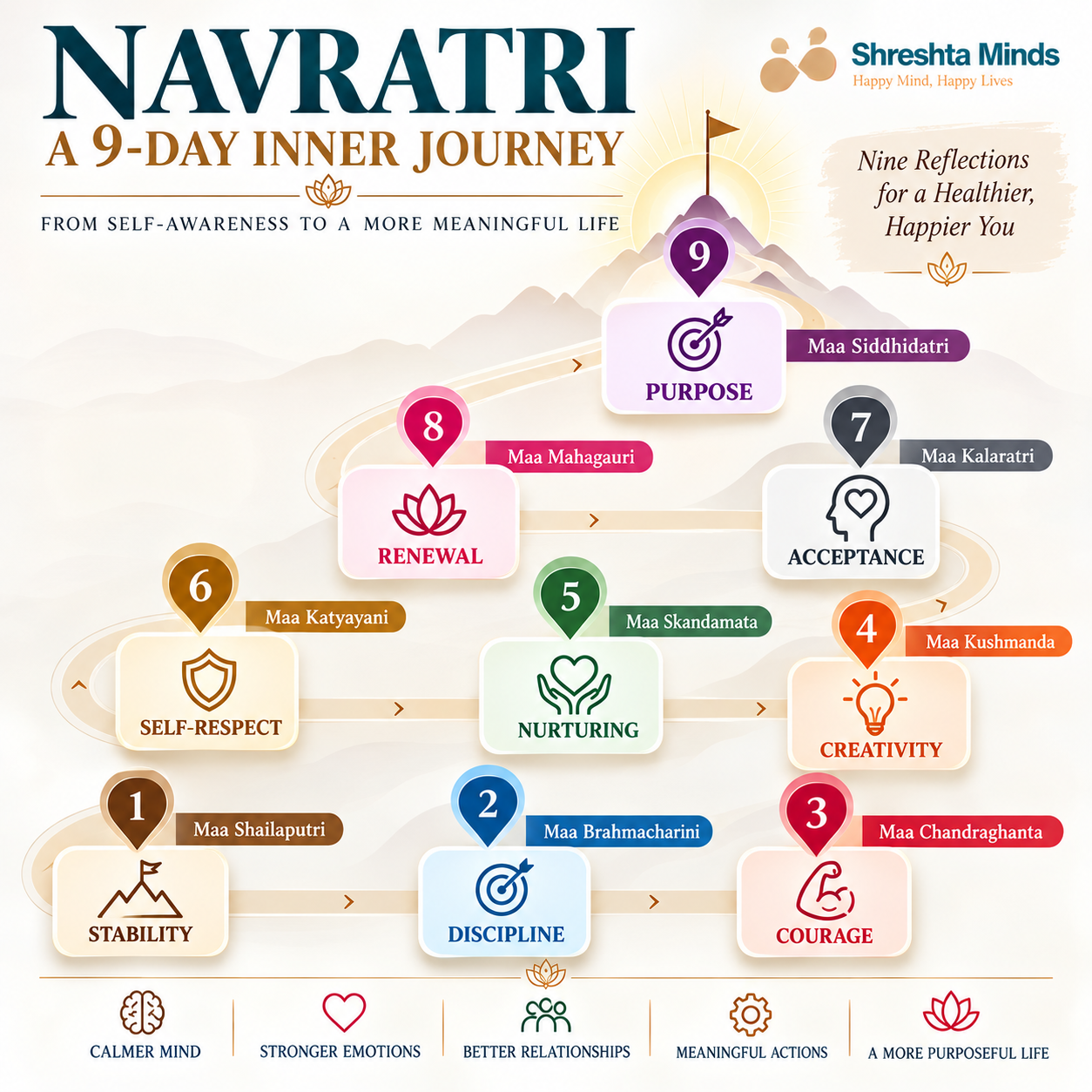
Navratri: A 9-Day Inner Journey

Psychology of the Nine Days of Navratri

What if the nine days of Navratri could become a journey of transforming not just our prayers, but also our thoughts, emotions, relationships and actions?

Through the symbolism of the nine forms of the Divine Mother, we can reflect on nine qualities that help us grow psychologically, philosophically and personally.

Day 1 — Maa Shailaputri: Stability

Every meaningful change begins with a strong inner foundation. Emotional stability helps us face life’s uncertainties without losing ourselves.

Read Significance of Day 1: CLICK HERE

Day 2 — Maa Brahmacharini: Discipline

Awareness shows us what needs to change; discipline helps us act on it consistently. Small, purposeful actions turn intentions into habits.

Read Significance of Day 2: CLICK HERE

Day 3 — Maa Chandraghanta: Courage

Courage is not the absence of fear, but the willingness to act wisely despite it. When fear stops controlling our choices, new possibilities emerge.

Read Significance of Day 3: CLICK HERE

Day 4 — Maa Kushmanda: Creativity

We may not control every circumstance, but we can influence how we respond. Creativity helps us discover possibilities and take meaningful action.

Read Significance of Day 4: CLICK HERE

Day 5 — Maa Skandamata: Nurturing

Healthy relationships grow through empathy, care and emotional connection. When we learn to understand others without controlling them, relationships become stronger.

Read Significance of Day 5: CLICK HERE

Day 6 — Maa Katyayani: Self-Respect

Self-respect enables us to express our needs and establish healthy boundaries. True assertiveness protects our dignity while respecting the dignity of others.

Read Significance of Day 6: CLICK HERE

Day 7 — Maa Kalaratri: Acceptance

Growth begins when we face our inner struggles honestly instead of avoiding them. Accepting an emotion does not mean surrendering to it; it means understanding it before responding.

Read Significance of Day 7: CLICK HERE

Day 8 — Maa Mahagauri: Renewal

Self-forgiveness allows us to learn from our mistakes without letting them define us. We cannot rewrite the past, but we can choose a wiser next step.

Read Significance of Day 8: CLICK HERE

Day 9 — Maa Siddhidatri: Purpose

Wisdom emerges when what we understand becomes the way we live. A purposeful life brings our values, decisions and actions into greater alignment.

Read Significance of Day 9: CLICK HERE

The Journey Beyond Nine Days

The nine reflections form a meaningful progression: Stability → Discipline → Courage → Creativity → Nurturing → Self-Respect → Acceptance → Renewal → Purpose.

Together, they remind us that personal growth is not about becoming perfect; it is about becoming more aware, responsible and intentional in the way we live.

The spiritual symbolism of Navratri offers a framework for reflection, while psychology helps us translate these reflections into everyday practices. Real transformation takes time, consistency and conscious effort.

The true measure of this nine-day journey is not merely what we celebrate, but what we practise when the celebrations end.

A calmer mind. Stronger emotions. Better relationships. Meaningful actions. A more purposeful life.

That is the inner journey Navratri invites us to begin.

Written by Rakesh Babu | Rakesh Writes

Know Yourself. Grow N Glow.
www.shreshtaminds.com

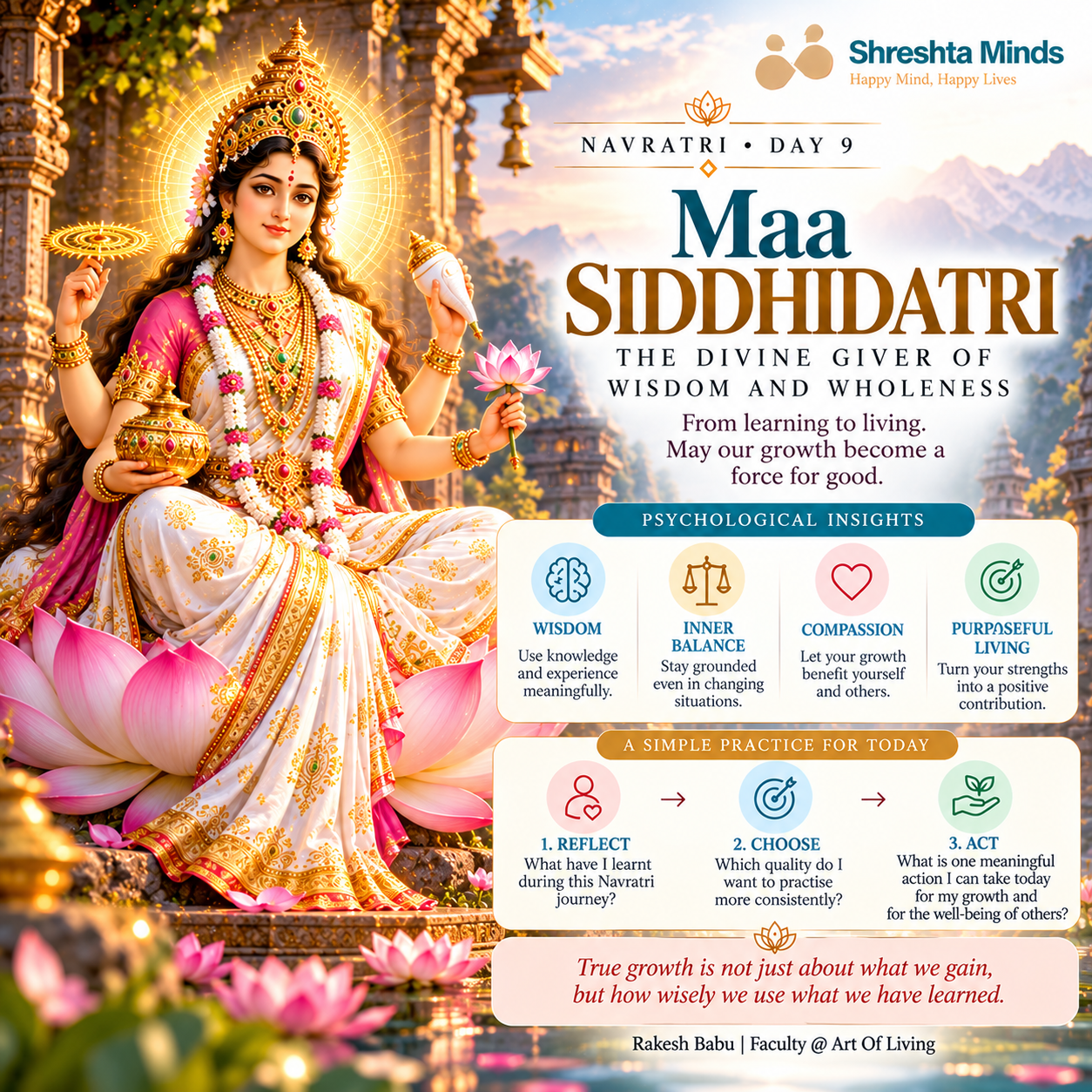
Maa Siddhidatri: The Psychology of Wisdom, Wholeness and Purpose

Psychology of Maa Siddhidatri

Navratri Day 9 | When personal growth becomes meaningful living

Every journey teaches us something. But the real question is: What do we do with what we have learned?

We may gain knowledge, develop skills, overcome difficulties and achieve our goals. Yet, if these experiences do not make us wiser, more compassionate and more responsible, have we truly grown?

On the ninth and final day of Navratri, we worship Maa Siddhidatri, traditionally revered as the Goddess who bestows siddhis — spiritual attainments and accomplishments. Her significance offers a beautiful reflection on the culmination of a journey: the movement from learning towards wisdom.

Beyond Achievement: The Psychology of Wholeness

In psychology, personal growth is not simply about becoming more successful. It also involves understanding ourselves, making thoughtful decisions, building meaningful relationships and using our abilities constructively.

Think about someone who has developed excellent communication skills. Those skills become truly valuable when used to resolve conflicts, encourage others or communicate an uncomfortable truth with kindness.

Knowledge gives us information. Experience gives us lessons. But wisdom helps us decide how to use both.

This is where we can reflect on Maa Siddhidatri’s spiritual symbolism. Her form reminds devotees of spiritual accomplishment. As a psychological reflection, it invites us to ask whether our own growth is bringing greater clarity, balance and purpose into our lives.

The Final Day Is Not the End

Over these nine days, we have reflected on inner stability, discipline, courage, creativity, nurturing, self-respect, emotional acceptance and self-forgiveness.

Each theme offers a lesson. But the real transformation happens when these lessons begin to influence our everyday choices.

Can we remain grounded when life becomes uncertain? Can we act with discipline when motivation fades? Can we respect others while standing up for ourselves? Can we acknowledge our mistakes without losing the willingness to improve?

These are not qualities we master overnight. They are capacities we strengthen through daily practice.

And perhaps that is the deeper meaning of completing a spiritual journey: not merely reaching its final day, but carrying its lessons into the days that follow.

A Reflection for Today

Take a moment and ask yourself:

  • What have these nine days helped me recognise about myself?
  • Which quality do I need to practise more consistently?
  • How can I use my strengths to make a positive difference in someone’s life?

Choose one answer and turn it into one practical action today.

You do not need to transform your entire life in a single moment. Begin with one thoughtful decision, one sincere conversation or one act of kindness.

As we seek the blessings of Maa Siddhidatri, may we remember that achievement is meaningful when guided by wisdom, strength when balanced with compassion, and knowledge when translated into responsible action.

The true measure of growth is not merely how much we have gained, but how wisely we live with what we have learned.

May the nine days of Navratri conclude not just with devotion, but with a renewed commitment to live consciously, grow sincerely and serve humanity with humility.

With devotion and reflection,

Rakesh Babu
Psychologist | Faculty @ The Art Of Living

www.shreshtaminds.com

Maa Mahagauri: The Psychology of Self-Forgiveness and New Beginnings

Psychology of Maa Mahagauri

Navratri Day 8 | A reflection on inner renewal and the beauty of beginning again

Have you ever made a mistake years ago and yet found yourself thinking about it as though it happened yesterday?

Perhaps you regret a decision, a relationship you could not save, an opportunity you missed, or words you wish you had never spoken.

Life moves forward, but sometimes our mind keeps returning to the past.

On the eighth day of Navratri, we worship Maa Mahagauri, whose serene and radiant form is traditionally associated with purity, peace, and spiritual renewal.

Her symbolism offers us a meaningful question:

What if a new beginning does not require us to erase our past but to stop allowing it to define our present?

The Psychology of Beginning Again

We all make mistakes. We misunderstand people, react impulsively, make poor decisions, and sometimes fail despite our best efforts.

Learning from these experiences is important. But repeatedly punishing ourselves for them does not necessarily help us grow.

Psychology distinguishes between taking responsibility for a mistake and turning that mistake into a negative judgement about our entire identity.

“I made a mistake” leaves room for learning. Feeling that, “I am a failure” turns one experience into a definition of who we are.

Self-forgiveness does not mean pretending that nothing happened or escaping responsibility. It means acknowledging the mistake, repairing what we can, learning from the experience, and allowing ourselves to move forward.

This is where spiritual reflection and psychological growth can meet: not in the pursuit of an imaginary, flawless self, but in the willingness to become wiser.

You Are Allowed to Begin Again

Think of a person who has neglected their health, damaged a relationship through anger, or abandoned a meaningful goal.

They can spend years regretting what happened. Or they can use that regret as a starting point for change.

A sincere apology can begin repairing a relationship. One small daily habit can restore consistency. Asking for help can become the first step towards healing.

The past cannot always be changed. But our relationship with the past—and the choices we make today—can change.

Maa Mahagauri’s symbolism may remind us that renewal is not about proving that we have never been imperfect. It is about choosing clarity, sincerity, and constructive action from this moment onwards.

A Simple Practice for Today

Take a few quiet minutes and ask yourself:

  • What am I still blaming myself for?
  • Did I learn anything from that experience?
  • What is one small action I can take today to move forward?

If someone was hurt, consider making amends. When you commit a mistake, learn from it. If a chapter has ended, give yourself permission to build a new one.

You do not have to solve your entire life today. One honest step is enough to begin.

Let Today Be a Fresh Beginning

We often wait for the perfect time, the perfect circumstances, or a perfect version of ourselves before we begin again.

But life rarely offers such conditions.

Perhaps the real beauty of renewal is this: we can acknowledge yesterday without surrendering tomorrow to it.

As we seek the blessings of Maa Mahagauri, may we cultivate a gentler relationship with ourselves, the wisdom to learn from our experiences, and the strength to take the next right step.

You are not required to remain the person you were during your most difficult chapter. Learn from it. Make peace with what you can. And give yourself the opportunity to grow.

With devotion and reflection,

Rakesh Babu
Psychologist | Faculty @ The Art Of Living

Maa Katyayani: The Psychology of Self-Respect, Assertiveness and Personal Agency

Psychology of Maa Katyayani

Navratri Day 6 | Learning to Honour Your Voice

Have you ever said “yes” when every part of you wanted to say “no”? Is there any instance where you remain silent to avoid disappointing someone, only to feel frustrated with yourself later?

Many of us do this—not because we lack opinions, but because we want to be accepted, avoid conflict or keep others happy. Over time, repeatedly ignoring our own needs can leave us feeling disconnected from ourselves.

On the sixth day of Navratri, we worship Maa Katyayani, the sixth form of Goddess Durga, traditionally associated with divine power and the destruction of evil. Her formidable form invites us to reflect on a different dimension of mental wellness: the ability to stand for what is right without losing respect for ourselves or others.

In psychology, this ability is closely related to assertiveness—expressing our thoughts, needs, feelings and opinions clearly and respectfully. It is different from aggression, which disregards the rights of others, and passivity, which may involve repeatedly sacrificing our own needs to avoid disagreement.

Consider a familiar situation. A colleague keeps assigning you additional work when your schedule is already full.

You could agree reluctantly and become resentful, respond aggressively and damage the relationship, or communicate assertively: “I understand this is important, but I cannot take on another task today. Let us discuss what should be prioritised.”

The third response protects both your dignity and the possibility of a constructive relationship.

Science and Practice identifies assertiveness training as a useful evidence-based psychological intervention across several clinical contexts. It highlights the importance of developing communication skills rather than expecting people to change simply by thinking positively.

This is where Maa Katyayani’s spiritual symbolism becomes personally meaningful. Her divine strength can inspire us to examine where we need greater honesty, self-respect and accountability.

The connection is reflective rather than a claim that worship itself automatically develops these psychological skills.

Assertiveness does not mean winning every argument, proving that we are right or refusing to compromise.

It means recognising that our needs matter while acknowledging that other people’s needs matter too. Sometimes it requires saying no.

Sometimes it means admitting a mistake, asking for fair treatment or expressing an uncomfortable truth with kindness.

A small practice for today: Identify one situation in which you have been withholding an honest response. Write down what you genuinely feel, what you need and how you can communicate it respectfully.

Practise expressing your position without blaming, threatening or apologising unnecessarily for having a reasonable need.

Remember, self-respect is not measured by how many people agree with you. It is reflected in whether your actions remain aligned with your values, even when approval is uncertain.

As we offer our prayers to Maa Katyayani, let us also reflect on the strength required to live truthfully.

May our devotion inspire not only reverence for divine Shakti but also the wisdom to use our own voice responsibly.

Sometimes, the most meaningful change begins when we stop asking, “Will everyone be pleased with me?” and start asking, “Am I responding with honesty, fairness and self-respect?”


Rakesh Babu

Psychologist | Faculty @ The Art Of Living

www.shreshtaminds.com

Spirituality: Creating Heaven on Earth

Spirituality and Love

What if heaven is not a destination we reach after death, but a reality we can experience while we are alive?

We often think spirituality is about reaching heaven, escaping the world, or searching for something beyond our understanding. But have we ever paused to ask ourselves whether we are missing the beauty of the very life we are living?

To me, spirituality is not about running away from the world; it is about learning how to live in it with love, compassion, and awareness.

What is the point of praying for peace when we cannot bring peace into our own homes? What is the value of worshipping the divine when we fail to recognise the humanity in the person standing beside us?

Spirituality begins when we stop looking only towards the sky and start looking into our own hearts.

It is the courage to understand ourselves, accept our imperfections, and grow beyond our ego. It is learning to love ourselves without becoming selfish and loving others without expecting anything in return.

When we begin to understand our own pain, we become more sensitive to the pain of others. When we learn to forgive ourselves, forgiveness becomes easier to offer to someone else. And when we discover kindness within us, we no longer need a reason to be kind to the world.

This is where spirituality moves beyond rituals, beliefs, and religious boundaries and becomes a way of life. It reflects in the way we speak to our parents, treat our children, respect strangers, and respond to those who disagree with us.

Spirituality is not measured merely by how many hours we spend in prayer, but also by how much love and understanding we bring into our everyday relationships.

The world may never become perfect, but our presence can make someone’s little corner of it more peaceful. A comforting word, a forgiving heart, a helping hand, or a moment of genuine understanding can transform an ordinary day into something beautiful.

Perhaps the ultimate purpose of life is not to find a way out of this world, but to discover how beautifully we can live within it. Know yourself. Love yourself. Extend that same love and understanding to others. In that simple truth lies the essence of spirituality.

Heaven may remain a mystery beyond this life, but we do not have to postpone love, compassion, and peace until then. We can begin creating heaven right here, right now.

In Love & Gratitude,

Rakesh Babu

Psychologist | www.shreshtaminds.com

What If “Someday” Never Comes?

Living in the present is not impossible…It needs courage!

We work for a future we are not even sure we will reach.

Also, we tell ourselves, “One day, I will relax. I will travel one day. One day, I will spend more time with my family. One day, I will finally live the way I want.”

And in preparing for that “one day,” we quietly sacrifice today.

We:

— save money for the future, but sometimes forget to save time to enjoy what we have earned.

— work for our children’s future, yet miss the little moments of their childhood that can never return.

— postpone our dreams until retirement, without knowing what life, health, energy or circumstances will look like then.

From a psychological perspective, the habit of constantly saying “later” can make the present feel less valuable.

Planning for tomorrow is wisdom.

But sacrificing every today for an uncertain tomorrow is not necessarily wisdom.

We:

— need financial security, but we also need meaningful experiences.

— have responsibility, but we also need rest.

— need ambition, but we should not become so exhausted chasing success that we have no energy left to experience it.

— cannot change yesterday. We cannot completely control tomorrow.

All we truly have is this moment.

  • So express the love you feel.
  • Say the thank you.
  • Meet the people who matter.
  • Take that meaningful journey.
  • Create memories while you are still creating your future.

Work for tomorrow, but don’t mortgage today.

We don’t know when our “last phase” of life will begin.

But we do know that today is here.

So perhaps the goal is not merely to reach the end of life with everything accumulated…

but to reach it with the quiet satisfaction of being able to say:

“I didn’t just prepare for life.
I actually lived it.”

What are you saving for tomorrow—and what are you living for today?


In Love & Gratitude,

Rakesh Babu | Psychologist | www.shreshtaminds.com

Your Brain Is Learning Even When You Are Not Trying to Learn

How do learning and neuroplasticity connect?

We usually think learning happens when we read, study, practice, or consciously try to acquire something new.

But your brain is learning far more than you realize, even when you are not trying to learn.

Every thought you repeat, every response you practice, and every behavior you experience repeatedly leaves an impression on the brain.

This is one of the fascinating realities of neuroplasticity—the brain has the ability to adapt based on experience.

And that means learning is not only about what you intentionally teach yourself.

You may be teaching your brain patience every time you pause before reacting or avoidance every time you repeatedly escape what feels difficult.

You may be building curiosity every time you explore something unfamiliar or rigidity when you repeatedly resist anything that challenges your existing way of thinking.

In other words, everyday life itself can become a training ground for the brain.

This makes learning much bigger than education, because learning can gradually become capacity building.

The more you practice a way of thinking or responding, the more available that capacity may become when you need it.

And when a capacity can be consistently brought into action, it begins to express itself as capability.

Perhaps this is why knowing something does not always mean we can actually do it.

The brain does not simply need information; it needs experience, practice, repetition, and meaningful engagement.

So instead of asking only, “What did I learn today? “Perhaps we should sometimes ask, “What capacity did I build today?”

Because whether we realize it or not, our everyday experiences are constantly shaping what our brain becomes better prepared to do.

And that leaves us with a fascinating question: If your brain is learning every day, what are you teaching it to become?


Enjoying the articles? Leave your comment!

In Love & Gratitude,

Rakesh Babu | Psychologist | www.shreshtaminds.com

Radha & Dhara: The Direction of the Mind

Self-awareness in Decision Making!

Dhara represents the outward flow—the mind constantly moving toward people, problems, possessions, information and expectations.

Our attention naturally flows outward, responding to everything happening around us.

But there is another movement: Radha—the symbolic journey of returning toward the source within.

Psychologically, this can be understood as the ability to pause and observe what is happening inside us.

Before reacting to a situation, we can notice our thoughts, emotions, assumptions and impulses.

That small inward movement can create something powerful: awareness.

In the workplace, this becomes especially important when pressure, conflict or uncertainty demands an immediate response.

A reactive mind flows directly from stimulus to behavior.

A conscious mind creates a space between what happens and how it chooses to respond.

That space is where emotional regulation, reflection, and better decision-making begin.

A leader who can return inward is less likely to be controlled by every external disturbance.

The same principle applies to careers, relationships, and everyday choices.

The objective is not to stop the outward flow of life.

It is to learn the rhythm of moving outward, returning inward, and moving outward again with greater clarity.

Dhara → Radha → Dhara.

Experience → Awareness → Response.

Perhaps growth is not about controlling the world outside us.

Perhaps it begins with learning when to return to the world within us.


Enjoying it? Comment your thoughts.

In Love & Gratitude,

Rakesh Babu | Psychologist | www.shreshtaminds.com

WHEN LESS BECOMES MEDICINE

Fasting Beyond Food……..

Langhanam Parama Aushadham — sometimes, emptiness itself becomes the medicine.

When the stomach is overloaded, a little fasting can give the body space to heal.

Perhaps the same wisdom applies to the mind, heart and life.

Emotional Fasting — sometimes, stop reacting, explaining, defending and carrying everything personally.

Social Fasting — step away from people occasionally, not because you dislike them, but because you need to hear yourself again.

Digital Fasting — disconnect from the endless stream of notifications, opinions and comparisons.

Mental Fasting — give your mind permission to stop consuming information and simply be still.

Financial Fasting — pause unnecessary buying and discover how much of what we want is actually unnecessary.

Fasting from Negativity — stop feeding your mind with gossip, outrage, fear and conversations that leave you smaller.

Fasting from Productivity — remember that a human being is not a machine that must constantly produce to deserve rest.

Because life can become unhealthy not only from what we lack, but also from what we consume excessively.

Sometimes, the most powerful thing you can add to your life is space.

Space to breathe. Space to think. Space to feel. Space to heal.

Perhaps Langhanam Parama Aushadham is not merely about fasting from food.

It is a reminder that sometimes, healing begins when we stop taking in—and start letting go.


In Love & Gratitude, Rakesh Babu | Psychologist | www.shreshtaminds.com 

The Architecture of Overthinking

How to stop overthinking!

Have you ever noticed how one small thought can become a full-blown story in your mind?

A message goes unanswered.
The conversation feels slightly different.
Decision keeps replaying in your head.

And suddenly, your mind is running through possibilities that haven’t even happened.

That is the architecture of overthinking. The interesting part is—you don’t have to silence your mind.

You have to understand how the pattern is built.

Overthinking rarely begins with a big problem; it often begins with a single thought.

Something happens, and the mind immediately starts searching for meaning.

We interpret the event through our beliefs, experiences, fears, and expectations.

That interpretation creates an emotional response.

The emotion then makes the original thought feel even more important.

So, we revisit it—again and again—hoping that repetition will give us certainty.

But repetition doesn’t always create clarity; sometimes, it creates amplification.

A small possibility becomes a probable outcome, and a probable outcome becomes a frightening certainty.

This is where overthinking begins to feel like problem-solving.

Yet thinking more does not necessarily mean thinking better.

The turning point comes when we develop awareness of the pattern.

Awareness creates a small but powerful pause between the thought and our reaction.

Inside that pause lies something we often forget: choice.

We may not control every thought that enters our mind, but we can influence what we do with it.

Questioning the thought instead of automatically believing it.

We can separate facts from assumptions, possibilities from probabilities, and fears from reality.

“Choose a response instead of endlessly rehearsing the problem.”

That is how the journey moves from overthinking to awareness, from awareness to clarity, and from clarity to action.

A calmer mind isn’t a mind without thoughts; it is a mind that doesn’t have to obey every thought.

Think. Pause. Question. Choose. Act. — Better Thinking. Better Decisions. Better Outcomes.


In Love & Gratitude, Rakesh Babu | Psychologist | www.shreshtaminds.com