Vitamin “G” – Gratitude & Brain
“Wear gratitude like a cloak, and it will feed every corner of your life.” – Rumi
 Gratitude is an attitude to live with! Gratitude or Gratefulness cannot be expressed in words, however, we can experience the benefit of it. I feel that if everyone of us live with the gratitude, greed never hit anyone. If there is no greed, the there is no comparison, jealous, emotional violence etc.,
We should foster gratitude to children right from their early age and can also be practiced at schools. Love is contagious. When we inculcate good values in children, they grow naturally with good values and ethics. It is important to teach or preach the effects of gratitude. There is a Viatnamese Proverb – “When eating fruit, remember the one who planted the tree”. When they remember the farmer while eating the fruit, an unconditional love evolves in them, which can develop the attitude of gratitude.
Now, what is Gratitude according to researchers?
Religious traditions including Judaism, Christianity, Islam, Buddhism, and Hinduism all encourage cultivating gratitude as an important moral virtue. For millennia, gratitude has been a popular topic among philosophers:
• Cicero said gratitude “is not only the greatest one but also the mother of all the other remaining virtues”;
• Seneca “ranked ingrates below thieves, rapists and adulterers”;
• Hume wrote, “Of all crimes that human creatures are capable of committing, the most horrid and unnatural is ingratitude”;
• Adam Smith believed that gratitude was vital for maintaining a society based on goodwill
Robert Emmons and Michael McCullough define gratitude as a two-step process:
1) “recognizing that one has obtained a positive outcome”
2) “recognizing that there is an external source for this positive outcome.”
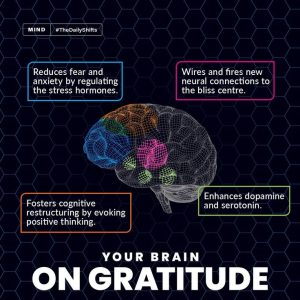 How Gratitude Helps Brain & Body – According to Research?
Scientific studies reveal that the effects of gratitude on the brain and body are complex but calming, mentally strengthening, and motivating. With the rise of positive psychology in the 2000s, the study of gratitude has tremendously expanded. – Mind’s Journal.
A study by Kyeong et al. in 2017 states as follows:
- Gratitude Modulates Heart Rhythms in a way that enhances mental health.
- Gratitude Strengthens The Emotion-Related Activity Of The Brain.
- Gratitude Enhances The Motivation-Related Activity Of The Brain.
In another study in 2008, it says “that gratitude causes synchronized activation in multiple brain regions, and lights up parts of the brain’s reward pathways and the hypothalamus. In short, gratitude can boost neurotransmitter serotonin and activate the brain stem to produce dopamine. “Dopamine is our brain’s pleasure chemical.”
 How to practice Gratitude?
- Always feel that you are given with what you want and are enough with it
- Write down your gratitude notes/journal
- Meditation keeps you still and will be able to be in contentment
- Be a Philanthropist – Doing Service/Charity to the needy helps a lot.
Anything when you start it may be challenging. However on continuous practice it will become a habit and can be in gratitude mode ever. This happens with neuroplasticity due to continuous practice.
Finally, I feel happy and blessed to write this article on “Gratitude” today. It is a day to offer gratitude to the masters or Gurus who have given or transcended the wisdom to us. Happy Gurupurnima!.
Much gratitude to my Father & Mother, all my Teachers, Professors, Professional Mentors and Spiritual guides. Also to all those masters who came to this world and got enlightened!
I am grateful to my master Global Humanitarian and Spiritual Leader Gurudev Sri Sri Ravishankar for spreading love and compassion to the world through his wisdom.
(Emmons & Crumpler, 2000), (McCullough, Kilpatrick, Emmons, & Larson, 2001), (Manela, 2015).
(Reference: Kyeong, S., Kim, J., Kim, D. et al. (2017). Effects of gratitude meditation on neural network functional connectivity and brain-heart coupling. Scientific Reports, 7, 5058.)
https://doi.org/10.1038/s41598-017-05520-9
Disclaimer: Pictures that are relevant to this topic has taken from different sources. Credits to those original creators.
In Gratitude
N.R.Rakesh Babu | Psychologist | PhD Research Scholar
www.rakeshbabu.com | www.rbac.in


Julie Jpaul
A very beautiful and informative article..Often times we take things for granted and this was a very useful one that helped me personally and to teach my kids too