Archives 2022

Peace Of Mind Matters!

Peace Of Mind Matters!

It is up to us to start the day with the desired emotions and mindset!

Zigs – Zags will be there. However, if we decide to make it enjoyable, then the journey will be #fun. If we feel it as trouble, then we may end up in worries.

What makes a person #happy? It’s their own mindset! We know this better. Sometimes, some turbulences pass through us and these motivating mindset or attitude may get affected. The one who can withstand that with “Let Go” attitude can live peacefully. This is what we say, “Live in the present”.

Think about the output. What kind of output you need. Is it a happier one or #worrisome one? Accordingly, make yourself engaged in the present moment. This is “Mindful Thinking” or “Mindful Doing”.

When Mind Is FULL, there is no Mindfulness. Think! What actually you want – MindFull or Mindful? When we do it mindfully, with awareness, with alertness, we will be safe. Be a #Meraki.

How to become aware of such turbulence which passes through?

Learn and Practice:

1. Breathing Exercises

2. Meditation

3. Yogasanas/Other Physical Exercises

4. Eat healthy balanced food

5. Take Enough Rest.

It will keep oneself aware and alert. Thus we can be more mindful.

Mental wellness is more important or equally important as physical well-being. An equilibrium of both can give the actual happiness that a person desire and deserve.

Let’s live happily and mindfully!


In Gratitude,
N.R.Rakesh Babu
Psychologist | PhD Research Scholar
www.rakeshbabu.com | www.rbac.in

“Meraki” – Putting a part of yourself into what you’re doing!

How Many “Meraki” Professionals are here?

While reading an interesting article, found this word. Just loved it.

“Meraki” – Putting a part of yourself into what you’re doing!

(Noun / Origin: Greek / me·ra·ki)

This is a modern #Greek word that’s often used to describe the instance wherein you leave a part of yourself (your soul, creativity, or love) in your work — so it’s like when you intensely love to do something or just about anything that you put something of yourself into it.

In Psychological term, it is “Mindfully” doing something. When we do something mindfully, we will put ourself into it! Aren’t we?

In Gratitude,
N.R.Rakesh Babu
Psychologist | PhD Research Scholar
www.rakeshbabu.com | www.rbac.in

Vitamin “G” – Gratitude & Brain

“Wear gratitude like a cloak, and it will feed every corner of your life.” – Rumi

Gratitude is an attitude to live with! Gratitude or Gratefulness cannot be expressed in words, however, we can experience the benefit of it. I feel that if everyone of us live with the gratitude, greed never hit anyone. If there is no greed, the there is no comparison, jealous, emotional violence etc.,

We should foster gratitude to children right from their early age and can also be practiced at schools. Love is contagious. When we inculcate good values in children, they grow naturally with good values and ethics. It is important to teach or preach the effects of gratitude. There is a Viatnamese Proverb – “When eating fruit, remember the one who planted the tree”. When they remember the farmer while eating the fruit, an unconditional love evolves in them, which can develop the attitude of gratitude.

Now, what is Gratitude according to researchers?

Religious traditions including Judaism, Christianity, Islam, Buddhism, and Hinduism all encourage cultivating gratitude as an important moral virtue. For millennia, gratitude has been a popular topic among philosophers:

• Cicero said gratitude “is not only the greatest one but also the mother of all the other remaining virtues”;

• Seneca “ranked ingrates below thieves, rapists and adulterers”;

• Hume wrote, “Of all crimes that human creatures are capable of committing, the most horrid and unnatural is ingratitude”;

• Adam Smith believed that gratitude was vital for maintaining a society based on goodwill

Robert Emmons and Michael McCullough define gratitude as a two-step process:

1) “recognizing that one has obtained a positive outcome”

2) “recognizing that there is an external source for this positive outcome.”
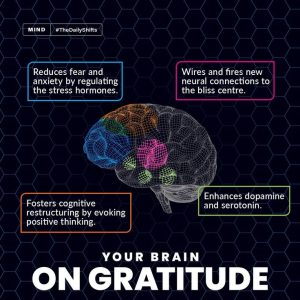
How Gratitude Helps Brain & Body – According to Research?

Scientific studies reveal that the effects of gratitude on the brain and body are complex but calming, mentally strengthening, and motivating. With the rise of positive psychology in the 2000s, the study of gratitude has tremendously expanded. – Mind’s Journal.

A study by Kyeong et al. in 2017 states as follows:

  1. Gratitude Modulates Heart Rhythms in a way that enhances mental health.
  2. Gratitude Strengthens The Emotion-Related Activity Of The Brain.
  3. Gratitude Enhances The Motivation-Related Activity Of The Brain.

    In another study in 2008, it says “that gratitude causes synchronized activation in multiple brain regions, and lights up parts of the brain’s reward pathways and the hypothalamus. In short, gratitude can boost neurotransmitter serotonin and activate the brain stem to produce dopamine. “Dopamine is our brain’s pleasure chemical.”

How to practice Gratitude?

  1. Always feel that you are given with what you want and are enough with it
  2. Write down your gratitude notes/journal
  3. Meditation keeps you still and will be able to be in contentment
  4. Be a Philanthropist – Doing Service/Charity to the needy helps a lot.

    Anything when you start it may be challenging. However on continuous practice it will become a habit and can be in gratitude mode ever. This happens with neuroplasticity due to continuous practice.

Finally, I feel happy and blessed to write this article on “Gratitude” today. It is a day to offer gratitude to the masters or Gurus who have given or transcended the wisdom to us. Happy Gurupurnima!.

Much gratitude to my Father & Mother, all my Teachers, Professors, Professional Mentors and Spiritual guides. Also to all those masters who came to this world and got enlightened!

I am grateful to my master Global Humanitarian and Spiritual Leader Gurudev Sri Sri Ravishankar for spreading love and compassion to the world through his wisdom.

(Emmons & Crumpler, 2000), (McCullough, Kilpatrick, Emmons, & Larson, 2001), (Manela, 2015).

(Reference: Kyeong, S., Kim, J., Kim, D. et al. (2017). Effects of gratitude meditation on neural network functional connectivity and brain-heart coupling. Scientific Reports, 7, 5058.)

https://doi.org/10.1038/s41598-017-05520-9

Disclaimer: Pictures that are relevant to this topic has taken from different sources. Credits to those original creators.

In Gratitude

N.R.Rakesh Babu | Psychologist | PhD Research Scholar
www.rakeshbabu.com | www.rbac.in
Anger – “D”anger!

“Anger is One Letter Short of Danger! – Eleanor Roosevelt”

Anger can create any sort of Danger at any point of time, as it is one of the challenging emotions that we deal with. When we are angry, our mind is not in our control and it will be like a vortex. To calm down the vortex, we should be still and calm for sometime. It helps to come out of the Danger Zone.

Anger leads to poor choice of words while we talk, poor decision through thought process, it can break the relationships.

So long as we don’t know how the anger affects our body and mind, we don’t deal with it properly. That’s the truth. In this article, I help the readers to demonstrate with the help of the picture which I got it from NICABM.

Emotional Vortex not only stir your mind but also the body! I re-iterate this Mind-Body connection in most of my posts. It is inter-connected.

How Anger Affects Your Brain & Body?

Anger is an Emotion – That triggers “Amygdala” -> Amygdala Activates Hypothalamus -> It Signals Pituitary Gland -> Adrenal Glands -> It then secretes Stress Hormones!

It is necessary to educate this simple mechanism right from the school to avoid unnecessary anger that creates right from the childhood, else it will aggravate and the adulthood will become a mess. Early education will help the society for non-violence.

Psychologists/Therapists can educate this mechanism to their clients also for the better understanding.

To Stay Calm in Anger: Take Few Deep Breaths | Observe Your Breath | Let it come Normal | Drink a cup of water | If needed Take a short Nap

When you are normal, think about the source of Anger – It may be disappointment, Fear, Frustration, Judgement, Rejection or anything else. Start working on that, you will be alright.

I read a recent Tweet from Global Humanitarian and Peace Ambassador Gurudev Sri Sri Ravishankar, he states, “Anger is the punishment one gives oneself for someone else’s mistake. #SaveYourMind at all costs.”

Let us not put the remote control of our happiness in other’s pockets.

This post can help the readers in a certain way to make themselves calm and to help others by understanding the reality or practical happenings in our health system.

Mental health fraternities are working towards peaceful lives. Let Peace Prevail In This World. Peace Starts From Us!

Disclaimer: The attached picture’s source is “National Institute of Clinical Application of Behavioral Medicine’s website”. Picture Credits to the original creator.

In Gratitude – N.R.Rakesh Babu | Psychologist | PhD Research Scholar
www.rakeshbabu.com | www.rbac.in

Happy Birthday Howard Gardner | 11th July

Happy Birthday Howard Gardner! Born: 11 July 1943 (age 79 years)!

Howard Earl Gardner is an American developmental psychologist and the John H. and Elisabeth A. Hobbs Research Professor of Cognition and Education at the Harvard Graduate School of Education at Harvard University. (Source – wikipedia | https://en.wikipedia.org/wiki/Howard_Gardner)

As a Psychologist who deal with career development and career consultation, I personally explored lot on Howard Garner’s Mutiple Intelligence Theory. It shows the various Intelligences that an individual posses and based on that how we can nurture him/her accordingly.

According to Gardner, there is no ONE WAY to become smarter. Since the smartness associated with different parts of the brain, he thought there may be many ways to become smarter. He did research with kids and adults to discover more about how people learn. He named his theory as Multiple Intelligence Theory or MI Theory.

He came up with names for the different kinds of intelligences. Here are the eight kinds of smart he talked about: (1) Linguistic Intelligence, (2) Musical Intelligence, (3) Logical/Mathematical Intelligence, (4) Spatial Intelligence, (5) Bodily-Kinesthetic Intelligence, (6) Interpersonal Intelligence, (7) Intrapersonal Intelligence, and (8) Naturalist Intelligence, (9) Existential Intelligence (Life Smart).

There are few assessment tools to decode these smartness in children & adults. Post decoding, the assessor should be competent enough to explain the significant findings of the assessment to their parents (for children) or to them (for adults).

Since I am practicing this theory for quite a long time, I feel that decoding and explaining anyone can do. The challenging part is nurturing. Any nurturing needs perfect practice with continuous effort. For children, even when we find the smartness in them through MI Theory, they cannot explore their smartness 100% in schools.

In India, the Smart System should get implemented in all schools, irrespective of the curriculum. Setting up or organizing the classroom in such a way that areas of the room are dedicated to specific intelligences. Although students can certainly engage in MI activities while seated at their desks, the use of long periods of seat time places significant limits on the kinds of MI experiences they can have. Restructuring the classroom to create “intelligence-friendly” areas or activity centers can greatly expand the parameters for student exploration in each domain.

Looking forward to implement this wonderful assessment to all children with proper system in schools not only in India but across the world.

Let’s create SMART WORLD with Smart NextGen!

Note: I have attached few pictures which are downloaded from different sources in internet. As an author of this article, I don’t claim any credit for those pictures.

In Gratitude – N.R.Rakesh Babu | Psychologist | PhD Research Scholar | www.rakeshbabu.com