It was a busy evening.
People were walking in every direction. Vehicles were passing by. Conversations were happening around them.
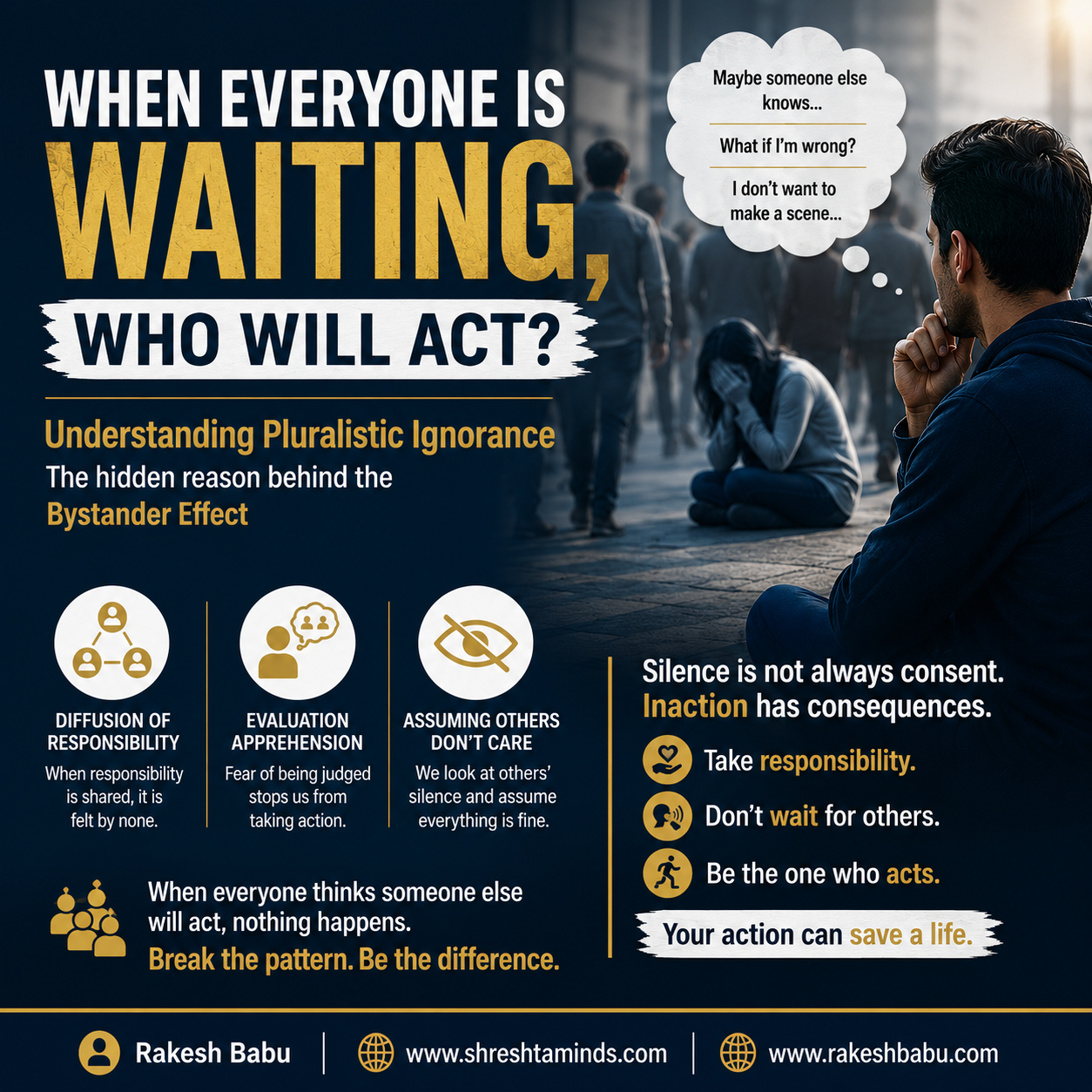
Suddenly, a young man sitting near the roadside collapsed. For a few seconds, nobody moved. People noticed. One person looked at him. Another looked at the people around him.
Someone whispered, “Maybe he is drunk.” Another person said, “Someone will help.” A few people stopped and watched.
But nobody stepped forward. Not because they didn’t care. Not because they were cruel. They were simply waiting.
Waiting for someone else to decide whether this was really an emergency.
Finally, one person ran towards him and called for help. Something changed immediately. Two more people came forward. Someone called an ambulance. Another person moved the crowd away.
Within seconds, the situation changed from “Nobody is doing anything” to “Everyone is helping.”
What changed?
The emergency didn’t. One person simply broke the silence. And that small action gave everyone else permission to act.
What actually happened?
There is an interesting psychological idea behind this. It is called Pluralistic Ignorance.
It sounds complicated, but the idea is surprisingly simple. You see something happening. You are not quite sure what it means. So, naturally, you look around.
“What are others doing?”
If everyone else looks calm, you think:
“Maybe it’s not serious.” The person next to you does exactly the same thing. They look at you. You look at them.
Nobody acts.
And now everyone starts taking everyone else’s silence as proof that everything is probably okay.
That’s the trap. Everyone may actually be concerned. Everyone may simply be waiting for someone else to make the first move.
And then comes the “Bystander Effect”
This is where the Bystander Effect can come into play. The more people around us, the easier it can become to think.
“Surely somebody will handle it.” — That’s Diffusion of Responsibility.
The responsibility gets spread across the crowd. And strangely, when responsibility belongs to everyone, we can start feeling that it belongs to someone else.
Then there is another very human thought:
“If I’m wrong, what will happen?”
What if the person isn’t actually in trouble?
What if people think I’m interfering?
That’s Evaluation Apprehension — our hesitation because we worry about how our actions will be judged.
So we look around again. Nobody is moving. We don’t move either. And the cycle continues.
One person’s hesitation becomes another person’s reassurance.
This doesn’t happen only on the street
We see the same thing in everyday life.
A meeting where everyone disagrees—but nobody speaks.
A student who doesn’t understand—but assumes everyone else does.
A colleague who notices something wrong—but thinks someone senior will raise it.
An opportunity everyone quietly wants—but nobody is willing to pursue first.
The situation changes, but the thought remains the same: “If nobody else is doing it, maybe I shouldn’t either.”
The Dangerous Chain
Pluralistic ignorance can create a psychological chain reaction:
Something happens → I am uncertain → I look at others → Others appear calm → I assume it isn’t serious → I don’t act → Others see me not acting → They assume it isn’t serious → Nobody acts.
And suddenly, everyone’s inaction becomes the reason for everyone else’s inaction.
So, what can we do?
We don’t need to become heroes.
We don’t need to interfere in everything.
But we can become a little more conscious of that first instinct to look around and wait.
Pause.
Ask yourself:
“Am I choosing not to act—or am I simply following everyone else’s silence?”
If something genuinely needs attention, take the first small step.
Ask:
“Are you okay?”
“Does someone need help?”
“Is anyone taking responsibility for this?”
Sometimes, that’s all it takes. Because when one person acts, the crowd often changes. Someone else joins. Then another.
Suddenly, what looked like a crowd of indifferent people turns out to be a crowd of people who simply needed one person to go first.
Don’t wait for the crowd to give you permission
The next time you find yourself thinking,
“Someone else will do it.”
Pause | Look again | Ask yourself
“What if everyone is thinking exactly what I am thinking?”
Maybe nobody is indifferent. Maybe everyone is uncertain.
And maybe the person everyone is waiting for…
is you.
Take responsibility. Break the silence. Be the first to act.
Because sometimes, doing nothing is also a decision. And in an emergency, that decision could cost a life.
In everyday life, it could cost someone an opportunity, support, dignity—or a chance that may never come again.
Understanding pluralistic ignorance and the bystander effect is not about blaming people for failing to act. It is about becoming aware of how easily social situations can influence our decisions—and choosing to respond consciously rather than automatically following the crowd.
Let’s LIVE here and don’t just EXIST.
In Love, Rakesh Babu N.R | www.shreshtaminds.com | www.rakeshbabu.com