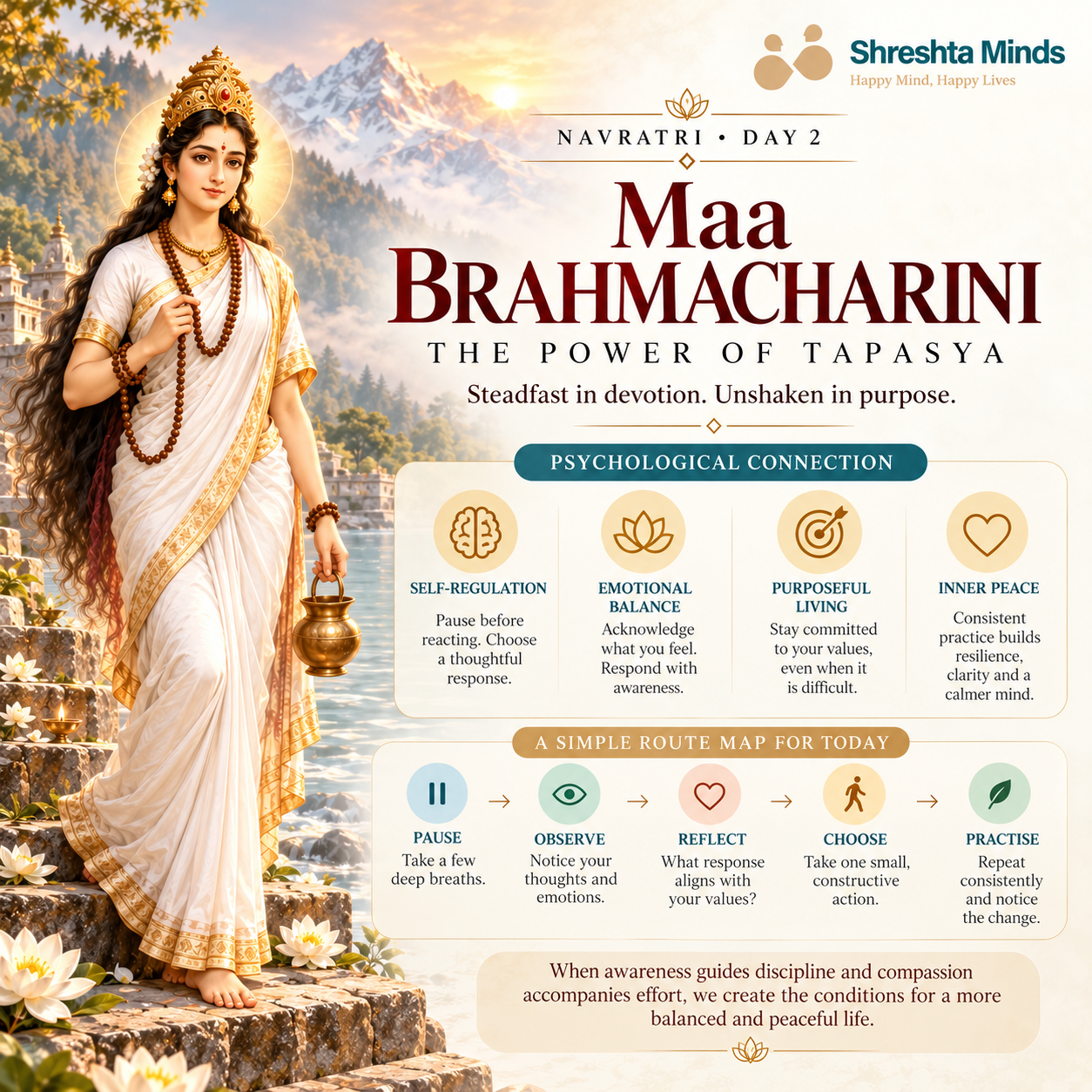
“Maa Brahmacharini: Psychology of Inner Peace”
Navratri Day 2 | A Reflection on Spiritual Wisdom and Psychological Well-being
Why do we lose our peace even when we know what is right? Often, the challenge is not a lack of knowledge but the difficulty of practising patience, regulating emotions and remaining committed to our values.
The second day of Navratri, dedicated to Maa Brahmacharini, offers a meaningful opportunity to reflect on this human struggle.
Maa Brahmacharini symbolises tapasya—dedication, perseverance and spiritual discipline. Beyond its religious significance, this symbolism invites us to explore an important psychological principle: lasting personal growth requires consistent, conscious effort.
In psychology, self-regulation refers to the processes through which we manage our thoughts, emotions and behaviours in pursuit of meaningful goals. When anger arises, discipline helps us pause before reacting. The moment anxiety creates uncertainty, awareness helps us examine our thoughts. When motivation declines, commitment helps us continue taking constructive steps.
However, discipline should not be confused with suppressing emotions or demanding perfection from ourselves. Emotional balance begins when we acknowledge what we feel and choose how to respond.
Research says that mindfulness meditation programmes produced small to moderate improvements in anxiety and depressive symptoms, although evidence varied across outcomes and these practices were not shown to be superior to every active treatment.
The connection between Maa Brahmacharini’s symbolism and psychology lies in the practice of purposeful living.
Spiritual discipline encourages us to look beyond immediate impulses and reconnect with what truly matters. Psychological approaches similarly encourage thoughtful responses rather than automatic reactions.
Together, these perspectives invite us to develop patience without passivity, commitment without rigidity, and self-discipline without self-criticism.
A peaceful life does not mean a life without challenges. It means gradually developing the capacity to meet challenges with greater clarity, emotional awareness and compassion. A difficult conversation can become an opportunity to practise patience.
Personal setback can teach resilience. A moment of anger can remind us to pause, understand our feelings and respond constructively.
A simple practice for today: Spend five minutes in quiet reflection. Observe your breathing, identify the emotion that is most present, and ask yourself, “What response would reflect my values rather than my immediate impulse?” Choose one small action that expresses patience, kindness or responsibility, and practise it consciously.
The purpose is not to eliminate every uncomfortable thought or emotion, but to become more intentional in how we live.
Maa Brahmacharini’s spiritual message reminds us that meaningful transformation unfolds through perseverance and dedication.
Psychology helps us understand how consistent practice can support that journey. When awareness guides discipline and compassion accompanies effort, we create the conditions for a more balanced and peaceful life.
This Navratri, let tapasya become more than a ritual. Let it become a daily commitment to understanding ourselves, regulating our responses and living with purpose.
Rakesh Babu
Psychologist | Spiritual Teacher | Mental Wellness Advocate