The Mentor Who Didn’t Give Answers

Contemplative philosophy in coaching

What if the greatest mentor was not the one who gave the right answers but the one who helped us discover the right questions?

When Arjuna stood on the battlefield of Kurukshetra, he was not lacking knowledge. He was overwhelmed by it.

He knew his duty, the consequences, and what was at stake. Yet, when the moment demanded action, he was confused, emotionally disturbed and unable to move forward.

Krishna did not simply tell him what to do. He mentored him and that distinction has enormous relevance to the contemporary world.

Krishna as a Mentor

What makes Krishna’s mentoring of Arjuna fascinating is that it was not merely about transferring knowledge. It was about transforming the way Arjuna saw himself, his situation and his responsibility.

Lord Krishna listened, questioned, challenged assumptions, and offered different perspectives.

He allowed Arjuna to reflect, and ultimately, he left the decision with Arjuna.

This is very different from the traditional idea of mentoring, where the experienced person says, “I have been through this before. Do what I tell you.” Krishna’s approach was closer to:

“Let me help you see clearly. The decision must become yours.”

That is powerful mentoring.

From Bhagavad Gita to the Contemporary Workplace

Today’s learner does not necessarily need more information.

We already live in an information-rich world.

What people increasingly need is clarity, perspective, self-awareness and the ability to make meaningful decisions.

This is where Krishna’s contemplative approach becomes relevant to Learning & Development.

A good trainer transfers knowledge.

Perfect coach facilitates discovery.

A great mentor helps a person see differently.

The shift is from:

Information → Reflection Instruction → Inquiry Dependency → Ownership Performance → Purpose

What Can L&D Learn From Krishna?

Imagine a leadership programme where the facilitator does not immediately provide solutions to every workplace challenge.

Instead, participants are invited to ask:

What am I seeing? What is within my control? Am I avoiding any responsibilities? What is the right action—not merely the convenient action?

Suddenly, training becomes more than a programme. It becomes a space for inner learning.

This is where contemplative philosophy can enrich contemporary coaching and leadership development.

Reflection can precede action.

Awareness can precede performance.

Purpose can precede goals and responsibility can replace blame.

The Mentor’s Real Work

Perhaps Krishna’s greatest lesson for mentors, coaches and L&D professionals is this:

Your job is not to create followers who depend on your wisdom. Your job is to develop people who can access their own wisdom.

That requires patience & listening.

It requires asking better questions.

Sometimes, it requires the courage to step back and allow the learner to struggle with a question rather than rushing to provide an answer.

The Kurukshetra may have been ancient. But the inner conflict is not.

Every leader, professional, student and human being eventually faces a moment when knowledge alone is not enough.

At that moment, perhaps what we need is not another instructor.

We need a Krishna or Mentor.

Perhaps, in the contemporary world, the real challenge for every mentor is to learn how to become one.

“Close your eyes and let what you just read run through your mind.”

Rakesh Babu | Psychologist | www.shreshtaminds.com
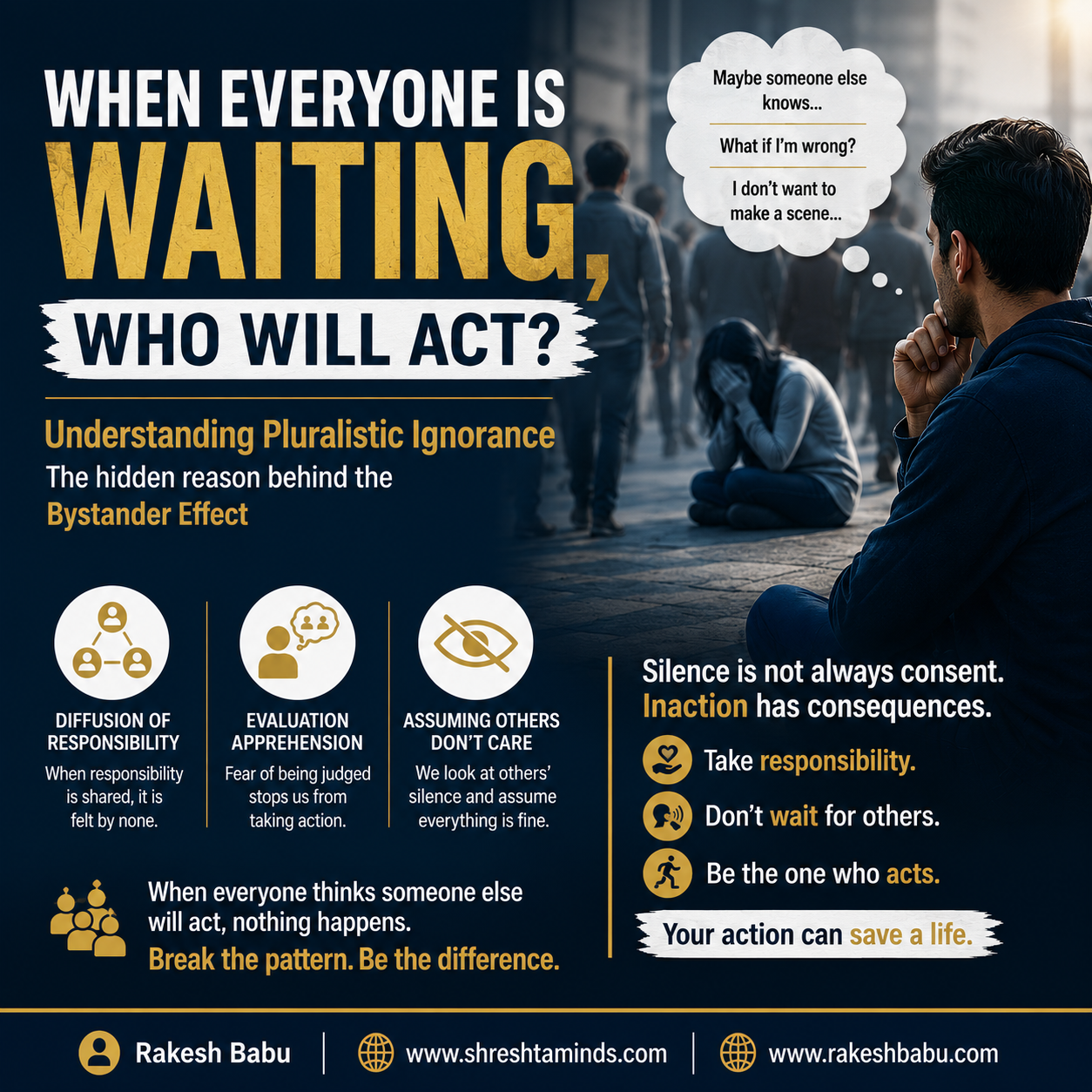
When Everyone Is Waiting: Who Will Act?

It was a busy evening.

People were walking in every direction. Vehicles were passing by. Conversations were happening around them.

Suddenly, a young man sitting near the roadside collapsed. For a few seconds, nobody moved. People noticed. One person looked at him. Another looked at the people around him.

Someone whispered, “Maybe he is drunk.” Another person said, “Someone will help.” A few people stopped and watched.

But nobody stepped forward. Not because they didn’t care. Not because they were cruel. They were simply waiting.

Waiting for someone else to decide whether this was really an emergency.

Finally, one person ran towards him and called for help. Something changed immediately. Two more people came forward. Someone called an ambulance. Another person moved the crowd away.

Within seconds, the situation changed from “Nobody is doing anything” to “Everyone is helping.”

What changed?

The emergency didn’t. One person simply broke the silence. And that small action gave everyone else permission to act.

What actually happened?

There is an interesting psychological idea behind this. It is called Pluralistic Ignorance.

It sounds complicated, but the idea is surprisingly simple. You see something happening. You are not quite sure what it means. So, naturally, you look around.

“What are others doing?”

If everyone else looks calm, you think:

“Maybe it’s not serious.” The person next to you does exactly the same thing. They look at you. You look at them.

Nobody acts.

And now everyone starts taking everyone else’s silence as proof that everything is probably okay.

That’s the trap. Everyone may actually be concerned. Everyone may simply be waiting for someone else to make the first move.

And then comes the “Bystander Effect”

This is where the Bystander Effect can come into play. The more people around us, the easier it can become to think.

“Surely somebody will handle it.” — That’s Diffusion of Responsibility.

The responsibility gets spread across the crowd. And strangely, when responsibility belongs to everyone, we can start feeling that it belongs to someone else.

Then there is another very human thought:

“If I’m wrong, what will happen?”

What if the person isn’t actually in trouble?

What if people think I’m interfering?

That’s Evaluation Apprehension — our hesitation because we worry about how our actions will be judged.

So we look around again. Nobody is moving. We don’t move either. And the cycle continues.

One person’s hesitation becomes another person’s reassurance.

This doesn’t happen only on the street

We see the same thing in everyday life.

A meeting where everyone disagrees—but nobody speaks.

A student who doesn’t understand—but assumes everyone else does.

A colleague who notices something wrong—but thinks someone senior will raise it.

An opportunity everyone quietly wants—but nobody is willing to pursue first.

The situation changes, but the thought remains the same: “If nobody else is doing it, maybe I shouldn’t either.”

The Dangerous Chain

Pluralistic ignorance can create a psychological chain reaction:

Something happens → I am uncertain → I look at others → Others appear calm → I assume it isn’t serious → I don’t act → Others see me not acting → They assume it isn’t serious → Nobody acts.

And suddenly, everyone’s inaction becomes the reason for everyone else’s inaction.

So, what can we do?

We don’t need to become heroes.

We don’t need to interfere in everything.

But we can become a little more conscious of that first instinct to look around and wait.

Pause.

Ask yourself:

“Am I choosing not to act—or am I simply following everyone else’s silence?”

If something genuinely needs attention, take the first small step.

Ask:

“Are you okay?”

“Does someone need help?”

“Is anyone taking responsibility for this?”

Sometimes, that’s all it takes. Because when one person acts, the crowd often changes. Someone else joins. Then another.

Suddenly, what looked like a crowd of indifferent people turns out to be a crowd of people who simply needed one person to go first.

Don’t wait for the crowd to give you permission

The next time you find yourself thinking,

“Someone else will do it.”

Pause | Look again | Ask yourself

“What if everyone is thinking exactly what I am thinking?”

Maybe nobody is indifferent. Maybe everyone is uncertain.

And maybe the person everyone is waiting for…

is you.

Take responsibility. Break the silence. Be the first to act.

Because sometimes, doing nothing is also a decision. And in an emergency, that decision could cost a life.

In everyday life, it could cost someone an opportunity, support, dignity—or a chance that may never come again.

Understanding pluralistic ignorance and the bystander effect is not about blaming people for failing to act. It is about becoming aware of how easily social situations can influence our decisions—and choosing to respond consciously rather than automatically following the crowd.

Let’s LIVE here and don’t just EXIST.

In Love, Rakesh Babu N.R | www.shreshtaminds.com | www.rakeshbabu.com
Psychological Flexibility – Coping Tool for Resilient & Peaceful Life

Acceptance brings peace inside You! It helps in preventing the emotional damages. When the practicality is accepted, it is easy to undergo any phase of challenging situations in life.

A phrase goes, “Expectation Hurts.” An intriguing psychological lesson came from an old Tamil (one of the oldest languages in the world and a regional language of southern India) film. I saw it twenty years ago. It reads, “Depression is caused by unrealistic expectations from the wrong people or places.”

Accepting the reality is wise. Expecting the practicality is wiser.

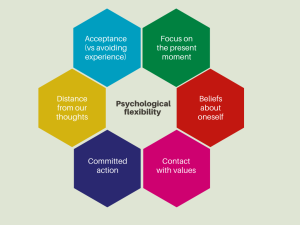
Resilience and balance are aided by “psychological flexibility.” A basic comprehension of this idea can help someone act and think more effectively in any circumstance.

Psychological Flexibility could be reflected by how a person:

  1. Adapts to fluctuating situational demands
  2. Reconfigures mental resources
  3. Shifts perspective
  4. Balances competing desires, needs, and life domains.

From my understanding Acceptance or Flexibility are fundamental aspect of Mental Wellness. It is a protective shield when we deal with any challenging phases of life. A research in 2011 says “When experiencing stressful life events psychological flexibility is protective against negative feelings and can promote positive mental health”.

In 2017, another research says that psychological flexibility can act as a buffer between stress and negative psychological outcomes. Psychological Flexibility is the core concept of Acceptance & Commitment Therapy – ACT.

Psychological Flexibility promotes emotional equilibrium and creates space for deliberate action rather than emotions in a reactive setting. When a person is psychologically flexible, their decisions are based more on their long-term values than on their current feelings.

Psychological acceptance can fill up some gaps for a more psychologically flexible personality. Acceptance entails accepting a situation as it is and not focusing on why it shouldn’t be that way. With this attitude, we are able to let go of feelings of guilt or unfairness as well as the frequently harsh judgments of ourselves.

How to develop psychological flexibility

  1. The Psychological Flexibility Model.
  2. Present moment: Live in the “now”.
  3. Acceptance: Embracing your thoughts.
  4. Values: Staying true to yourself.
  5. Cognitive Defusion: Separate yourself from your thoughts.
  6. Self-as-context: Practice mindful reframing.


What are the benefits of Psychological Flexibility?

  1. Helps to take proactive decision instead of reactive.
  2. Balanced Emotions
  3. Emotional Resilience
  4. Stress Free and reduced anxiety & depression
  5. Better Inter-personal relationships.
  6. Promotes Healthy Behavioral Changes
  7. Improved Coping mechanism
  8. Keeps Focused despite setbacks and challenges

According to Bond in 2011, “Psychological Inflexibility” is defined as “the rigid dominance of psychological reactions over chosen values and contingencies in guiding action”

What are the effects of Psychological Inflexibility?

  1. Behavioral Issues
  2. Lack of values
  3. Persistent inaction and avoidance
  4. Attachment to conceptualized self.
  5. Weak Self Knowledge

A necessary acquired talent to handle any stressful event in life is psychological flexibility. A person can live happily and with a greater grasp of world events by learning and using this ability. The individual may be in a better position to comprehend themselves and others as a result.

Being flexible is not naïve!

How we accept other people and our circumstances determines how happy we are. Your happiness shouldn’t, in any event, be dependent on other people. Life will be beautiful if you learn to accept other people as they are and to be flexible in even the most trying circumstances.

Wishing you all a happy and stress-free life.

In Gratitude,

N.R.Rakesh Babu
Psychologist | Doctoral Researcher
www.rakeshbabu.com | www.rbac.in

Possessiveness – A Poison Of The Mind

#Possessiveness is a #Poison of the #Mind!

It is not just poison, it is a #pain too. Experts says that Possessiveness is due to unrealistic expectations.

This happens with people, money, things etc., It becomes danger when it crosses the boundary in relationships. Relationships may be between parents and children, life partners, friends, office colleagues. At some point, the “so called” CARE will change into “Over Protectiveness”. This will be a real torture to the partner.

Possessiveness is kind of a mental pressure that the person encounters and also radiate it to the counterparts. It is a fear of loss of belongings, persons etc., This creates fear, anger, anxiety and loneliness.

Trust is a vital aspect of a healthy relationship. In order to trust, you must feel your partner is reliable, cares about you, and can be counted on. You can see abusive relationship when the partner lose the trust. They feel insecured.

In the name of love and care, they do overprotection!

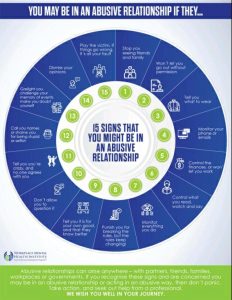
✍️ Few Signs of Possessiveness:

  • Monitor your phone and emails.
  • Tell what to wear.
  • Text you nonstop.
  • Control you and rob your privacy.
  • Gaslight you.
  • Stop you talk to your friends.
  • They will be jealous
  • In the name of protection, they will restrict you from being connected to the social network.

It is imperative to understand that the partner is possessive at early stage. Talk to them that it is not good for the relationship. It will ruin the happiness in between them. It will affect physically, mentally and emotionally.

It will reduce the self-esteem, confidence, trust.

Possessiveness is not love, it is simply projected fear and insecurity.

Either, they can sit and talk about this to overcome this issue. Else, they need strong support from a Psychological Consultant.

Some may ask, how come a third person can help them in such issues. It is similar to a patient approaches doctors for their health issues.

Licensed or Authorized and Competent #Psychologists, #Therapists, #Relationship #healers can certainly help them when they themselves are unable to deal with this problem.

✍️ How to deal the possessive partner?

  • Love them and give little extra care
  • Listen to what they say and address the problem
  • When they want to talk to you, be available for them.
  • Communicate properly and set proper, realistic goals.
  • Don’t argue or justify for what you have done.

Appreciating your comments on this topic.

Disclaimer: Image source – Workplace Mental Health Institute. With gratitude, sharing the image for knowledge sharing.

In Gratitude,

N.R.Rakesh Babu
Psychologist | Doctoral Researcher
www.rakeshbabu.com | www.rbac.in

Overthinking will rob your peace

Think….Think….Think…and over a period it will become overthinking. Overthinking causes unnecessary stress. It is not a good habit to possess. You can observe your thoughts clearly when you remain calm.

If you are thinking more than 10 to 15 minutes, it will be about the past happenings or the future or upcoming events. Beauty on overthinking is, you will dwell in the past or future and will not come to the present.

Actually the calmness and steadiness will be in the present and not in past or future. The more you dwell in past or future, observe your breath. It will be restless and will be in abnormal rhythm. This is not good for health. It will create multiple physical and psychological issues.

At this time, you will be emotionally weak. Your decision making will be poor. Thoughts will be like ripples of water when stone is thrown on it. Overthinking will rob your happiness and thoughts will be distorted. Instead of solving the issues, your mind will be wavering. You will become a fearmonger of your own self.

In one of the life skill classes, my mentor taught me that:

Past is like broken glass pot – You cannot fix the broken pot

Future is like cat on the wall – you don’t know where this cat will fall from the wall.

Present is the treasure. – It is right there with you – “The Now” moment.

An easy tip for you to bring yourself back to the present moment is through your breath. Observe your breath. Take few long deep breaths. Settle down and slowly come back to the present moment. It will be challenging while you start practicing. However, it will become a habit on regular practice.

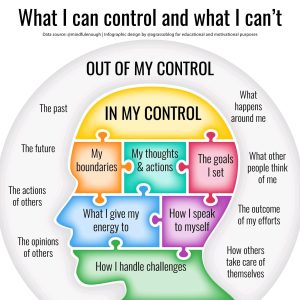
Few things are out of your control and few are in your control. When you understand these TWO differences, life will be easy and it will prevent from overthinking.

Things that you cannot control:

  • The past, future and it’s occurrences.
  • You cannot control what others are thinking about you or their opinions.
  • Similarly, you cannot control their actions.
  • Whatever is happening around you.
  • Obviously the results of your efforts.

Things that You can control:

  • Your boundaries as where to pitch in and where you should not poke your nose.
  • Your thoughts and actions.
  • Your goals and objectives.
  • Where you should channelize your energy.
  • How you should interact with yourSELF.
  • How do you handles your challenges.

Without having awareness on what you can and cannot control, you will end up in overthinking and your energy will get drained unnecessarily.

Wake up; Shake Up. Be with people who can uplift you morally even in crisis. Surround with positively interacting communities who can see your elevation. Do not do or think anything that harm your mental wellness. Be happy with what you have and even if you do not have anything, be grateful that you have LIFE with you to live to the fullest.

The entire world is creating emotional pollution by accumulating unwanted thought processes and this is not good for the ecosystem. It is right time that we should be in peace and help others to be in peace.

Let’s live in peace and not rest in peace.

Disclaimer: Image credits to the original creator and I, the author of this article doesn’t claim any credit for the images attached.

In Gratitude,

N.R.Rakesh Babu
Psychologist | Doctoral Researcher
www.rakeshbabu.com | www.rbac.in

Stimulants are damaging functions of Brain

Young lives are getting affected due to drugs. World wide efforts are in large to curb the usage of illegal drugs. The preventive measures varies from country to country. Addicts are majorly children and youngsters. In the age of self-transformation, they are getting addicted to such drugs at the stake of their life.

Addiction is “Brain Disease”. However, prevention is crucial. Not just medical or mental health departments take responsibilities to help in prevention. It requires multi-sectoral approach.

Addiction of substance is manifestation of Psychological issues. Something is lacking in their life. The major proportion is due to their adverse childhood experiences. Abuses such as Physical torture, mental torture, sexual torture. Mental illness and other psychological disturbances are also significant contributors to addicts.

Sad thing is, these children dies approximately 20 years before their normal death. This morally affects the family members and society.

What is/are Stimulant/s?

Stimulants or Stimulant drugs are range of psychoactive drug that gives temporary improvements in physical or mental functioning, thus elevating mood and increasing feelings of wellbeing, energy and alertness.

Few examples of stimulant drugs are as follows:

  1. Cocaine
  2. Methamphetamines
  3. Amphetamines
  4. Nicotine
  5. Ecstasy.

These Stimulants are abused in many ways such as swallowed as pills, snorted as powder, injecting through syringes and making it as solid form for smoking.

Drugs that are injected & smoked reaches brain faster. Effect of such drugs are adverse. Snorted and swallowed may not show immediate effect but it’s longer lasting.

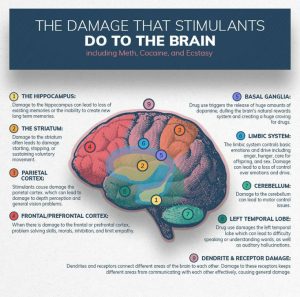
Damage To The Brain:

  1. The Hippocampus: Damage to hippocampus can lead to loss of existing memories or the inability to create new long term memories.
  2. The Striatum: Damage causes to striatum leads to starting, stopping or sustaining voluntary movements.
  3. Parietal Cortex: Damage in Parietal Cortex leads to damage in perception and general visual problems.
  4. Frontal/Prefrontal Cortex: Moral values problem solving skills, inhibition and empathy gets affected.
  5. Basal Ganglia: Drugs release huge amount of dopamine. It reduces the natural reward system and increases the cravings for drugs.
  6. Limbic System: Damage can lead a loss of control over emotions and drive.
  7. Cerebellum: Damage to this part can lead to motor control issues.
  8. Left Temporal Lobe: Damage to this region reduces the logical thoughts. Difficulty in speaking, understanding words, logical decision making as well as auditory hallucinations.
  9. Dendrite or Receptor: Dendrites and receptors connects different parts of the brain. Damage to these areas leads to poor communication and may cause general damages.

Long term use of stimulants can cause huge damage to the central nervous system. It will deteriorate one’s energy level, adverse health consequences and normal functions.

The risk factor is being young. At young age they are very vulnerable and their Brain’s speed is formed, unfortunately “Brake” is not applied often.

Prevention of Abuse:

  1. Primary – Before it occurs.
  2. Secondary – Early diagnosis as soon as identified and active treatment to be introduced.
  3. Tertiary – Rehabilitation

Who can help or treat addiction? Psychiatrists, Psychologists, Therapists.

NOTE: There are positive effects when these stimulants are used as medicine when it is administered carefully by a medical expert.

Disclaimer: Image credits to all those generous creators who have floated in internet for free usage.

In Gratitude,
N.R.Rakesh Babu
Psychologist | Doctoral Researcher
www.rakeshbabu.com | www.rbac.in

7 Habits of Highly Effective People – Stephen Covey’s Book

The 7 Habits

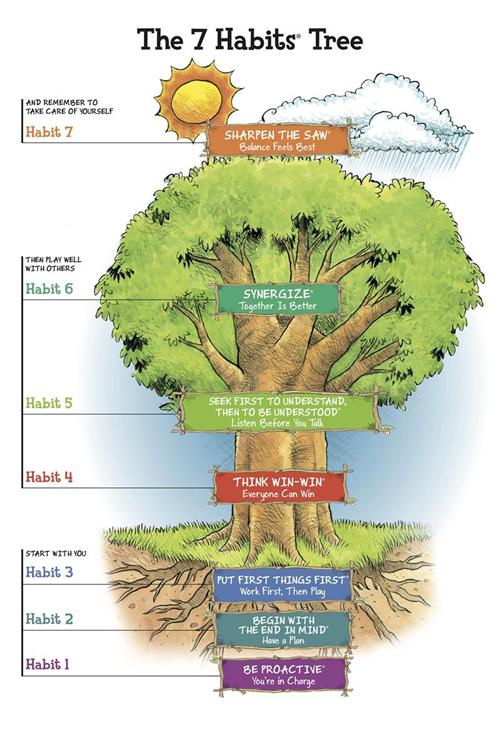
The 7 Habits of Highly Effective People are:

  • Habit 1: Be Proactive
  • Habit 2: Begin With the End in Mind
  • Habit 3: Put First Things First
  • Habit 4: Think Win-Win
  • Habit 5: Seek First to Understand, Then to Be Understood
  • Habit 6: Synergize
  • Habit 7: Sharpen the Saw

Testimonial:

Stephen Covey is an American Socrates, opening your mind to the ‘permanent things’ —
values, family, relationships, communicating.

— Brian Tracy, author of Psychology of Achievement

The below given picture is about 7 Habits of Happy Kids. Implementing these Seven tips in Children for their happy and harmonious life.

Download the Book here: The 7 Habits of Highly Effective People by S. Covey ( PDFDrive )

Disclaimer: I have downloaded this book somewhere in internet long back. Sharing this information and book in the intention of knowledge sharing. All credits goes to Steven Covey.

In Gratitude,
N.R.Rakesh Babu
Psychologist | Doctoral Researcher
www.rakeshbabu.com | www.rbac.in

Metacognitive Skills For Better Results

Metacognition has been defined as “one’s knowledge concerning one’s own cognitive processes or anything related to them” (Flavell, 1976, in Kaplan et al., 2013) and is commonly referred to as “thinking about one’s thinking”. Having well-developed metacognitive thinking skills is associated with improved learning.

Knowledge of Cognition & Regulation of Cognition:

For example, Consider, you are thinking about writing an article today with an interesting topic, now you think about what to write, where to take reference, how it will impact your readers, what are the significance in your writing or what are the strategies that you plan to write it effectively. However, thinking about what you thought to write is Metacognition.

According to metacognitive theories, metacognition includes two domains: knowledge of cognition and regulation of cognition (Schraw & Moshman, 1995).

Knowledge of cognition includes knowledge about oneself as a learner, knowledge about learning strategies, and knowledge about why and when to use a given strategy.

Regulation of cognition includes the ability to plan, monitor, regulate and evaluate your learning process.

Easy THREE Steps of Regulation of Cognition:

#Planning:

  1. What is the nature of the task?
  2. What is my goal?
  3. What kind of information and strategies do I need?
  4. How much time and resources will I need?

#Monitoring:

  1. Do I have a clear understanding of what I am doing?
  2. Does the task make sense?
  3. Am I reaching my goals?
  4. Do I need to make changes?

#Evaluating:

  1. Have I reached my goal?
  2. What worked?
  3. What didn’t work?
  4. Would I do things differently next time?

Few Metacognitive Strategies in Learning are as Follows:

  1. Identifying one’s own style of learning and the needs associated with it.
  2. Planning for task
  3. Collecting and organizing the materials
  4. Arranging learning space and schedules
  5. Monitor mistakes
  6. Evaluate the mistakes happened and task
  7. Evaluate the success of any learning strategy and adjusting

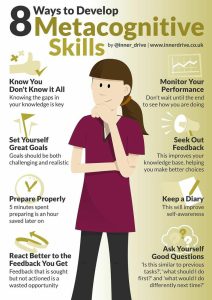
The above information are basic theories about Metacognition. The attached infographic is really good to understand the easy ways to develop the Metacognitive Skills.

EASY WAYS TO DEVELOP METACOGNITIVE SKILLS:

  1. Know that you don’t know everything
  2. Set GOALS
  3. Introspection (or) Keep Questioning Yourself
  4. Prepare Promptly
  5. Monitor or Measure Your Progress
  6. Get Honest Feedback
  7. Journal or Keep a Diary

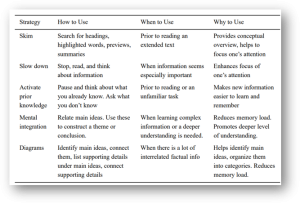
Below Table Helps to Develop Metacognitive Skills in General!

Disclaimer: Extending my sincere gratitude to image creators and source of details.

In Gratitude,
N.R.Rakesh Babu
Psychologist | Doctoral Researcher
www.rakeshbabu.com | www.rbac.in

SIX High Impacting Ways For Stress Free Morning!

Your “Good” Morning is influenced by your yesterday’s “Good” Night!

We all wish to have a good day whenever we wake up in the morning. Who and what determines that “goodness”? Is it people around us or situation or news or what? These may impact in certain percentage. The major contribution is your own lifestyle and attributes.

Here, in this article I wish to write something on the previous day night and the present day morning. I have seen many people who are depressed in the morning and their entire day gets affected by this state of prolonged stress.

If you spend your evenings stressed out, you will go to bed with all those negative energy & thoughts that won’t be able to fully recover during the night. However, if you fix your evenings well, your mornings are automatically going to get better.

How your Mornings can get affected or what are the symptoms?

  • Very hard to wake up early in the morning
  • Lack of stamina and energy
  • Self chores like Bathing and eating looks difficult
  • Delayed physical or cognitive functioning
  • Lack of attention, poor concentration
  • Intense agitation or frustration
  • Losing interest in routine activities
  • Feeling lonely and empty
  • Unusual eating habits (more or less than usual)
  • They sleep long than normally – Hypersomnia

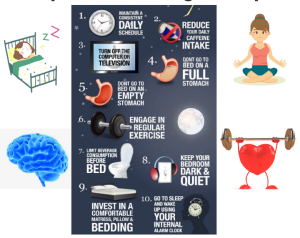
To make your Morning Happy, you have to plan the previous day evening a better one. Let’s see, how we can work on that:

Plan Your Dinner: You can plan your dinner little earlier and take easily digested food which can fill your stomach with sufficient energy.

Sleep Early: Practice a habit of going to bed early and at same time everyday. Avoid taking long naps in the day time. It will affect the night sleep.

Avoid Substances: Avoiding substances such as alcohol, caffeine and tobacco in late evening or night can prevent a good night’s sleep.

Emotion Free Evening: Emotion has significant influence on the cognitive processes in humans, including perception, attention, learning, memory, reasoning, and problem solving. Emotion has a particularly strong influence on attention. Emotionally imbalanced evening/night can affect next day morning based on the intensity.

Screen Time: Studies show two or more hours of screen time in the evening can seriously disrupt the melatonin surge needed to fall sleep. Consider turning off all electronic devices at least one hour before sleep, at a minimum. Try reading a book, taking a bath or doing some other type of relaxing activity.

Avoid Excessive Exercises: Heavy exercising right before going to bed isn’t favorable as it boosts your metabolism, pumps your heart rate, and makes it difficult to calm down. (It may vary from person to person). Instead of strenuous exercise, subtle stretches and massaging are better way to sleep better. Always do exercises little earlier than the bed time.

If you have any sleep disorders, migraine or any other physiological and psychological issues, seek medical or therapeutical guidance for the better sleep. This helps you to be active in the morning.

The natural body clock, regulates our heart rate to body temperature and everything. It also affects energy, thinking and mood. These daily rhythms help you keep a stable mood and stay in good health.

Certain hormones in our body such as cortisol and melatonin, help your body prepare for certain events. For example, your body makes cortisol when the sun rises. This hormone gives you energy so you can be active and alert during the day. When the sun sets, your body releases melatonin. That hormone that makes you sleepy.

Hence, we should allow the body chemicals to work on it’s own schedule and not in our schedule.

Live healthy for happy life!

In Gratitude,

N.R.Rakesh Babu
Psychologist | Doctoral Researcher
www.rakeshbabu.com | www.rbac.in

Previous Articles can be read at: https://rakeshbabu.com/category/rakesh-writes/

Balanced EQ for Happy SELF!

“IQ is Important but EQ is Sine Qua Non of Leadership!” – Daniel Goleman

Without Love and Compassion, we are going to win nothing in this world. I strongly believe in this. Every other aspects of our life is important in a right proportion. The one with more love is more stronger.

As we grow big, we love to lead happy life. For a happy life, as Daniel Goleman Said, Emotional Quotient is important as much as Intelligence Quotient.

EQ is the ability to understand, utilize & manage your own emotions in better ways to de-stress, effective communication, empathize with others and to overcome challenges in day-to-day life.

When we know how to improve our EQ, it helps us to build ourself a better version in terms of intra-personal, inter-personal relationships and to achieve our goals.

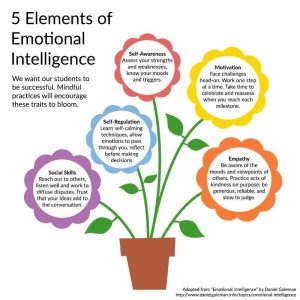
FIVE Elements of Emotional Intelligence are:

  1. Self-Awareness: A person with emotional self-awareness is usually receptive to, and able to learn from, constructive criticism more than one who doesn’t have emotional self-awareness.
  2. Self-Regulation: A person with a high emotional intelligence has the ability to exercise restraint and control when expressing their emotions.
  3. Social Skills: People who are emotionally intelligent are able to build trust with other people, and are able to quickly gain respect from the people they meet.
  4. Empathy: An empathetic person has compassion and is able to connect with other people on an emotional level, helping them respond genuinely to other people’s concerns.
  5. Motivation: People with high emotional intelligence are self-motivated, resilient and driven by an inner ambition rather than being influenced by outside forces, such as money or prestige.

Balanced EQ for Happy SELF!

S – Stress Free

E – Emotionally Stable

L – Locus Of Control

F – Fantabulous Life Guaranteed

#emotionalintelligence #motivation #leadership #empathy #love #communication #intelligence #psychology #psychologists #linkedinlearning #linkedIn #linkedincontent #research #scholar #phd #self #IQ #EQ #stressfreelife #hapylife

In #Gratitude,
N.R.Rakesh Babu
Psychologist | Doctoral Researcher
www.rakeshbabu.com | www.rbac.in