Stimulants are damaging functions of Brain
Young lives are getting affected due to drugs. World wide efforts are in large to curb the usage of illegal drugs. The preventive measures varies from country to country. Addicts are majorly children and youngsters. In the age of self-transformation, they are getting addicted to such drugs at the stake of their life.
Addiction is “Brain Disease”. However, prevention is crucial. Not just medical or mental health departments take responsibilities to help in prevention. It requires multi-sectoral approach.
Addiction of substance is manifestation of Psychological issues. Something is lacking in their life. The major proportion is due to their adverse childhood experiences. Abuses such as Physical torture, mental torture, sexual torture. Mental illness and other psychological disturbances are also significant contributors to addicts.
Sad thing is, these children dies approximately 20 years before their normal death. This morally affects the family members and society.
What is/are Stimulant/s?
Stimulants or Stimulant drugs are range of psychoactive drug that gives temporary improvements in physical or mental functioning, thus elevating mood and increasing feelings of wellbeing, energy and alertness.
Few examples of stimulant drugs are as follows:
- Cocaine
- Methamphetamines
- Amphetamines
- Nicotine
- Ecstasy.
These Stimulants are abused in many ways such as swallowed as pills, snorted as powder, injecting through syringes and making it as solid form for smoking.
Drugs that are injected & smoked reaches brain faster. Effect of such drugs are adverse. Snorted and swallowed may not show immediate effect but it’s longer lasting.
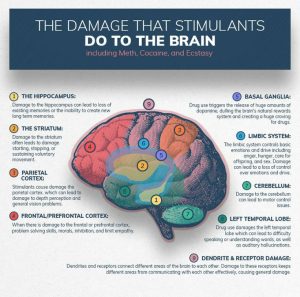
Damage To The Brain:
- The Hippocampus: Damage to hippocampus can lead to loss of existing memories or the inability to create new long term memories.
- The Striatum: Damage causes to striatum leads to starting, stopping or sustaining voluntary movements.
- Parietal Cortex: Damage in Parietal Cortex leads to damage in perception and general visual problems.
- Frontal/Prefrontal Cortex: Moral values problem solving skills, inhibition and empathy gets affected.
- Basal Ganglia: Drugs release huge amount of dopamine. It reduces the natural reward system and increases the cravings for drugs.
- Limbic System: Damage can lead a loss of control over emotions and drive.
- Cerebellum: Damage to this part can lead to motor control issues.
- Left Temporal Lobe: Damage to this region reduces the logical thoughts. Difficulty in speaking, understanding words, logical decision making as well as auditory hallucinations.
- Dendrite or Receptor: Dendrites and receptors connects different parts of the brain. Damage to these areas leads to poor communication and may cause general damages.
Long term use of stimulants can cause huge damage to the central nervous system. It will deteriorate one’s energy level, adverse health consequences and normal functions.
The risk factor is being young. At young age they are very vulnerable and their Brain’s speed is formed, unfortunately “Brake” is not applied often.
Prevention of Abuse:
- Primary – Before it occurs.
- Secondary – Early diagnosis as soon as identified and active treatment to be introduced.
- Tertiary – Rehabilitation
Who can help or treat addiction? Psychiatrists, Psychologists, Therapists.
NOTE: There are positive effects when these stimulants are used as medicine when it is administered carefully by a medical expert.
Disclaimer: Image credits to all those generous creators who have floated in internet for free usage.
In Gratitude,
N.R.Rakesh Babu
Psychologist | Doctoral Researcher
www.rakeshbabu.com | www.rbac.in