Psychological Flexibility – Coping Tool for Resilient & Peaceful Life

Acceptance brings peace inside You! It helps in preventing the emotional damages. When the practicality is accepted, it is easy to undergo any phase of challenging situations in life.
A phrase goes, “Expectation Hurts.” An intriguing psychological lesson came from an old Tamil (one of the oldest languages in the world and a regional language of southern India) film. I saw it twenty years ago. It reads, “Depression is caused by unrealistic expectations from the wrong people or places.”
Accepting the reality is wise. Expecting the practicality is wiser.
Resilience and balance are aided by “psychological flexibility.” A basic comprehension of this idea can help someone act and think more effectively in any circumstance.
Psychological Flexibility could be reflected by how a person:
- Adapts to fluctuating situational demands
- Reconfigures mental resources
- Shifts perspective
- Balances competing desires, needs, and life domains.
From my understanding Acceptance or Flexibility are fundamental aspect of Mental Wellness. It is a protective shield when we deal with any challenging phases of life. A research in 2011 says “When experiencing stressful life events psychological flexibility is protective against negative feelings and can promote positive mental health”.
In 2017, another research says that psychological flexibility can act as a buffer between stress and negative psychological outcomes. Psychological Flexibility is the core concept of Acceptance & Commitment Therapy – ACT.
Psychological Flexibility promotes emotional equilibrium and creates space for deliberate action rather than emotions in a reactive setting. When a person is psychologically flexible, their decisions are based more on their long-term values than on their current feelings.
Psychological acceptance can fill up some gaps for a more psychologically flexible personality. Acceptance entails accepting a situation as it is and not focusing on why it shouldn’t be that way. With this attitude, we are able to let go of feelings of guilt or unfairness as well as the frequently harsh judgments of ourselves.
How to develop psychological flexibility
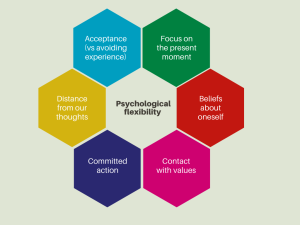
- The Psychological Flexibility Model.
- Present moment: Live in the “now”.
- Acceptance: Embracing your thoughts.
- Values: Staying true to yourself.
- Cognitive Defusion: Separate yourself from your thoughts.
- Self-as-context: Practice mindful reframing.
What are the benefits of Psychological Flexibility?
- Helps to take proactive decision instead of reactive.
- Balanced Emotions
- Emotional Resilience
- Stress Free and reduced anxiety & depression
- Better Inter-personal relationships.
- Promotes Healthy Behavioral Changes
- Improved Coping mechanism
- Keeps Focused despite setbacks and challenges
According to Bond in 2011, “Psychological Inflexibility” is defined as “the rigid dominance of psychological reactions over chosen values and contingencies in guiding action”
What are the effects of Psychological Inflexibility?
- Behavioral Issues
- Lack of values
- Persistent inaction and avoidance
- Attachment to conceptualized self.
- Weak Self Knowledge
A necessary acquired talent to handle any stressful event in life is psychological flexibility. A person can live happily and with a greater grasp of world events by learning and using this ability. The individual may be in a better position to comprehend themselves and others as a result.
Being flexible is not naïve!
How we accept other people and our circumstances determines how happy we are. Your happiness shouldn’t, in any event, be dependent on other people. Life will be beautiful if you learn to accept other people as they are and to be flexible in even the most trying circumstances.
Wishing you all a happy and stress-free life.
In Gratitude,
N.R.Rakesh Babu
Psychologist | Doctoral Researcher
www.rakeshbabu.com | www.rbac.in