The Architecture of Overthinking

How to stop overthinking!

Have you ever noticed how one small thought can become a full-blown story in your mind?

A message goes unanswered.
The conversation feels slightly different.
Decision keeps replaying in your head.

And suddenly, your mind is running through possibilities that haven’t even happened.

That is the architecture of overthinking. The interesting part is—you don’t have to silence your mind.

You have to understand how the pattern is built.

Overthinking rarely begins with a big problem; it often begins with a single thought.

Something happens, and the mind immediately starts searching for meaning.

We interpret the event through our beliefs, experiences, fears, and expectations.

That interpretation creates an emotional response.

The emotion then makes the original thought feel even more important.

So, we revisit it—again and again—hoping that repetition will give us certainty.

But repetition doesn’t always create clarity; sometimes, it creates amplification.

A small possibility becomes a probable outcome, and a probable outcome becomes a frightening certainty.

This is where overthinking begins to feel like problem-solving.

Yet thinking more does not necessarily mean thinking better.

The turning point comes when we develop awareness of the pattern.

Awareness creates a small but powerful pause between the thought and our reaction.

Inside that pause lies something we often forget: choice.

We may not control every thought that enters our mind, but we can influence what we do with it.

Questioning the thought instead of automatically believing it.

We can separate facts from assumptions, possibilities from probabilities, and fears from reality.

“Choose a response instead of endlessly rehearsing the problem.”

That is how the journey moves from overthinking to awareness, from awareness to clarity, and from clarity to action.

A calmer mind isn’t a mind without thoughts; it is a mind that doesn’t have to obey every thought.

Think. Pause. Question. Choose. Act. — Better Thinking. Better Decisions. Better Outcomes.


In Love & Gratitude, Rakesh Babu | Psychologist | www.shreshtaminds.com 
Overthinking will rob your peace

Think….Think….Think…and over a period it will become overthinking. Overthinking causes unnecessary stress. It is not a good habit to possess. You can observe your thoughts clearly when you remain calm.

If you are thinking more than 10 to 15 minutes, it will be about the past happenings or the future or upcoming events. Beauty on overthinking is, you will dwell in the past or future and will not come to the present.

Actually the calmness and steadiness will be in the present and not in past or future. The more you dwell in past or future, observe your breath. It will be restless and will be in abnormal rhythm. This is not good for health. It will create multiple physical and psychological issues.

At this time, you will be emotionally weak. Your decision making will be poor. Thoughts will be like ripples of water when stone is thrown on it. Overthinking will rob your happiness and thoughts will be distorted. Instead of solving the issues, your mind will be wavering. You will become a fearmonger of your own self.

In one of the life skill classes, my mentor taught me that:

Past is like broken glass pot – You cannot fix the broken pot

Future is like cat on the wall – you don’t know where this cat will fall from the wall.

Present is the treasure. – It is right there with you – “The Now” moment.

An easy tip for you to bring yourself back to the present moment is through your breath. Observe your breath. Take few long deep breaths. Settle down and slowly come back to the present moment. It will be challenging while you start practicing. However, it will become a habit on regular practice.

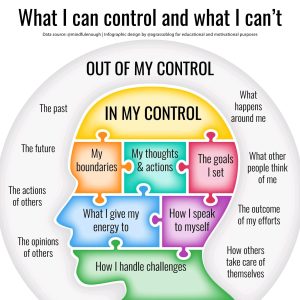
Few things are out of your control and few are in your control. When you understand these TWO differences, life will be easy and it will prevent from overthinking.

Things that you cannot control:

  • The past, future and it’s occurrences.
  • You cannot control what others are thinking about you or their opinions.
  • Similarly, you cannot control their actions.
  • Whatever is happening around you.
  • Obviously the results of your efforts.

Things that You can control:

  • Your boundaries as where to pitch in and where you should not poke your nose.
  • Your thoughts and actions.
  • Your goals and objectives.
  • Where you should channelize your energy.
  • How you should interact with yourSELF.
  • How do you handles your challenges.

Without having awareness on what you can and cannot control, you will end up in overthinking and your energy will get drained unnecessarily.

Wake up; Shake Up. Be with people who can uplift you morally even in crisis. Surround with positively interacting communities who can see your elevation. Do not do or think anything that harm your mental wellness. Be happy with what you have and even if you do not have anything, be grateful that you have LIFE with you to live to the fullest.

The entire world is creating emotional pollution by accumulating unwanted thought processes and this is not good for the ecosystem. It is right time that we should be in peace and help others to be in peace.

Let’s live in peace and not rest in peace.

Disclaimer: Image credits to the original creator and I, the author of this article doesn’t claim any credit for the images attached.

In Gratitude,

N.R.Rakesh Babu
Psychologist | Doctoral Researcher
www.rakeshbabu.com | www.rbac.in