Overthinking will rob your peace
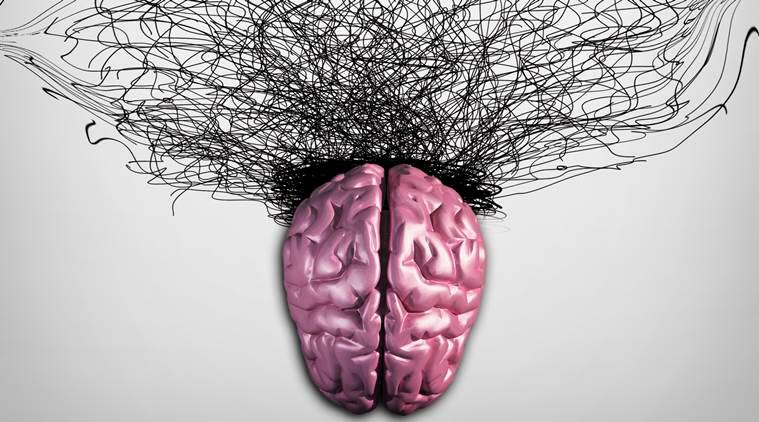
Think….Think….Think…and over a period it will become overthinking. Overthinking causes unnecessary stress. It is not a good habit to possess. You can observe your thoughts clearly when you remain calm.

If you are thinking more than 10 to 15 minutes, it will be about the past happenings or the future or upcoming events. Beauty on overthinking is, you will dwell in the past or future and will not come to the present.

Actually the calmness and steadiness will be in the present and not in past or future. The more you dwell in past or future, observe your breath. It will be restless and will be in abnormal rhythm. This is not good for health. It will create multiple physical and psychological issues.

At this time, you will be emotionally weak. Your decision making will be poor. Thoughts will be like ripples of water when stone is thrown on it. Overthinking will rob your happiness and thoughts will be distorted. Instead of solving the issues, your mind will be wavering. You will become a fearmonger of your own self.

In one of the life skill classes, my mentor taught me that:

Past is like broken glass pot – You cannot fix the broken pot

Future is like cat on the wall – you don’t know where this cat will fall from the wall.

Present is the treasure. – It is right there with you – “The Now” moment.

An easy tip for you to bring yourself back to the present moment is through your breath. Observe your breath. Take few long deep breaths. Settle down and slowly come back to the present moment. It will be challenging while you start practicing. However, it will become a habit on regular practice.

Few things are out of your control and few are in your control. When you understand these TWO differences, life will be easy and it will prevent from overthinking.
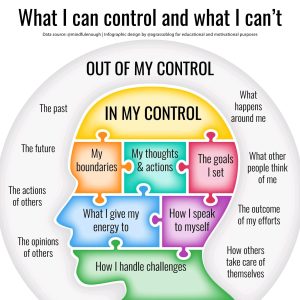
Things that you cannot control:

  • The past, future and it’s occurrences.
  • You cannot control what others are thinking about you or their opinions.
  • Similarly, you cannot control their actions.
  • Whatever is happening around you.
  • Obviously the results of your efforts.

Things that You can control:

  • Your boundaries as where to pitch in and where you should not poke your nose.
  • Your thoughts and actions.
  • Your goals and objectives.
  • Where you should channelize your energy.
  • How you should interact with yourSELF.
  • How do you handles your challenges.

Without having awareness on what you can and cannot control, you will end up in overthinking and your energy will get drained unnecessarily.

Wake up; Shake Up. Be with people who can uplift you morally even in crisis. Surround with positively interacting communities who can see your elevation. Do not do or think anything that harm your mental wellness. Be happy with what you have and even if you do not have anything, be grateful that you have LIFE with you to live to the fullest.

The entire world is creating emotional pollution by accumulating unwanted thought processes and this is not good for the ecosystem. It is right time that we should be in peace and help others to be in peace.

Let’s live in peace and not rest in peace.

Disclaimer: Image credits to the original creator and I, the author of this article doesn’t claim any credit for the images attached.

In Gratitude,

N.R.Rakesh Babu
Psychologist | Doctoral Researcher
www.rakeshbabu.com | www.rbac.in

Meditation Helps in Brain Functions

“Brilliant things happen in calm minds. Be calm. You’re brilliant.”

Hectic Deadlines, arguments, targets, inter-personal and intra-personal issues, social life imbalances, poor work-life balance, dealing with losses etc., creates more stress. Meditation has emerged as an antidote to ubiquitous stress. Meditation is a tool to calm down and help you relax and unwind in just a few minutes.

Approximately there are more than 3,000 scientific studies are done with meditation to prove scientifically that meditation helps our body and mind. The reasons to meditate can be physical, mental, emotional as well as spiritual.

Meditating for minimum 15 – 20 minutes daily for a few weeks brings transformation in our life. When we practice meditation regularly, it helps to:

  • Improve your mental health Reduce anxiety
  • A feel of personal growth
  • Reduce depression
  • Increase your peace of mind
  • Lower levels of stress hormones
  • Get a better quality of life
  • May reduce blood pressure

Effects Of Meditation On Brain:

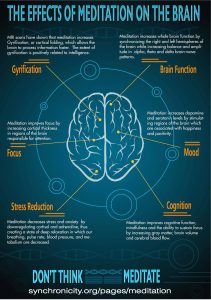
  1. Meditation for Stress Reduction: Meditation helps to decrease the stress revel by regulating the cortisol and adrenaline. It develops a state of deep relaxation in which our breathing, pulse rate, blood pressure are balanced and can helps o bring down to normal rate. When you are stress, check out your pulse rate and breathing pattern, it would be abnormal. Thus, meditation helps in stress reduction.
  2. Meditation Improves Cognition: Meditation helps to improve cognitive function, mindfulness and to focus clearly by increasing the gray matter, brain volume and cerebral blood flow. It has been termed as a powerful fuel to increase your productivity. It also increases the blood flow to brain, it creates a strong network in cerebral cortex and reinforces the memory capacity.
  3. Meditation for Mood Stability: Meditation helps to increase the brain chemicals such as serotonin and dopamine levels by stimulating brain regions which are connected with positivity and happiness. Meditation decreases mood disturbances, anxiety and fatigue. It can also reduce the behavioral anxiety response in psychosocial stress.
  4. Meditation for Laser Sharp Focus: Meditation increases focus and concentration/attention span. By increasing the cortical thickness in the region of brain responsible for attention, focus gets improved. Researchers from Columbia University found that meditation can change the structure and functions of the brain.
  5. Meditation Increases Brain Function: It helps in synchronizing the right and left hemispheres of the brain while increasing balance and amplitude in alpha, theta and delta-wave patterns. Meditation can thicken the pre-frontal cortex. This helps in increased concentration, awareness, execution and decision making.

The above given points are very few to touch upon. However, meditation helps in larger extent for Brain and Mind. There are occasions where meditation can do adverse effect. Meditation can act as a stressor in vulnerable patients who may develop a transient psychosis with polymorphic symptomatology. In such cases, advice from the mental health practitioner helps to put things better. Clinically if it is advised not to meditate, then patients should listen to it.

Learn from the Master: It is good that one can start practicing meditation from a trained master under his supervision rather self-teaching. After a point of time when you practice it with more focus, you may not need the help of instructor. Meditation instructor will help you understand the nuances, science behind the meditation and can clear your doubts if any you have.

Disclaimer: The image has taken from synchronicity website as they have posted it as free image for sharing. Credits to the original creator.

In Gratitude,

N.R.Rakesh Babu
Psychologist | Doctoral Researcher
www.rakeshbabu.com | www.rbac.in
World Brain Day | July 22 | Theme of the Year – “Brain Health For All”

The most fascinating organ in our body is Brain. Most of my articles hovered over BRAIN. It’s “World Brain Day – July 22”. The World Federation of Neurology has declared July 22 as World Brain Day with a bid to increase public awareness and promote advocacy related to brain health.

Theme of this year is “Brain Health For All”. A much needed theme. Not only in the perspectives of the medical importance, but also in the psychological aspect. Actually, it is a resilient year for every one of us after pandemic, a threatening war between Ukraine and Russia, more disease threats and economic imbalances in the World.

To cope with the situation better for the peaceful life is to understand our Brain, it will be easy to handle ourselves better.

According to World Health Organization, Good brain health is a state in which every individual can realize their own abilities and optimize their cognitive, emotional, psychological and behavioral functioning to cope with life situations.

  1. Awareness: Both physiological and psychological significances to be educated and for that more awareness campaigns to be executed.
  2. Resource & Access: Ready reckoners and easily available resources, easy access to rehabilitation and treatment.
  3. Educate: As I mentioned above, education sector should take more care on this. Include scholarly articles, recent researches and updates on Brain in schools and colleges.
  4. Humanity: For optimal Brain Health, more hands to be joined globally.
  5. Prevention: In a recent seminar that I have attended on “Substance Abuse and Brain Damage”, the resource person from India’s renowned Mental Health Organization thrown a light on the mix. He said, many Brain diseases are preventable. Prevention is Better Than Cure.
  6. Feed The Needy: Malnutrition is another alarming area to be looked upon. Multiple sclerosis, Parkinson’s disease, neuroinfections, brain tumors, traumatic injury and neurological disorders are resulting from malnutrition

By dragging attention to this complex organ will emphasize the significance of brain and its vital role in controlling all aspects of collective human life.

Let’s inspire with our action and we can achieve Brain Health for All.

Wishing healthy and peaceful life to everyone!

Disclaimer: Credits to World Federation of Neurology for this wonderful initiative. The image and technically necessary points have been taken from their campaign. The intention is just to promote the awareness about this Special Day. Whole credits to them.

In Gratitude,

N.R.Rakesh Babu
Psychologist | Doctoral Researcher
www.rakeshbabu.com | www.rbac.in