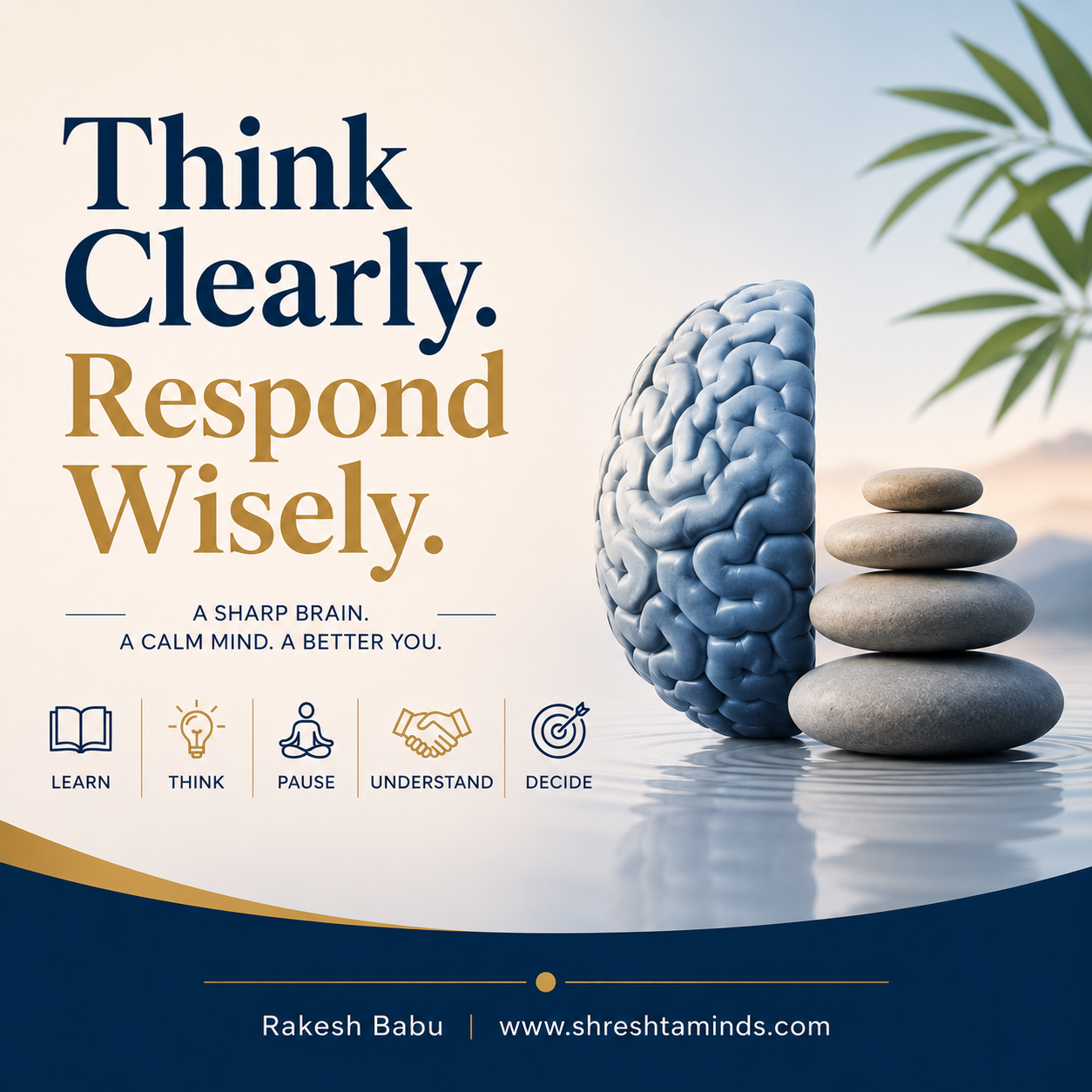
The quiet balance between a sharp brain and a calm mind
We often admire people who have a sharp brain. They learn quickly, understand things easily, solve problems and make decisions with confidence. We also admire people who have a calm mind—those who can remain composed when things go wrong, listen without immediately reacting and handle pressure with steadiness.
But a sharp brain and a calm mind are not the same thing.
A sharp brain helps us think, learn, analyse and solve. A calm mind helps us pause, regulate, listen and respond.
One helps us understand what is happening around us. The other helps us decide how we want to respond to it. And throughout life, we need both.
It Begins with Learning
For a student, a sharp brain can make learning easier. It helps in understanding concepts, connecting ideas, remembering information and solving problems. But intelligence alone does not guarantee good learning.
A student may understand a subject well and still struggle during an examination because of anxiety. Another may be capable of doing much better but become frustrated when something does not come easily.
This is where a calm mind makes a difference. It allows a student to stay with a difficult subject, accept mistakes and try again without immediately feeling defeated.
A sharp brain says, “I can understand this.”
A calm mind says, “Even if I don’t understand it yet, I can keep trying.”
That combination can make learning a much healthier experience.
As a Child, It Shapes Behaviour
Children are naturally curious. Their brains are constantly trying to understand people, situations and the world around them. But understanding something does not mean they can always control their reactions.
A child may know that hitting is wrong and still hit when angry. They may know that shouting is not appropriate and yet shout when frustrated.
We often tell children, “Don’t get angry,” or “Don’t react.” Perhaps what they really need is to learn what to do with the anger.
A calm mind does not mean that a child never becomes angry. It means that, gradually, the child learns to recognise the emotion, pause and express it in a healthier way.
That is not just good behaviour. It is the beginning of emotional maturity.
During the Teenage Years, It Creates Perspective
Teenage years bring a growing desire for independence. Young people want to make their own choices, question things and experience life for themselves. This is a natural and important part of growing up.
A sharp brain can help a teenager think ahead, question assumptions and consider consequences. But emotions, peer influence and the excitement of the moment can sometimes make a decision faster than thoughtful reasoning can catch up.
A calm mind creates that small space between feeling and action.
Someone sends an offensive message. The teenager can immediately respond—but pauses.
A friend suggests something risky. The teenager may be excited—but takes a moment to think about tomorrow.
That pause may take only a few seconds. Yet sometimes, those few seconds can prevent a decision that could take months or years to undo.
In Professional Life, it improves decision-making.
At work, a sharp brain is a valuable asset. We need to analyse information, solve problems, understand people, identify opportunities and make decisions.
But professional life also brings pressure, disagreement, deadlines, criticism and uncertainty.
A person may be highly intelligent and still make a poor decision when angry. Someone may have all the facts and yet allow fear to influence the choice. Another may have a good idea but struggle to communicate it because of insecurity.
A calm mind does not make us less ambitious or less decisive. It gives us the ability to think without allowing the pressure of the moment to take complete control.
The sharp brain asks, “What are my options?”
The calm mind asks, “Which option deserves my response?”
That distinction becomes particularly important in leadership.
And Then Come Our Relationships
Perhaps this is where the balance becomes most meaningful.
When someone disagrees with us, our brain can quickly prepare a defence. We remember what they said yesterday, what happened last month and everything that supports our position.
We may win the argument and still lose something more valuable—the connection.
A sharp brain can help us understand another person’s words. A calm mind helps us listen to the person behind those words.
When a partner says, “You don’t spend enough time with me,” we can immediately explain why that isn’t true. Or we can pause and ask, “What is making you feel this way?”
When a child says something hurtful, we can react to the words—or become curious about the emotion behind them.
When a colleague reacts strongly, we can defend our intention—or first understand their experience.
Being calm does not mean agreeing with everyone. It simply gives us the ability to disagree without losing our balance.
Sometimes, the most intelligent thing we can do in a relationship is not respond immediately.
What Happens When One Is Missing?
A sharp brain without a calm mind can become restless. Thinking can turn into overthinking. Awareness can become constant worry. Intelligence can even become a tool for creating endless possibilities and problems.
On the other hand, calmness without enough mental engagement can sometimes become passivity. “Let it be” is not always wisdom. Some situations need us to think, decide and act.
So the goal is not to make the brain less active or the mind completely free of emotions. The goal is to let each do its work.
Keep the brain active. Keep the mind settled.
Read. Learn. Question. Solve problems. Explore new ideas. These keep the brain sharp.
And also pause. Breathe. Listen. Walk. Spend some time without constant stimulation. Give yourself a moment before reacting. These create space for the mind to settle.
None of this requires us to become a different person overnight. It is simply a practice of becoming more aware of how we think and how we respond.
The Balance We Can Carry Through Life
Student needs a sharp brain to learn and a calm mind to handle the challenges of learning.
Children needs a sharp brain to understand and a calm mind to regulate behaviour.
Teenager needs a sharp brain to think ahead and a calm mind to resist impulsive choices.
Professionals need a sharp brain to solve problems and a calm mind to make balanced decisions.
In relationships, all of us need a sharp brain to understand and a calm mind to respond with sensitivity.
Perhaps that is the balance we should strive for—not a life without problems, pressure or emotions, but the ability to meet them with the right combination of clarity and composure.
“A sharp brain helps us navigate the world. A calm mind helps us navigate ourselves.”
And when the two work together, we don’t simply become better at thinking.
We become better at living. So perhaps the question worth asking ourselves today is not only,
“How sharp is my brain?”
but also,
“How calm is my mind when my brain is at work?”
Because sometimes, the quality of our life depends not merely on how well we think, but on how wisely we respond.
I got this Gyan “Sharp Brain & Calm Mind” as a learning from the Spiritual Leader & Humanitarian Gurudev Sri Sri Ravi Shankar ji.
In Gratitude, Rakesh Babu | Psychologist | www.shreshtaminds.com