Psychology of Maa Kalaratri
Navratri Day 7 | A spiritual reflection on emotional acceptance, self-awareness and inner transformation
Have you ever smiled in front of everyone while carrying something heavy inside? In any other situation, have you ever said, “I am fine,” not because you were fine, but because explaining what you felt seemed more exhausting than hiding it?
Most of us have done this at some point in our lives.
We learn to celebrate happiness, display confidence and appreciate success. But when sadness, jealousy, disappointment, guilt or emotional exhaustion visits us, we often try to push these feelings away.
What we do? We label them as weakness, pretend they do not exist, or distract ourselves until they become difficult to ignore.
But what if the emotions we try so hard to hide are asking us to understand something important about ourselves?
The Divine Meaning of Maa Kalaratri
On the seventh day of Navratri, devotees worship Maa Kalaratri, a powerful and fearsome manifestation of Goddess Durga.
Her dark appearance and fierce form are traditionally associated with the destruction of darkness and the removal of negative forces.
At first glance, her form may appear frightening. Yet, within the devotional understanding of the Goddess, her fierce appearance represents a deeper promise: darkness does not always mean danger, and what appears terrifying may also carry the possibility of transformation.
There is a beautiful psychological reflection here.
Sometimes, the darkness we need to understand is not outside us. It is within our own unexamined thoughts, suppressed emotions, repeated reactions and unresolved disappointments.
Maa Kalaratri invites us to reflect on a difficult but necessary question:
Can we look honestly at ourselves without becoming our own enemy?
The Psychology of Our Inner Darkness
In everyday life, we often divide emotions into two categories: good emotions that we welcome and bad emotions that we want to eliminate.
Happiness is acceptable. Anger is uncomfortable. Confidence is celebrated. Jealousy is hidden. Gratitude is encouraged. Disappointment is sometimes treated as personal failure.
But human emotions are more complex than this.
Feeling jealous does not automatically make someone a bad person. Similarly, feeling angry does not mean a person must behave aggressively.
Disappointment does not mean life has failed. Even experiencing guilt can become an opportunity to recognise a mistake and make amends.
The important question is not simply, “Why am I feeling this?”
It is also, “What am I going to do with this feeling?”
Psychology offers a useful distinction between experiencing an emotion and acting on it. We may not always choose the emotion that arises, but we can gradually learn to respond to it more thoughtfully.
Research found that accepting rather than judging negative thoughts and emotions was associated with better psychological health.
This does not mean that acceptance solves every problem. It suggests that constantly condemning ourselves for what we feel may add another layer of distress to an already difficult experience.
Sometimes, peace begins when we stop fighting the fact that we are human.
Acceptance Is Not Approval
This is where an important distinction must be made.
Accepting anger does not mean justifying hurtful behaviour. And, accepting sadness does not mean giving up on life.
Similarly, accepting disappointment does not mean abandoning our goals. And accepting a difficult situation does not mean tolerating injustice or harm.
However, acceptance simply means acknowledging what is happening within us before deciding what to do next.
Imagine that a colleague receives the recognition you had hoped for. You feel disappointed and perhaps a little jealous.
You could pretend that you feel nothing. Criticising the colleague to make yourself feel better. Or you could pause and acknowledge the truth:
“I am disappointed because this opportunity mattered to me. What can I learn from this experience, and what constructive step can I take next?”
The emotion has not made the decision for you. You have created space to respond with awareness.
That small space between feeling and action can change the direction of a conversation, a relationship and sometimes an entire day.
When Self-Awareness Becomes a Form of Worship
Spirituality often encourages us to look beyond appearances and examine the quality of our inner life.
Psychology, in its own way, also encourages us to observe our thoughts, understand our emotional patterns and recognise how they influence behaviour.
These are not identical approaches, but they can offer complementary perspectives.
For a devotee, Maa Kalaratri may symbolise the divine power that dispels darkness.
As a personal reflection, we can allow that symbolism to remind us to examine the darkness created by resentment, denial, self-deception or unacknowledged pain.
Not to judge ourselves and label ourselves as damaged.
But to understand ourselves more honestly.
The person who recognises their anger can learn to express it responsibly. Those who acknowledge their insecurity can begin developing confidence. Anyone who accepts a mistake can take responsibility and repair the harm.
Awareness does not magically remove every difficulty. It gives us a clearer starting point from which to work.
Perhaps one of the most meaningful spiritual practices is not merely asking for our difficulties to disappear but developing the willingness to meet ourselves truthfully.
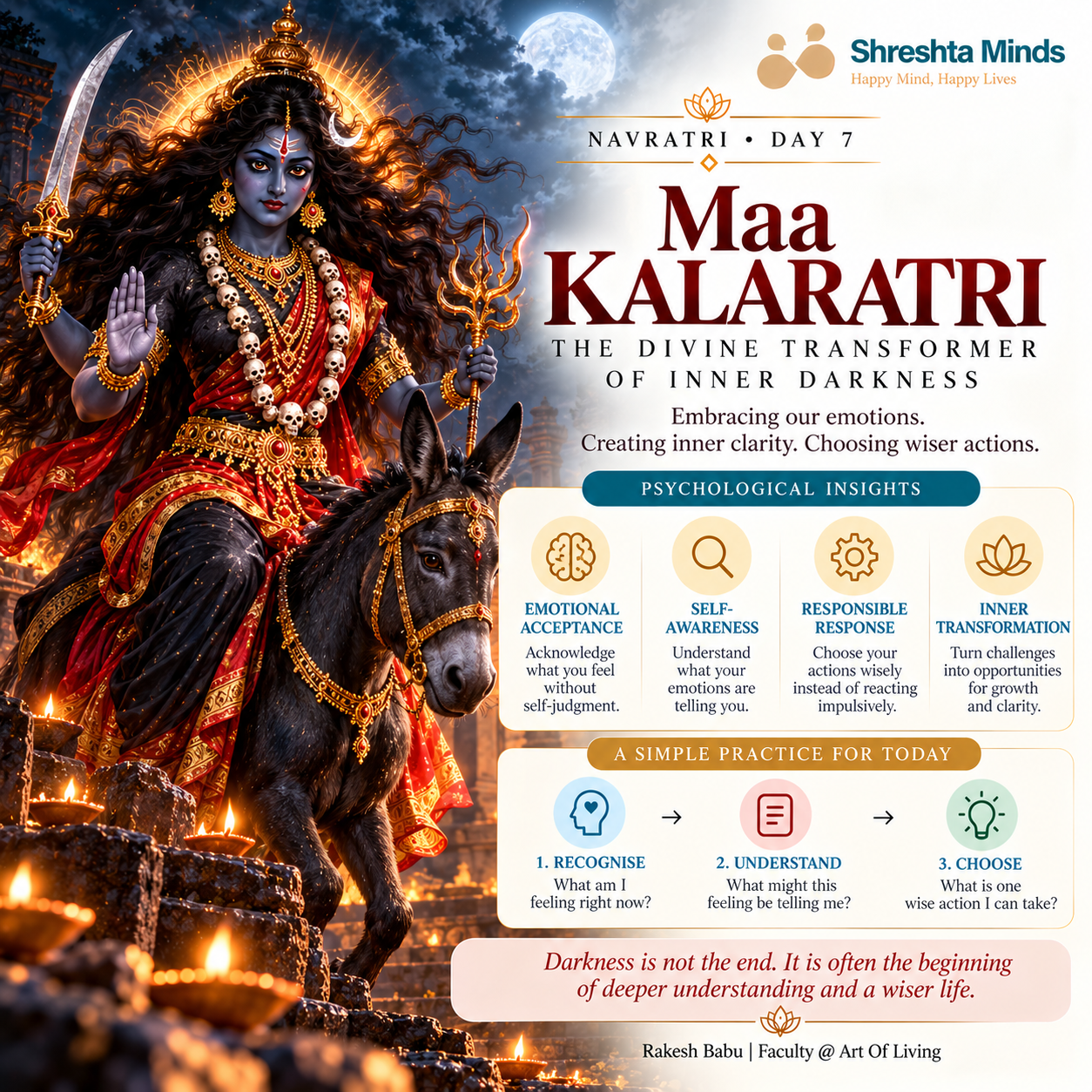
A Small Practice for Today
Take five quiet minutes today. You do not need a special setting or a complicated technique.
Ask yourself these three questions:
1. What am I feeling right now?
Name the emotion as honestly as you can. It may be sadness, irritation, loneliness, gratitude or even confusion.
2. What might this feeling be telling me?
Is there a need you have ignored? A disappointment you have not acknowledged? A conversation you need to have? Or is this simply an uncomfortable emotion that needs time to pass?
You do not need to find a perfect answer.
3. What is one wise action I can take?
Perhaps it is apologising, setting a healthy boundary, asking for help, resting, having an honest conversation or letting go of a thought that is not helping you.
Remember, the purpose is not to analyse every emotion endlessly. It is to acknowledge what you feel and choose your next step with greater clarity.
If an emotion feels overwhelming, persists for a long time or interferes with daily life, seeking support from a qualified mental health professional is also a meaningful act of self-care.
The Light That Begins Within
We often imagine transformation as becoming a completely different person — someone who never gets angry, never feels insecure, never makes mistakes and never struggles.
But perhaps genuine growth is more realistic than that.
It is becoming someone who recognises anger before it becomes cruelty, acknowledges insecurity without surrendering to it, accepts mistakes without losing self-respect, and faces uncomfortable truths without running away.
Maa Kalaratri’s fierce form offers a powerful devotional reminder that darkness need not have the final word.
And in our everyday lives, the same symbolism can inspire a simple practice: stop hiding from every uncomfortable feeling. Understand it. Learn from it. Choose your response.
You do not have to be free from every difficult emotion to move towards a wiser life. Sometimes, the transformation begins when you stop being afraid of what you feel and start becoming responsible for what you do with it.
May this seventh day of Navratri inspire us to look within with honesty, meet ourselves with compassion, and transform awareness into meaningful action.
With devotion and reflection,
Rakesh Babu
Psychologist | Faculty @ The Art Of Living
www.shreshtaminds.com

 We often think we are living our lives through conscious choices, but much of everyday life is quietly shaped beneath awareness.