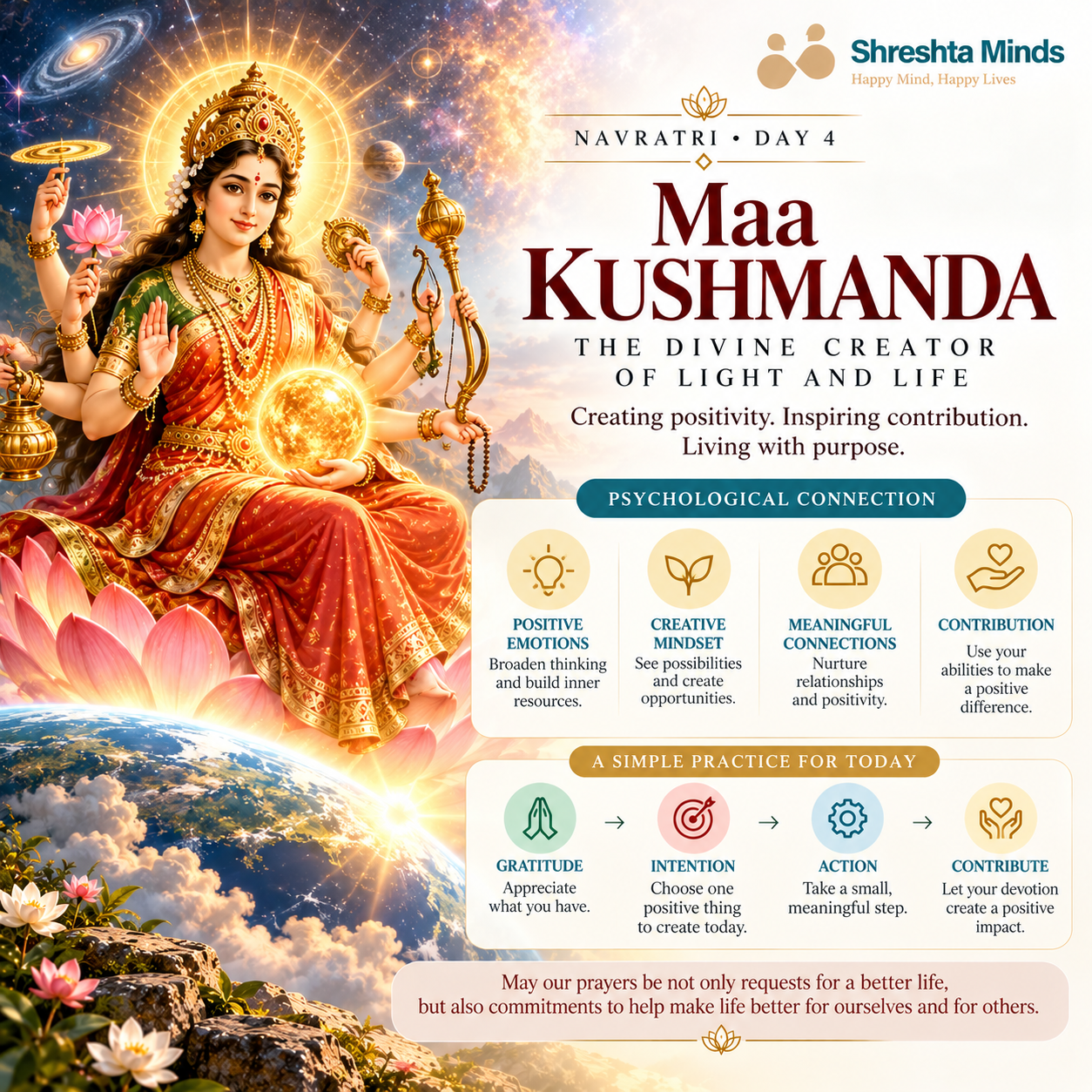
Maa Kushmanda: The Psychology of Creation and the Power of Meaningful Living

“Psychology of Maa Kushmanda”

Navratri Day 4 | From Divine Creation to Human Potential

What are we creating through the way we think, speak and live each day?

On the fourth day of Navratri, devotees worship Maa Kushmanda, traditionally revered as the divine force associated with the creation of the universe. Her radiant form symbolises the emergence of life and light from primordial darkness.

Beyond its spiritual significance, this imagery invites a profound psychological reflection: human beings are not merely experiencing life; through their choices and actions, they are continually shaping it.

Psychology recognises that our experiences are influenced not only by external circumstances but also by how we interpret situations, respond to emotions and engage with others. A kind word can strengthen a relationship. An encouraging response can help someone rediscover confidence. A thoughtful decision can create possibilities where none seemed apparent.

This does not mean that positive thinking can control every outcome. Rather, it reminds us that although we cannot create every circumstance, we can consciously influence what we contribute to it.

Research in positive psychology offers an interesting connection and proposes that positive emotions such as joy, interest and contentment can broaden our momentary thinking and help build enduring psychological and social resources. Positive emotions do not eliminate suffering, but they can support our capacity to explore, connect and respond constructively.

Maa Kushmanda’s symbolism of creation can therefore inspire us to cultivate more than personal happiness. It can encourage us to create understanding instead of unnecessary conflict, opportunities instead of discouragement, and meaningful connections instead of indifference.

This perspective can also transform the way we pray. Instead of asking only, “Mother, what will You give me?”, we may also ask, “Mother, what good can I create with the life, abilities and opportunities I have received?”

Such a prayer does not replace devotion; it gives devotion a practical expression. Gratitude becomes appreciation for what we have. Intention becomes a commitment to constructive action. Faith becomes an inspiration to contribute meaningfully.

A reflection for today: After your prayer, identify one positive thing you can create—a moment of encouragement, an act of generosity, a new idea or a small step towards improving someone’s day. Let your devotion find expression in that action.

Maa Kushmanda reminds us, through her sacred symbolism, of the wonder of creation. Psychology helps us recognise how our emotions, choices and relationships can influence the small world we shape around us.

This Navratri, let our prayers be not only requests for a better life but also commitments to help make life better—for ourselves and for others.

Rakesh Babu
Psychologist | Faculty @ The Art Of Living
www.shreshtaminds.com

Your Brain Is Learning Even When You Are Not Trying to Learn

How do learning and neuroplasticity connect?

We usually think learning happens when we read, study, practice, or consciously try to acquire something new.

But your brain is learning far more than you realize, even when you are not trying to learn.

Every thought you repeat, every response you practice, and every behavior you experience repeatedly leaves an impression on the brain.

This is one of the fascinating realities of neuroplasticity—the brain has the ability to adapt based on experience.

And that means learning is not only about what you intentionally teach yourself.

You may be teaching your brain patience every time you pause before reacting or avoidance every time you repeatedly escape what feels difficult.

You may be building curiosity every time you explore something unfamiliar or rigidity when you repeatedly resist anything that challenges your existing way of thinking.

In other words, everyday life itself can become a training ground for the brain.

This makes learning much bigger than education, because learning can gradually become capacity building.

The more you practice a way of thinking or responding, the more available that capacity may become when you need it.

And when a capacity can be consistently brought into action, it begins to express itself as capability.

Perhaps this is why knowing something does not always mean we can actually do it.

The brain does not simply need information; it needs experience, practice, repetition, and meaningful engagement.

So instead of asking only, “What did I learn today? “Perhaps we should sometimes ask, “What capacity did I build today?”

Because whether we realize it or not, our everyday experiences are constantly shaping what our brain becomes better prepared to do.

And that leaves us with a fascinating question: If your brain is learning every day, what are you teaching it to become?


Enjoying the articles? Leave your comment!

In Love & Gratitude,

Rakesh Babu | Psychologist | www.shreshtaminds.com

The Mentor Who Didn’t Give Answers

Contemplative philosophy in coaching

What if the greatest mentor was not the one who gave the right answers but the one who helped us discover the right questions?

When Arjuna stood on the battlefield of Kurukshetra, he was not lacking knowledge. He was overwhelmed by it.

He knew his duty, the consequences, and what was at stake. Yet, when the moment demanded action, he was confused, emotionally disturbed and unable to move forward.

Krishna did not simply tell him what to do. He mentored him and that distinction has enormous relevance to the contemporary world.

Krishna as a Mentor

What makes Krishna’s mentoring of Arjuna fascinating is that it was not merely about transferring knowledge. It was about transforming the way Arjuna saw himself, his situation and his responsibility.

Lord Krishna listened, questioned, challenged assumptions, and offered different perspectives.

He allowed Arjuna to reflect, and ultimately, he left the decision with Arjuna.

This is very different from the traditional idea of mentoring, where the experienced person says, “I have been through this before. Do what I tell you.” Krishna’s approach was closer to:

“Let me help you see clearly. The decision must become yours.”

That is powerful mentoring.

From Bhagavad Gita to the Contemporary Workplace

Today’s learner does not necessarily need more information.

We already live in an information-rich world.

What people increasingly need is clarity, perspective, self-awareness and the ability to make meaningful decisions.

This is where Krishna’s contemplative approach becomes relevant to Learning & Development.

A good trainer transfers knowledge.

Perfect coach facilitates discovery.

A great mentor helps a person see differently.

The shift is from:

Information → Reflection Instruction → Inquiry Dependency → Ownership Performance → Purpose

What Can L&D Learn From Krishna?

Imagine a leadership programme where the facilitator does not immediately provide solutions to every workplace challenge.

Instead, participants are invited to ask:

What am I seeing? What is within my control? Am I avoiding any responsibilities? What is the right action—not merely the convenient action?

Suddenly, training becomes more than a programme. It becomes a space for inner learning.

This is where contemplative philosophy can enrich contemporary coaching and leadership development.

Reflection can precede action.

Awareness can precede performance.

Purpose can precede goals and responsibility can replace blame.

The Mentor’s Real Work

Perhaps Krishna’s greatest lesson for mentors, coaches and L&D professionals is this:

Your job is not to create followers who depend on your wisdom. Your job is to develop people who can access their own wisdom.

That requires patience & listening.

It requires asking better questions.

Sometimes, it requires the courage to step back and allow the learner to struggle with a question rather than rushing to provide an answer.

The Kurukshetra may have been ancient. But the inner conflict is not.

Every leader, professional, student and human being eventually faces a moment when knowledge alone is not enough.

At that moment, perhaps what we need is not another instructor.

We need a Krishna or Mentor.

Perhaps, in the contemporary world, the real challenge for every mentor is to learn how to become one.

“Close your eyes and let what you just read run through your mind.”

Rakesh Babu | Psychologist | www.shreshtaminds.com