Maa Kalaratri: The Psychology of Embracing Our Inner Darkness

Psychology of Maa Kalaratri

Navratri Day 7 | A spiritual reflection on emotional acceptance, self-awareness and inner transformation

Have you ever smiled in front of everyone while carrying something heavy inside? In any other situation, have you ever said, “I am fine,” not because you were fine, but because explaining what you felt seemed more exhausting than hiding it?

Most of us have done this at some point in our lives.

We learn to celebrate happiness, display confidence and appreciate success. But when sadness, jealousy, disappointment, guilt or emotional exhaustion visits us, we often try to push these feelings away.

What we do? We label them as weakness, pretend they do not exist, or distract ourselves until they become difficult to ignore.

But what if the emotions we try so hard to hide are asking us to understand something important about ourselves?

The Divine Meaning of Maa Kalaratri

On the seventh day of Navratri, devotees worship Maa Kalaratri, a powerful and fearsome manifestation of Goddess Durga.

Her dark appearance and fierce form are traditionally associated with the destruction of darkness and the removal of negative forces.

At first glance, her form may appear frightening. Yet, within the devotional understanding of the Goddess, her fierce appearance represents a deeper promise: darkness does not always mean danger, and what appears terrifying may also carry the possibility of transformation.

There is a beautiful psychological reflection here.

Sometimes, the darkness we need to understand is not outside us. It is within our own unexamined thoughts, suppressed emotions, repeated reactions and unresolved disappointments.

Maa Kalaratri invites us to reflect on a difficult but necessary question:

Can we look honestly at ourselves without becoming our own enemy?

The Psychology of Our Inner Darkness

In everyday life, we often divide emotions into two categories: good emotions that we welcome and bad emotions that we want to eliminate.

Happiness is acceptable. Anger is uncomfortable. Confidence is celebrated. Jealousy is hidden. Gratitude is encouraged. Disappointment is sometimes treated as personal failure.

But human emotions are more complex than this.

Feeling jealous does not automatically make someone a bad person. Similarly, feeling angry does not mean a person must behave aggressively.

Disappointment does not mean life has failed. Even experiencing guilt can become an opportunity to recognise a mistake and make amends.

The important question is not simply, “Why am I feeling this?”

It is also, “What am I going to do with this feeling?”

Psychology offers a useful distinction between experiencing an emotion and acting on it. We may not always choose the emotion that arises, but we can gradually learn to respond to it more thoughtfully.

Research found that accepting rather than judging negative thoughts and emotions was associated with better psychological health.

This does not mean that acceptance solves every problem. It suggests that constantly condemning ourselves for what we feel may add another layer of distress to an already difficult experience.

Sometimes, peace begins when we stop fighting the fact that we are human.

Acceptance Is Not Approval

This is where an important distinction must be made.

Accepting anger does not mean justifying hurtful behaviour. And, accepting sadness does not mean giving up on life.

Similarly, accepting disappointment does not mean abandoning our goals. And accepting a difficult situation does not mean tolerating injustice or harm.

However, acceptance simply means acknowledging what is happening within us before deciding what to do next.

Imagine that a colleague receives the recognition you had hoped for. You feel disappointed and perhaps a little jealous.

You could pretend that you feel nothing. Criticising the colleague to make yourself feel better. Or you could pause and acknowledge the truth:

“I am disappointed because this opportunity mattered to me. What can I learn from this experience, and what constructive step can I take next?”

The emotion has not made the decision for you. You have created space to respond with awareness.

That small space between feeling and action can change the direction of a conversation, a relationship and sometimes an entire day.

When Self-Awareness Becomes a Form of Worship

Spirituality often encourages us to look beyond appearances and examine the quality of our inner life.

Psychology, in its own way, also encourages us to observe our thoughts, understand our emotional patterns and recognise how they influence behaviour.

These are not identical approaches, but they can offer complementary perspectives.

For a devotee, Maa Kalaratri may symbolise the divine power that dispels darkness.

As a personal reflection, we can allow that symbolism to remind us to examine the darkness created by resentment, denial, self-deception or unacknowledged pain.

Not to judge ourselves and label ourselves as damaged.

But to understand ourselves more honestly.

The person who recognises their anger can learn to express it responsibly. Those who acknowledge their insecurity can begin developing confidence. Anyone who accepts a mistake can take responsibility and repair the harm.

Awareness does not magically remove every difficulty. It gives us a clearer starting point from which to work.

Perhaps one of the most meaningful spiritual practices is not merely asking for our difficulties to disappear but developing the willingness to meet ourselves truthfully.

A Small Practice for Today

Take five quiet minutes today. You do not need a special setting or a complicated technique.

Ask yourself these three questions:

1. What am I feeling right now?

Name the emotion as honestly as you can. It may be sadness, irritation, loneliness, gratitude or even confusion.

2. What might this feeling be telling me?

Is there a need you have ignored? A disappointment you have not acknowledged? A conversation you need to have? Or is this simply an uncomfortable emotion that needs time to pass?

You do not need to find a perfect answer.

3. What is one wise action I can take?

Perhaps it is apologising, setting a healthy boundary, asking for help, resting, having an honest conversation or letting go of a thought that is not helping you.

Remember, the purpose is not to analyse every emotion endlessly. It is to acknowledge what you feel and choose your next step with greater clarity.

If an emotion feels overwhelming, persists for a long time or interferes with daily life, seeking support from a qualified mental health professional is also a meaningful act of self-care.

The Light That Begins Within

We often imagine transformation as becoming a completely different person — someone who never gets angry, never feels insecure, never makes mistakes and never struggles.

But perhaps genuine growth is more realistic than that.

It is becoming someone who recognises anger before it becomes cruelty, acknowledges insecurity without surrendering to it, accepts mistakes without losing self-respect, and faces uncomfortable truths without running away.

Maa Kalaratri’s fierce form offers a powerful devotional reminder that darkness need not have the final word.

And in our everyday lives, the same symbolism can inspire a simple practice: stop hiding from every uncomfortable feeling. Understand it. Learn from it. Choose your response.

You do not have to be free from every difficult emotion to move towards a wiser life. Sometimes, the transformation begins when you stop being afraid of what you feel and start becoming responsible for what you do with it.

May this seventh day of Navratri inspire us to look within with honesty, meet ourselves with compassion, and transform awareness into meaningful action.

With devotion and reflection,

Rakesh Babu
Psychologist | Faculty @ The Art Of Living

www.shreshtaminds.com

Radha & Dhara: The Direction of the Mind

Self-awareness in Decision Making!

Dhara represents the outward flow—the mind constantly moving toward people, problems, possessions, information and expectations.

Our attention naturally flows outward, responding to everything happening around us.

But there is another movement: Radha—the symbolic journey of returning toward the source within.

Psychologically, this can be understood as the ability to pause and observe what is happening inside us.

Before reacting to a situation, we can notice our thoughts, emotions, assumptions and impulses.

That small inward movement can create something powerful: awareness.

In the workplace, this becomes especially important when pressure, conflict or uncertainty demands an immediate response.

A reactive mind flows directly from stimulus to behavior.

A conscious mind creates a space between what happens and how it chooses to respond.

That space is where emotional regulation, reflection, and better decision-making begin.

A leader who can return inward is less likely to be controlled by every external disturbance.

The same principle applies to careers, relationships, and everyday choices.

The objective is not to stop the outward flow of life.

It is to learn the rhythm of moving outward, returning inward, and moving outward again with greater clarity.

Dhara → Radha → Dhara.

Experience → Awareness → Response.

Perhaps growth is not about controlling the world outside us.

Perhaps it begins with learning when to return to the world within us.


Enjoying it? Comment your thoughts.

In Love & Gratitude,

Rakesh Babu | Psychologist | www.shreshtaminds.com

When Emotions Take Over, Don’t Let Them Take You Away From Yourself

Emotional imbalance does not always come from emotional turbulence.

Sometimes, it comes from being emotionally overwhelmed—even by positive emotions.

In both situations, we can temporarily lose touch with ourselves.

We may forget our patterns, our strengths, our talents, and even our past experiences. For a few moments, the situation feels bigger than our ability to handle it.

The first thing to do is simple: stay calm for a few minutes.
Don’t react immediately when your emotions are taking over.

  • Give yourself some space to breathe, pause, and settle down.
  • Once you are calmer, try to regain some emotional and cognitive balance.
  • A balanced mind can see possibilities that an overwhelmed mind cannot.

Then ask yourself, “What are the possible ways I can sort this out?”

Because sometimes, the problem itself carries a clue to its solution.

The problem may be pointing towards a pattern that needs to change, a choice that needs to be made, or a perspective that needs to shift.

In that sense, the problem is not always just an obstacle; sometimes, it is also the key.

When we think deeply and calmly, our thinking can reorganize and become more flexible.

This is where our brain’s natural capacity to adapt and learn can support us.

And remember, you don’t have to solve everything by yourself.

If you cannot find a way forward with your own abilities, seek support from an expert.

Sometimes, another person simply sees what we could not see because we were too close to the situation.

Until that point, there is much within our hands: calm down, regain balance, and think.

And if nothing works, that’s okay—sometimes a fresh pair of eyes is all we need to find our way again.


In Love & Gratitude, Rakesh Babu | www.shreshtaminds.com

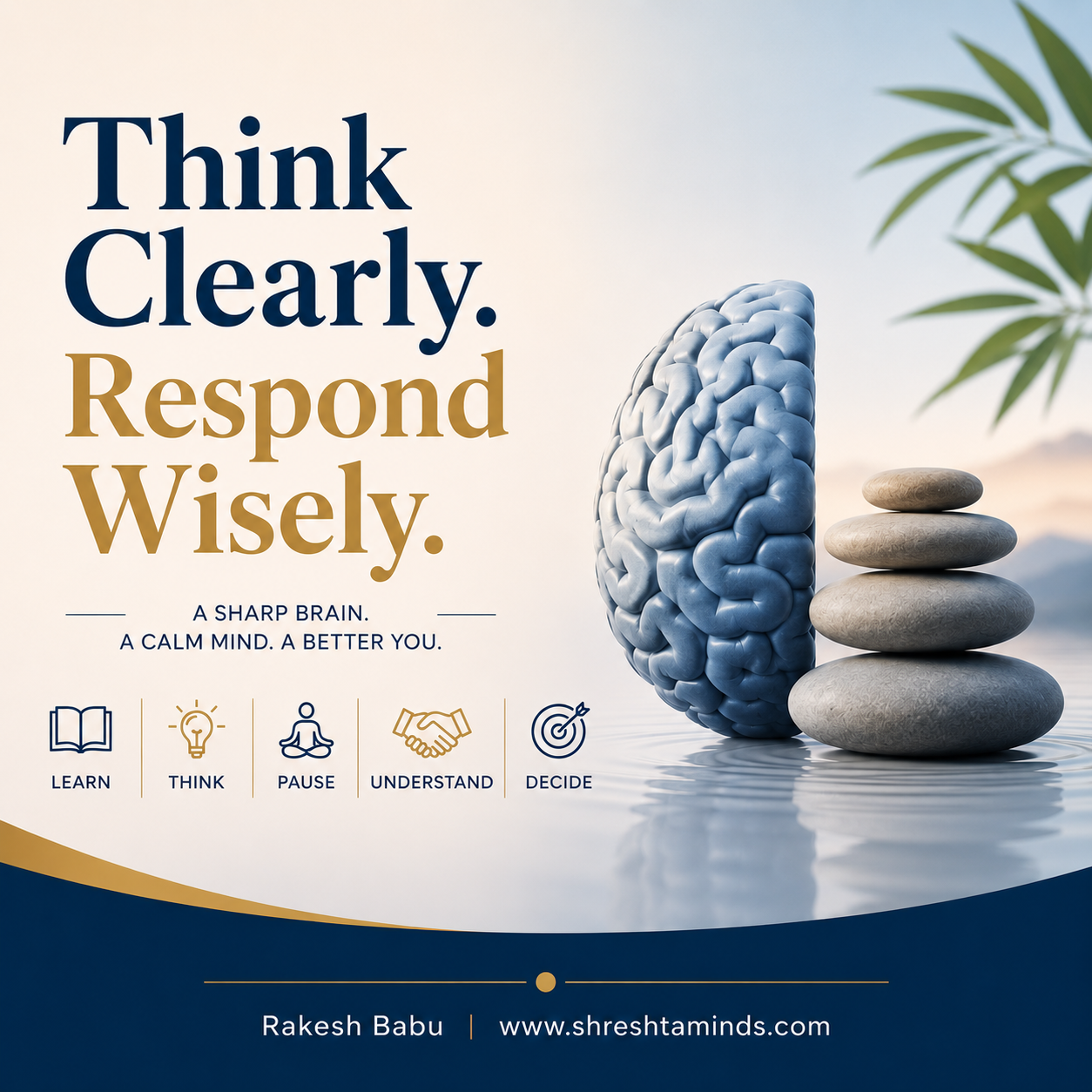
Think Clearly. Respond Wisely.

The quiet balance between a sharp brain and a calm mind

We often admire people who have a sharp brain. They learn quickly, understand things easily, solve problems and make decisions with confidence. We also admire people who have a calm mind—those who can remain composed when things go wrong, listen without immediately reacting and handle pressure with steadiness.

But a sharp brain and a calm mind are not the same thing.

A sharp brain helps us think, learn, analyse and solve. A calm mind helps us pause, regulate, listen and respond.

One helps us understand what is happening around us. The other helps us decide how we want to respond to it. And throughout life, we need both.

It Begins with Learning

For a student, a sharp brain can make learning easier. It helps in understanding concepts, connecting ideas, remembering information and solving problems. But intelligence alone does not guarantee good learning.

A student may understand a subject well and still struggle during an examination because of anxiety. Another may be capable of doing much better but become frustrated when something does not come easily.

This is where a calm mind makes a difference. It allows a student to stay with a difficult subject, accept mistakes and try again without immediately feeling defeated.

A sharp brain says, “I can understand this.”

A calm mind says, “Even if I don’t understand it yet, I can keep trying.”

That combination can make learning a much healthier experience.

As a Child, It Shapes Behaviour

Children are naturally curious. Their brains are constantly trying to understand people, situations and the world around them. But understanding something does not mean they can always control their reactions.

A child may know that hitting is wrong and still hit when angry. They may know that shouting is not appropriate and yet shout when frustrated.

We often tell children, “Don’t get angry,” or “Don’t react.” Perhaps what they really need is to learn what to do with the anger.

A calm mind does not mean that a child never becomes angry. It means that, gradually, the child learns to recognise the emotion, pause and express it in a healthier way.

That is not just good behaviour. It is the beginning of emotional maturity.

During the Teenage Years, It Creates Perspective

Teenage years bring a growing desire for independence. Young people want to make their own choices, question things and experience life for themselves. This is a natural and important part of growing up.

A sharp brain can help a teenager think ahead, question assumptions and consider consequences. But emotions, peer influence and the excitement of the moment can sometimes make a decision faster than thoughtful reasoning can catch up.

A calm mind creates that small space between feeling and action.

Someone sends an offensive message. The teenager can immediately respond—but pauses.

A friend suggests something risky. The teenager may be excited—but takes a moment to think about tomorrow.

That pause may take only a few seconds. Yet sometimes, those few seconds can prevent a decision that could take months or years to undo.

In Professional Life, it improves decision-making.

At work, a sharp brain is a valuable asset. We need to analyse information, solve problems, understand people, identify opportunities and make decisions.

But professional life also brings pressure, disagreement, deadlines, criticism and uncertainty.

A person may be highly intelligent and still make a poor decision when angry. Someone may have all the facts and yet allow fear to influence the choice. Another may have a good idea but struggle to communicate it because of insecurity.

A calm mind does not make us less ambitious or less decisive. It gives us the ability to think without allowing the pressure of the moment to take complete control.

The sharp brain asks, “What are my options?”

The calm mind asks, “Which option deserves my response?”

That distinction becomes particularly important in leadership.

And Then Come Our Relationships

Perhaps this is where the balance becomes most meaningful.

When someone disagrees with us, our brain can quickly prepare a defence. We remember what they said yesterday, what happened last month and everything that supports our position.

We may win the argument and still lose something more valuable—the connection.

A sharp brain can help us understand another person’s words. A calm mind helps us listen to the person behind those words.

When a partner says, “You don’t spend enough time with me,” we can immediately explain why that isn’t true. Or we can pause and ask, “What is making you feel this way?”

When a child says something hurtful, we can react to the words—or become curious about the emotion behind them.

When a colleague reacts strongly, we can defend our intention—or first understand their experience.

Being calm does not mean agreeing with everyone. It simply gives us the ability to disagree without losing our balance.

Sometimes, the most intelligent thing we can do in a relationship is not respond immediately.

What Happens When One Is Missing?

A sharp brain without a calm mind can become restless. Thinking can turn into overthinking. Awareness can become constant worry. Intelligence can even become a tool for creating endless possibilities and problems.

On the other hand, calmness without enough mental engagement can sometimes become passivity. “Let it be” is not always wisdom. Some situations need us to think, decide and act.

So the goal is not to make the brain less active or the mind completely free of emotions. The goal is to let each do its work.

Keep the brain active. Keep the mind settled.

Read. Learn. Question. Solve problems. Explore new ideas. These keep the brain sharp.

And also pause. Breathe. Listen. Walk. Spend some time without constant stimulation. Give yourself a moment before reacting. These create space for the mind to settle.

None of this requires us to become a different person overnight. It is simply a practice of becoming more aware of how we think and how we respond.

The Balance We Can Carry Through Life

Student needs a sharp brain to learn and a calm mind to handle the challenges of learning.

Children needs a sharp brain to understand and a calm mind to regulate behaviour.

Teenager needs a sharp brain to think ahead and a calm mind to resist impulsive choices.

Professionals need a sharp brain to solve problems and a calm mind to make balanced decisions.

In relationships, all of us need a sharp brain to understand and a calm mind to respond with sensitivity.

Perhaps that is the balance we should strive for—not a life without problems, pressure or emotions, but the ability to meet them with the right combination of clarity and composure.

“A sharp brain helps us navigate the world. A calm mind helps us navigate ourselves.”

And when the two work together, we don’t simply become better at thinking.

We become better at living. So perhaps the question worth asking ourselves today is not only,

“How sharp is my brain?”

but also,

“How calm is my mind when my brain is at work?”

Because sometimes, the quality of our life depends not merely on how well we think, but on how wisely we respond.

I got this Gyan “Sharp Brain & Calm Mind” as a learning from the Spiritual Leader & Humanitarian Gurudev Sri Sri Ravi Shankar ji.

In Gratitude, Rakesh Babu | Psychologist | www.shreshtaminds.com