Radha & Dhara: The Direction of the Mind

Self-awareness in Decision Making!

Dhara represents the outward flow—the mind constantly moving toward people, problems, possessions, information and expectations.

Our attention naturally flows outward, responding to everything happening around us.

But there is another movement: Radha—the symbolic journey of returning toward the source within.

Psychologically, this can be understood as the ability to pause and observe what is happening inside us.

Before reacting to a situation, we can notice our thoughts, emotions, assumptions and impulses.

That small inward movement can create something powerful: awareness.

In the workplace, this becomes especially important when pressure, conflict or uncertainty demands an immediate response.

A reactive mind flows directly from stimulus to behavior.

A conscious mind creates a space between what happens and how it chooses to respond.

That space is where emotional regulation, reflection, and better decision-making begin.

A leader who can return inward is less likely to be controlled by every external disturbance.

The same principle applies to careers, relationships, and everyday choices.

The objective is not to stop the outward flow of life.

It is to learn the rhythm of moving outward, returning inward, and moving outward again with greater clarity.

Dhara → Radha → Dhara.

Experience → Awareness → Response.

Perhaps growth is not about controlling the world outside us.

Perhaps it begins with learning when to return to the world within us.


Enjoying it? Comment your thoughts.

In Love & Gratitude,

Rakesh Babu | Psychologist | www.shreshtaminds.com

The Architecture of Overthinking

How to stop overthinking!

Have you ever noticed how one small thought can become a full-blown story in your mind?

A message goes unanswered.
The conversation feels slightly different.
Decision keeps replaying in your head.

And suddenly, your mind is running through possibilities that haven’t even happened.

That is the architecture of overthinking. The interesting part is—you don’t have to silence your mind.

You have to understand how the pattern is built.

Overthinking rarely begins with a big problem; it often begins with a single thought.

Something happens, and the mind immediately starts searching for meaning.

We interpret the event through our beliefs, experiences, fears, and expectations.

That interpretation creates an emotional response.

The emotion then makes the original thought feel even more important.

So, we revisit it—again and again—hoping that repetition will give us certainty.

But repetition doesn’t always create clarity; sometimes, it creates amplification.

A small possibility becomes a probable outcome, and a probable outcome becomes a frightening certainty.

This is where overthinking begins to feel like problem-solving.

Yet thinking more does not necessarily mean thinking better.

The turning point comes when we develop awareness of the pattern.

Awareness creates a small but powerful pause between the thought and our reaction.

Inside that pause lies something we often forget: choice.

We may not control every thought that enters our mind, but we can influence what we do with it.

Questioning the thought instead of automatically believing it.

We can separate facts from assumptions, possibilities from probabilities, and fears from reality.

“Choose a response instead of endlessly rehearsing the problem.”

That is how the journey moves from overthinking to awareness, from awareness to clarity, and from clarity to action.

A calmer mind isn’t a mind without thoughts; it is a mind that doesn’t have to obey every thought.

Think. Pause. Question. Choose. Act. — Better Thinking. Better Decisions. Better Outcomes.


In Love & Gratitude, Rakesh Babu | Psychologist | www.shreshtaminds.com 

When the Mind Rises: 10 Metaphors for an Elevated Mood

What if your mood could feel like sunlight entering a room after a long night?

An elevated mood is more than just being happy—it is that subtle shift within us when the mind feels lighter, thoughts become brighter, and life suddenly seems a little more possible.

🌤️ Elevated Mood — 10 Metaphors

  1. A Window Opening After Rain The mind feels fresh, clear, and ready to welcome the world again.

  2. Sunlight Entering a Quiet Room Positive energy gently fills spaces that once felt dull.

  3. A Bird Finding Its Wings The mind feels lighter, freer, and more capable of moving forward.

  4. A River Flowing Without Rocks Thoughts and emotions move smoothly without unnecessary resistance.

  5. A Lamp Burning Brighter Inner energy increases, making everything around you feel more hopeful.

  6. Clouds Making Way for the Sky Heavy emotions begin to fade, revealing a clearer emotional space.

  7. A Garden Suddenly in Bloom Joy, enthusiasm, and emotional warmth begin appearing naturally.

  8. A Song Finding Its Rhythm Your thoughts, emotions, and actions begin moving in greater harmony.

  9. A Kite Catching the Right Wind The right emotional momentum lifts your confidence and motivation.

  10. A Door Opening to Morning Possibility replaces limitation, and the future starts feeling brighter.

Core thought: An elevated mood is not simply “feeling happy”; it is the experience of the mind becoming lighter, more energetic, hopeful, and receptive to life.


In Love & Gratitude, Rakesh Babu | Psychologist | www.shreshtaminds.com

When Emotions Take Over, Don’t Let Them Take You Away From Yourself

Emotional imbalance does not always come from emotional turbulence.

Sometimes, it comes from being emotionally overwhelmed—even by positive emotions.

In both situations, we can temporarily lose touch with ourselves.

We may forget our patterns, our strengths, our talents, and even our past experiences. For a few moments, the situation feels bigger than our ability to handle it.

The first thing to do is simple: stay calm for a few minutes.
Don’t react immediately when your emotions are taking over.

  • Give yourself some space to breathe, pause, and settle down.
  • Once you are calmer, try to regain some emotional and cognitive balance.
  • A balanced mind can see possibilities that an overwhelmed mind cannot.

Then ask yourself, “What are the possible ways I can sort this out?”

Because sometimes, the problem itself carries a clue to its solution.

The problem may be pointing towards a pattern that needs to change, a choice that needs to be made, or a perspective that needs to shift.

In that sense, the problem is not always just an obstacle; sometimes, it is also the key.

When we think deeply and calmly, our thinking can reorganize and become more flexible.

This is where our brain’s natural capacity to adapt and learn can support us.

And remember, you don’t have to solve everything by yourself.

If you cannot find a way forward with your own abilities, seek support from an expert.

Sometimes, another person simply sees what we could not see because we were too close to the situation.

Until that point, there is much within our hands: calm down, regain balance, and think.

And if nothing works, that’s okay—sometimes a fresh pair of eyes is all we need to find our way again.


In Love & Gratitude, Rakesh Babu | www.shreshtaminds.com

The Five Kleshas at Work

What is really getting in our way?

We often think workplace productivity is about time management, technology, skills and targets. But sometimes, the biggest obstacle is not the workload.

It is the mind carrying unnecessary psychological weight.

An ancient framework called Pancha Kleshas describes five patterns that can disturb our clarity. We don’t have to approach them academically or spiritually. Look at them through the lens of everyday corporate life, and they become surprisingly practical.

1. Avidya (Ignorance) — “Am I seeing this clearly?”

At work, it can be as simple as mistaking our interpretation for reality.

“My manager doesn’t value me.”

“The team isn’t committed.”

“She is deliberately ignoring me.”

“He doesn’t respect my ideas.”

But do we actually know that?

When assumptions become facts in our mind, our decisions follow those assumptions.

The shift: Before reacting, ask, “What are the facts, and what am I adding to them?”

Clarity improves when assumptions reduce.

2. Asmita (Asmita = Egoism) — “Am I taking this personally?”

Someone rejects our idea and sometimes corrects our work. A colleague gets the promotion we expected.

Why does it sometimes hurt so much?

Because somewhere, “my work” has become “me”.

Our designation, expertise, achievements and opinions can become part of our identity. Then feedback feels like criticism of our worth.

The shift: Separate who you are from what you did.

An idea can be wrong without making you incapable. A mistake can happen without making you a failure. When identity becomes less fragile, learning becomes easier.

3. Raga (Attachment) — “Do I need this outcome?”

We all have ambitions. A promotion. Recognition. A particular role. Appreciation. Success.

There is nothing wrong with wanting these things.

The problem begins when:

“I want this” becomes “I must have this.”

Now our peace depends on an external outcome. We become anxious when someone else succeeds. Frustrated when our plans change. Disappointed when recognition doesn’t come.

The shift: Give your best to the process, but don’t make your emotional well-being completely dependent on the result.

Ambition needs direction. Attachment needs awareness.

4. Dvesha (Aversion) — “Am I avoiding what I dislike?”

I don’t like working with that person. I hate presenting. I don’t want to learn this. This is not how we do things.

Sometimes our dislike is justified.

But sometimes, discomfort becomes a reason to stop growing.

We avoid difficult conversations and unfamiliar responsibilities. We avoid people who challenge us. And slowly, our comfort zone becomes our limitation.

The shift: Replace immediate rejection with curiosity.

Ask:

“What exactly am I uncomfortable with?”

Not everything uncomfortable is harmful.

Sometimes, discomfort is simply growth wearing an unfamiliar face.

5. Abhinivesha (Fear of Death/Losing) — “What am I afraid of losing?”

Traditionally, Abhinivesha is associated with a deep fear of death and clinging to life.

In professional life, we can recognise a related pattern in our fear of losing security, status, identity or familiarity.

Fear of failure, losing a job, becoming irrelevant, changing careers & taking a risk.

Sometimes we remain in a situation we have outgrown simply because the unknown feels more frightening than the familiar.

The shift: Instead of asking,

“What if I lose this?”

Ask:

“If things change, can I learn, adapt and find my way forward?”

That question builds a different kind of security — inner security.

So, How Do We Come Out of These Patterns?

Not by fighting ourselves, not by suppressing emotions, not by pretending to be unaffected.

Three simple practices can help.

Awareness

Notice before you react.

What is happening inside me right now?

Is it ego? Attachment? Aversion? Fear?

Abhyasa — Consistent Practice

Reflection, meditation, journaling and mindful observation are not merely personal wellness practices.

They train us to pause before reacting.

And that pause can improve decisions, relationships and leadership.

Vairagya — Healthy Detachment

Work sincerely. Aim high. Care deeply.

But don’t make your identity, happiness or self-worth completely dependent on outcomes.

Hold your goals firmly. Hold your identity lightly.

The Workplace Impact

The clearer we see, decision-making improves. Ego becomes lighter; learning improves. When attachment reduces, clarity improves. Aversion reduces; collaboration improves. The moment fear reduces, courage improves.

And when these improve, productivity often follows organically.

Perhaps professional growth is not always about adding more skills, more strategies or more pressure. Sometimes, it is about removing what is standing in the way.

Less assumption. Less ego. Less attachment. Less resistance. Less fear.

And more:

Awareness. Clarity. Adaptability. Confidence.

The next time something at work triggers a strong reaction, pause for a moment and ask:

“Is the situation creating my reaction — or is something within me adding to it?”

That one question can change the quality of our response.

And sometimes, changing our response is the beginning of changing our professional life.

Think…Contemplate…Live…

In Love & Gratitude, Rakesh Babu | Psychologist | www.shreshtaminds.com

Balanced EQ for Happy SELF!

“IQ is Important but EQ is Sine Qua Non of Leadership!” – Daniel Goleman

Without Love and Compassion, we are going to win nothing in this world. I strongly believe in this. Every other aspects of our life is important in a right proportion. The one with more love is more stronger.

As we grow big, we love to lead happy life. For a happy life, as Daniel Goleman Said, Emotional Quotient is important as much as Intelligence Quotient.

EQ is the ability to understand, utilize & manage your own emotions in better ways to de-stress, effective communication, empathize with others and to overcome challenges in day-to-day life.

When we know how to improve our EQ, it helps us to build ourself a better version in terms of intra-personal, inter-personal relationships and to achieve our goals.

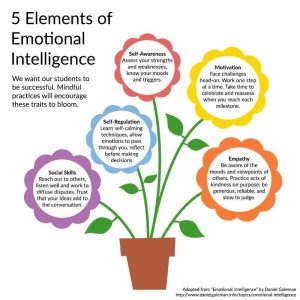
FIVE Elements of Emotional Intelligence are:

  1. Self-Awareness: A person with emotional self-awareness is usually receptive to, and able to learn from, constructive criticism more than one who doesn’t have emotional self-awareness.
  2. Self-Regulation: A person with a high emotional intelligence has the ability to exercise restraint and control when expressing their emotions.
  3. Social Skills: People who are emotionally intelligent are able to build trust with other people, and are able to quickly gain respect from the people they meet.
  4. Empathy: An empathetic person has compassion and is able to connect with other people on an emotional level, helping them respond genuinely to other people’s concerns.
  5. Motivation: People with high emotional intelligence are self-motivated, resilient and driven by an inner ambition rather than being influenced by outside forces, such as money or prestige.

Balanced EQ for Happy SELF!

S – Stress Free

E – Emotionally Stable

L – Locus Of Control

F – Fantabulous Life Guaranteed

#emotionalintelligence #motivation #leadership #empathy #love #communication #intelligence #psychology #psychologists #linkedinlearning #linkedIn #linkedincontent #research #scholar #phd #self #IQ #EQ #stressfreelife #hapylife

In #Gratitude,
N.R.Rakesh Babu
Psychologist | Doctoral Researcher
www.rakeshbabu.com | www.rbac.in

Garbage Truck Theory!

“What if you could take control of your life with one decision? You Can.” – David J. Pollay


How often does a bad driver, rude waiter, curt boss, or an insensitive relative ruin your day with a thoughtless action, an angry rant, or a snide remark? And how often have you ruined someone else’s day?

In The Law of the Garbage Truck, David J. Pollay shows us that by refusing to let others dump their “garbage” (negativity, anger, resentment) on us-and letting it “pass by” instead-we become happier and more successful, both personally and professionally. And when we stop dumping garbage on others, we improve our relationships, strengthen our businesses, and bring our communities together.

Twenty years ago, while riding in a New York City taxi, syndicated columnist and business consultant David J. Pollay narrowly escaped a life-threatening car crash. The driver who almost caused the accident and started yelling at the cab driver, who remarkably just smiled, waved, and wished him well. Pollay asked how the cabbie could remain so calm, and his response sparked the defining principle of The Law of the Garbage Truck.

Many people are like garbage trucks. They run around full of garbage, full of frustration, full of anger, and full of disappointment…And if you let them, they’ll dump it on you. So when someone wants to dump on you, don’t take it personally…move on.

Now Pollay shows you how to apply his Law in this remarkable audio book that can help you:

• Avoid getting dumped on by rude, thoughtless, and angry people

• Stop reliving the negative in your past, and fearing the future

• Focus on what you can control, not the negative things you can’t

• Reduce incivility wherever you find it, and stop bullies in their tracks

• Improve your relationships by not dumping on your friends, parents, spouse or coworkers

• Find happiness again after dealing with illness, loss, and personal tragedy

• Increase productivity, respect, and cooperation by creating a No Garbage Trucks! Zone in your business, school, and home

• Gain the courage to enjoy every day, do what you love, and make a difference

© 2010 Ascent Audio (Audiobook) ISBN: 9781596596023

Anger – “D”anger!

“Anger is One Letter Short of Danger! – Eleanor Roosevelt”

Anger can create any sort of Danger at any point of time, as it is one of the challenging emotions that we deal with. When we are angry, our mind is not in our control and it will be like a vortex. To calm down the vortex, we should be still and calm for sometime. It helps to come out of the Danger Zone.

Anger leads to poor choice of words while we talk, poor decision through thought process, it can break the relationships.

So long as we don’t know how the anger affects our body and mind, we don’t deal with it properly. That’s the truth. In this article, I help the readers to demonstrate with the help of the picture which I got it from NICABM.

Emotional Vortex not only stir your mind but also the body! I re-iterate this Mind-Body connection in most of my posts. It is inter-connected.

How Anger Affects Your Brain & Body?

Anger is an Emotion – That triggers “Amygdala” -> Amygdala Activates Hypothalamus -> It Signals Pituitary Gland -> Adrenal Glands -> It then secretes Stress Hormones!

It is necessary to educate this simple mechanism right from the school to avoid unnecessary anger that creates right from the childhood, else it will aggravate and the adulthood will become a mess. Early education will help the society for non-violence.

Psychologists/Therapists can educate this mechanism to their clients also for the better understanding.

To Stay Calm in Anger: Take Few Deep Breaths | Observe Your Breath | Let it come Normal | Drink a cup of water | If needed Take a short Nap

When you are normal, think about the source of Anger – It may be disappointment, Fear, Frustration, Judgement, Rejection or anything else. Start working on that, you will be alright.

I read a recent Tweet from Global Humanitarian and Peace Ambassador Gurudev Sri Sri Ravishankar, he states, “Anger is the punishment one gives oneself for someone else’s mistake. #SaveYourMind at all costs.”

Let us not put the remote control of our happiness in other’s pockets.

This post can help the readers in a certain way to make themselves calm and to help others by understanding the reality or practical happenings in our health system.

Mental health fraternities are working towards peaceful lives. Let Peace Prevail In This World. Peace Starts From Us!

Disclaimer: The attached picture’s source is “National Institute of Clinical Application of Behavioral Medicine’s website”. Picture Credits to the original creator.

In Gratitude – N.R.Rakesh Babu | Psychologist | PhD Research Scholar
www.rakeshbabu.com | www.rbac.in