Pomodoro Technique For Tactile Learners!

Pomodoro Technique

“In learning you will teach, and in teaching you will learn.” – Phil Collins


In Parenting, one of the challenging areas is Teaching Children at home. We may teach well, it may be easy to understand. However, children wouldn’t have taken it easy. You know why? The method which we use to teach them may not the right one which their Brain may adapt.

Identifying their learning method helps to teach them effectively, easily and it will become stress-free & effortless. They will also take less time to learn with interest. Many students will simply spend as much time as with the books, but we cannot find productive learning.

However, knowing the learning style helps a lot in parenting. It happens a lot that students are learning without realizing that the way they learn, their learning style, may not be their best option. This leads to poor outcome and their exact potential has not utilized optimally.


Various Learning Styles are simply called as VAK Method:

  1. Visual Learners: They benefit most if the study material is presented through posters, pictures, slides, photos, or videos.
  2. Auditory Learners: They learn best when they hear things. When they hear the information, they will remember it much better and easier than when they would read that material.
  3. Kinesthetic or Tactile Learners: They will learn and retain information better if they experience things themselves while using all of their senses, such as hearing, sight, touch, etc. Kinesthetic learners cannot sit for more time at a stretch.

In this article, let me explain the Tactile (or) Kinesthetic Style and The Best Way to adopt for Tactile Learners.

What is the Pomodoro study method?

In this method, the study which combined with breaks to help train your brain to concentrate better and recall more information. Chunking Down the schedule in short-term goals.

The process works in a series of short bursts and can be used while studying alone or in groups to help everyone do better on exams.

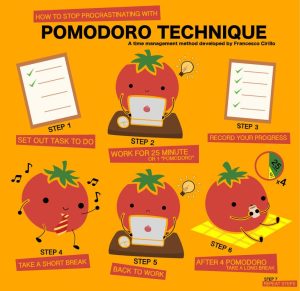
It is Created and developed during the 1990s, the essence of the study method is to use a timer set to 25 minutes and use that time to study without interruption.

Once the 25 minutes are up, take a 5-minute break so that you can relieve the pressure. If you need to study additional material, take another 25 minutes followed by a 5-minute break until you have covered everything needed.

25 Mins Study – 5 Mins Break – Again 25 Mins Study – Again Break – REPEAT.


Advantages of the Pomodoro study technique

To train the brain for laser sharp focus and to learn with full concentration, this method helps a lot. This helps not only in studying, but also for professional with kinesthetic or tactile learning aptitude. Advantages are:

  • Less distraction & more concentration.
  • It avoids unnecessary multi-tasking in between the studies.
  • Helps to think precisely.
  • Better Organization of Materials Used to Study.

Because the focus is on 25-minute intervals, the result is that it keeps you from multitasking which is the type of distraction that pulls you away from the material.

Instead, by organizing your time and materials in an efficient manner, by creating a good study plan, you can study in single 25-minute sessions for short tests and in multiple sessions for longer university exams.
How to use Pomodoro Technique?

  • Decide on a Specific Section or Task that Needs to be Studied
  • Start the Timer
  • Focus on the Task until the Timer reaches 25 Minutes
  • Take a 5 Minute Break
  • Start a New Task

If you should complete FOUR – 25 minute periods, take a 15 to 20-minute break so that you can better recover.

Using the Pomodoro Study Method, you can vastly improve your retention by focusing fully on the task at hand for 25-minute intervals.

Kinesthetic/tactile learners can have a hard time fitting into the traditional classroom. This is because these students learn by doing, by moving, by engaging- these processes form connections that help them remember, discover, and understand.

By adopting the above method, learners can cover a specific area of a subject deeply so that their brain can grasp the knowledge without becoming overly tired or strained.

Let’s create awareness on the learning styles to parents, teachers and students. It will help us to see students coming out with flying colors. Teach Easy – Learn Easy – Live at Ease!

Wishing everyone stress free life with yourself and your kids (if you are married).

Note: The above mentioned method of learning is one beautiful method to adopt. There may be other good approaches also, it is up to the learners to take whichever is comfortable for them.

Disclaimer: The images are taken from different sources. The Pomodoro Technique is a time management method developed by Francesco Cirillo in the late 1980s. Much gratitude to the developer and credit goes to him for the excellent content.

In Gratitude – N.R.Rakesh Babu | Psychologist | Doctoral Researcher

World Brain Day | July 22 | Theme of the Year – “Brain Health For All”

The most fascinating organ in our body is Brain. Most of my articles hovered over BRAIN. It’s “World Brain Day – July 22”. The World Federation of Neurology has declared July 22 as World Brain Day with a bid to increase public awareness and promote advocacy related to brain health.

Theme of this year is “Brain Health For All”. A much needed theme. Not only in the perspectives of the medical importance, but also in the psychological aspect. Actually, it is a resilient year for every one of us after pandemic, a threatening war between Ukraine and Russia, more disease threats and economic imbalances in the World.

To cope with the situation better for the peaceful life is to understand our Brain, it will be easy to handle ourselves better.

According to World Health Organization, Good brain health is a state in which every individual can realize their own abilities and optimize their cognitive, emotional, psychological and behavioral functioning to cope with life situations.

  1. Awareness: Both physiological and psychological significances to be educated and for that more awareness campaigns to be executed.
  2. Resource & Access: Ready reckoners and easily available resources, easy access to rehabilitation and treatment.
  3. Educate: As I mentioned above, education sector should take more care on this. Include scholarly articles, recent researches and updates on Brain in schools and colleges.
  4. Humanity: For optimal Brain Health, more hands to be joined globally.
  5. Prevention: In a recent seminar that I have attended on “Substance Abuse and Brain Damage”, the resource person from India’s renowned Mental Health Organization thrown a light on the mix. He said, many Brain diseases are preventable. Prevention is Better Than Cure.
  6. Feed The Needy: Malnutrition is another alarming area to be looked upon. Multiple sclerosis, Parkinson’s disease, neuroinfections, brain tumors, traumatic injury and neurological disorders are resulting from malnutrition

By dragging attention to this complex organ will emphasize the significance of brain and its vital role in controlling all aspects of collective human life.

Let’s inspire with our action and we can achieve Brain Health for All.

Wishing healthy and peaceful life to everyone!

Disclaimer: Credits to World Federation of Neurology for this wonderful initiative. The image and technically necessary points have been taken from their campaign. The intention is just to promote the awareness about this Special Day. Whole credits to them.

In Gratitude,

N.R.Rakesh Babu
Psychologist | Doctoral Researcher
www.rakeshbabu.com | www.rbac.in

How Gut Bacteria Affects Body & Brain?

How #Gut #Bacteria Affects our #Brain & #Body?

Read an #article, thought of sharing the information with this community of #aspirants.

Our bodies are made of more bacteria than human cells, and the gut alone contains trillions of microbes (bacteria and fungi). In fact, it’s estimated that the body is composed of 10 times more bacteria than human cells.

And the intestines are home to more bacteria than any other part of the body, including the skin. Now, #scientists are devoting increasing amounts of #time and #resources to understanding the gut ‘microbiome,’ as the massive collection of bacteria and microbes is called — and the influence it may exert on the brain and body. The National Institute of Health’s Human Microbiome Project, for instance, is devoting millions of research dollars to understanding the #microorganisms living within the human #ecosystem.

Of particular concern among scientists and the public is the effect that gut flora may have on mental health, as a mounting body of research suggests that gut bacteria can have a significant impact on the way we think, feel and behave, and also on the development of neurological conditions. Last year, a major neuroscience symposium called the investigation of gut microbes a “#paradigm shift” in brain science.
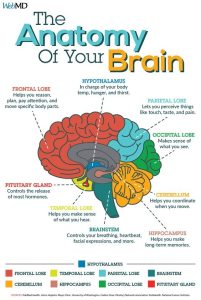
A number of #diseases and disorders have been linked to abnormalities or instability in gut flora, and the microbiome is an important area of research for these conditions. However, it’s important to note that while research has linked these conditions to alterations in the microbiome, it does not mean that in every case gut bacteria is the cause of the problem.

Some of the impacts are: Depression | Anxiety | Schizophrenia | Autism | Obesity & Diabetes | Parkinson’s Disease | Crohn’s Disease | Colon Cancer | Rheumatoid Arthritis | Irritable Bowel Syndrome.

Research Sources are mentioned in the attached picture. Recent researches may improvised the findings and working on the gaps.

Wishing everyone a healthy brain and pleasant mind!

#research | #neuroscience | #science | #mentalhealth | #health | #development | #psychology | #psychologystudent | #psychologyresearch | #researchscholar | #phd | #linkedinlearning | #linkedinforcreators | #linkedin | #psychologists

In Gratitude,

N.R.Rakesh Babu
Psychologist | Doctoral Researcher
www.rakeshbabu.com | www.rbac.in

Amazing Facts About Brain

“Your brain is the organ of your personality, character, and intelligence and is heavily involved in making you who you are.” – Dr.Daniel G. Amen (Psychiatrist and Brain Disorder Specialist)

The brain is a complex organ that controls thought, memory, emotion, touch, motor skills, vision, breathing, temperature, hunger and every process that regulates our body. Together, the brain and spinal cord that extends from it make up the central nervous system.
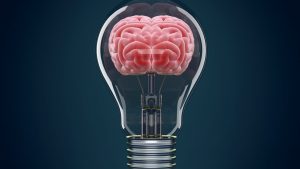
The human brain color physically appears to be white, black, and red-pinkish while it is alive and pulsating. Images of pink brains are relative to its actual state.

Let’s see some facts about Human Brain!

  1. Brain storage is virtually unlimited.
  2. Brain contains 100 Billion Neurons.
  3. We would have heard that only 10% of our brain is what we use. It is a MYTH. Actually we use all part of our brain, even while we sleep.
  4. Brain weighs about 3 pound (1.3 Kg).
  5. Human brain can generate approximately 20 watts of power.
  6. 25% of cholesterol in our body resides in brain.
  7. 60% of brain is fat.
  8. Men’s brain are 10% bigger than Women’s brain.
  9. Women’s brain have more grey matter and larger hippocampus which involves in emotional processing.

  1. The Neocortex accounts for 76% of the Brain’s mass.
  2. Brain development keeps processing until your late 40’s.
  3. Human Brain is not formed fully until the age of 25.
  4. Brain’s Information Processing speed is approximately 268 miles per hour.
  5. Gut is your second Brain.
  6. Gut bacteria makes over 30 neurotransmitters, including serotonin.

There may be lot many facts like this. From this we can understand the amazing nature of our brain and it’s significance. We all are bestowed with such a precious organ which commands all of our actions even when we are in silence.

Are we really concerned about our brain? It is said that a human being should have sharp brain and calm mind for the peace life.


Sharp/Focused brain helps to take decisions, think innovatively, logically and creatively, to identify good and bad, to control our impulses. Workout, reading, learning and unlearning, healthy diet, listening to music, plan your work and personal life – hangout with friends etc., can keep your brain healthy.


Calm Mind helps us to live peacefully without stress, to share and care, to love and show compassion, to live with humanity and humility, to help others when they are in need. Meditation, Yoga, Listening or reciting chanting, breathing exercise, listening to knowledge sessions, making yourself free to talk with your dear ones, sleep well, take it easy and win-win attitudes etc., can also helps you to keep your mind calm and steady.

Let’s be more grateful for being a human being. Know YourSELF | Grow & Glow!

In Gratitude,

N.R.Rakesh Babu
Psychologist | Doctoral Researcher
www.rakeshbabu.com | www.rbac.in

Brain Chemicals that influences Mood!

Without these messengers, you cannot become a messenger of your thoughts!


Neurotransmitters are chemical messengers without which a body cannot function properly. It carries the chemical signal from one neuron to next target cell. They are the molecules used by the nervous system to transmit messages between neurons, or from neurons to muscles.

Neurotransmitters influences a neuron in one of three ways: excitatory, inhibitory or modulatory.

Nervous system controls the functions such as: Heartbeat and blood pressure. | Breathing | Muscle movements | Thoughts, memory, learning and feelings | Sleep, healing and aging | Stress response | Hormone regulation | Digestion, sense of hunger and thirst | Senses.


How does neurotransmitters work?

Human body consists of billions of nerve cells in your body. Nerve cells are generally made up of three parts: 1. Cell Body, 2. An Axon & 3. An Axon Terminal.

  1. Cell Body plays a pivotal role in producing neurotransmitters and maintaining the functions of nerve cell.
  2. Axon carries electrical signals along with the nerve cell to axon terminal
  3. Axon Terminal is where the electrical messages are changed to chemical signal using neurotransmitter to communicate with next group of nerve cells or to organs.

Neurotransmitters are located in a part of the neuron called the axon terminal. They’re stored within thin-walled sacs called synaptic vesicles. Each vesicle can contain thousands of neurotransmitter molecules.

The seven “small – molecule” neurotransmitters are: acetylcholine, dopamine, gamma-aminobutyric acid (GABA), glutamate, histamine, norepinephrine, and serotonin

FIVE Major Neurotransmitters that Influences the Mood are: Serotonin, Dopamine, Glutamate, Norepinephrine, GABA

  1. Serotonin: It is “Happiness Molecule”. It helps in memory and learning. It contributes to feelings of well-being and happiness. It is also produced in the gastrointestinal tract in response to food. As a result, serotonin is involved in functions such as sleep, appetite, behavior & moods. It is speculated to have a role in depression, as some depressed patients are seen to have lower concentrations of metabolites of serotonin in their cerebrospinal fluid and brain tissue.
  2. Dopamine: It is “Motivation Molecule”. It plays a role in body’s reward system which includes feeling pleasure, motivation, motor control, reinforcement and learning. Parkinson’s Disease has been linked to low levels of dopamine and Schizophrenia has been linked to high levels of dopamine.
  3. Glutamate: This is the most common excitatory neurotransmitter of your nervous system. It’s the most abundant neurotransmitter in your brain. It plays a key role in cognitive functions like thinking, learning and memory. Imbalances in glutamate levels are associated with Alzheimer’s Disease, Dementia, Parkinson’s Disease and Seizures.
  4. Norepinephrine: It assists in fight-flight response and helps moderate mood by alleviating depression and anxiety. It also modulates the responses of the sleep patterns, focus and alertness.
  5. GABA (GAMMA AMINOBUTYRIC ACID): It helps increase feelings of calm and relaxation, reduces stress and pain. It also helps in improvement of sleep & concentration. This helps in eliminating the feeling of anxiety, stress, and fear, and may also further help in preventing seizures.

Conclusion: The ultimate aim of this article is to create awareness among people about the Brain chemicals that influences the mood of a person. Reaction or response around is is just a triggering factor. However, upon the chemical exchanges or signal exchanges are creating all mood swings. Upon balancing the chemicals by eating more of healthy & natural food, depression less activities, maintaining steadiness and patience, non-comparison with other people, stress free work-life balance, living for the bigger cause such as charity, service to the humanity, spiritual rituals (applies only to believers), practicing & cascading human values to next generation and maintaining healthy body and peaceful mind, a person can deal with the Brain Chemicals happily.

Disclaimer: Sources of pictures and technical terms are from wikipedia and other few trusted websites. Credits goes to the original creators of the images.

In Gratitude
N.R.Rakesh Babu
Psychologist | Doctoral Researcher
www.rakeshbabu.com | www.rbac.in

How do memories form?

A picture is worth a thousand words, but a memory is priceless. Memory is a way of holding on to the things you love, the things you are, the things you never want to lose. Death leaves a heartache no one can heal, love leaves a memory no one can steal.

“Memory is the reactivation of a specific group of neurons, formed from persistent changes in the strength of connections between neurons.”

Remembering begins with your senses. Any festivals or functions at home, for instance, your brain might take note of how good the food smells, how nice it feels to hug your mom, and how your relatives joined you with more happiness during the event. As your brain processes that sensory input, it creates neural connections and those connections will eventually become memories.
Your brain decides how important a memory is based on context cues, such as your level of emotion or stress at the time. The more important the recollection is, the stronger the neural connections will be.

“Remembering highly emotionally charged events is an important survival tool.” Say you’re in a certain area of the woods and all of a sudden there’s a dangerous animal chasing you—when you remember such occurrences happened before, you won’t go to that place again.

There are several areas of the brain that are involved in encoding and later retrieving memories, but one part—the hippocampus—is thought to play a key role in “binding together the different scattered components of memory. “It might function as a kind of index.”

The hippocampus is a pair of wormlike structures nestled deep inside the midbrain. It’s believed to be especially important for processing long-term memories—like your last vacation, or what your email password is.

The brain has three types of memory processes: 1. Sensory register, 2. Short-term memory and 3. Long-term memory.

Sensory Register: In the sensory register process, the brain obtains information from the environment. This activity is short, lasting at most a few seconds. During sensory register, the brain gathers information passively through visual and auditory cues, known respectively as “iconic” and “echoic” memory.

Short-term Memory is the other main type of memory, and it refers to things you need to keep in your consciousness for no more than a few seconds. “That’s the kind of memory you’re taxing if you’re trying to hold a phone number in your head before putting it into your phone.” It’s also the memory you use to recall the specials the server has just recited, or measure out the correct dose printed on the label of a medication. Those bits of information appear to be stored in the prefrontal cortex, the structure that sits at the very front of your brain.

Long-Term Memory: The process allows information to remain in the brain for an extended period, nothing in the brain avoids risk. Information stored in long-term memory can stay in the brain for a short while (a day, a week) or last as long as a lifetime.

Thanks to Daniel Schacter, PhD & Brian Becker Professors of Neuropsychology.

In Gratitude,
N.R.Rakesh Babu
Psychologist | Doctoral Researcher
www.rakeshbabu.com | www.rbac.in

Addiction Relapse is Ok!

Addiction Relapse is Ok! Don’t Isolate & corner them. Show some kindness!

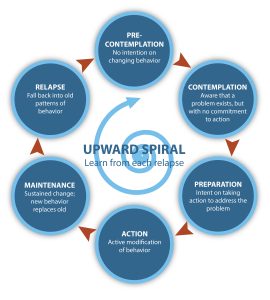
In the THE TRANSTHEORETICAL MODEL OF CHANGE, Relapse is one of the stages of intentional behavior change.

When it comes to substance addiction, many victims are very much aware that they are harming themselves. Out of which, a considerable percentage of people wish to come out of it. Very few seek support from family members. Most times, addicted people are taken to therapists/counselors or to rehabilitation centers.

Rather generalizing, it is seen that many are coming out of this issue and leading happy and peaceful life. Most of them fall into the stage called “RELAPSE”. Relapse is the resumption of substance use after an attempt to stop or period of abstinence. For example, someone who returns to drug use after months in rehab would be experiencing a relapse.

I would like to highlight this stage “Relapse” in this article. It is Ok to fall in relapse stage. It will make them to understand the severity of the issue that has happened to them. In fact, the therapists can use this situation positively to help the clients. When the client feels guilty, it is the best stage to re-iterate the importance of health (physical & mental), relationship, identity in society.

The reason for me to write this article is, I have seen a person who was in relapse stage and got rejected by therapist (so called), got stigmatized by family members, friends detached their company and this person had to encounter deep depression and the family lost a good human.

Love and compassion will certainly work in this situation. Rather stigmatizing, blaming and put them in a corner, if they are attended rightly by learned professional and kind-hearted people. They can come back to normal life. As shown in the picture, it is a cycle of change. Sometimes, two, three or more relapse may occur. However, if the victim is surrounded by a humanistic environment, there are lot of chances to bring back them to normalcy.

Point to be noted is, there may be situations where right treatment to be given and all stages of prevention methods to be introduced to avoid relapses. Family therapy to be given to people around the person. They should be properly educated about the consequences. CARE is more important. In the case of young adults, it is necessary to inculcate moral values. It is quite challenging during the treatment, however, it can also play a pivotal role in rehabilitation.

The ten processes of change include:

  1. Consciousness-raising (Get the facts) — increasing awareness via information, education, and personal feedback about the healthy behavior.
  2. Dramatic relief (Pay attention to feelings) — feeling fear, anxiety, or worry because of the unhealthy behavior, or feeling inspiration and hope when hearing about how people are able to change to healthy behaviors.
  3. Self-reevaluation (Create a new self-image) — realizing that the healthy behavior is an important part of who they want to be.
  4. Environmental reevaluation (Notice your effect on others) — realizing how their unhealthy behavior affects others and how they could have more positive effects by changing.
  5. Social liberation (Notice public support) — realizing that society is supportive of the healthy behavior.
  6. Self-liberation (Make a commitment) — believing in one’s ability to change and making commitments and re-commitments to act on that belief.
  7. Helping relationships (Get support) — finding people who are supportive of their change.
  8. Counterconditioning (Use substitutes) — substituting healthy ways of acting and thinking for unhealthy ways.
  9. Reinforcement management (Use rewards) — increasing the rewards that come from positive behavior and reducing those that come from negative behavior.
  10. Stimulus control (Manage your environment) — using reminders and cues that encourage healthy behavior and avoiding places that don’t.

Psychologist or community care workers should help Addicts who are in relapse stage with love & compassion which can heal them emotionally, mentally & physically! Let’s live with love and humanity. Love moves the world.

Disclaimer: The pictures attached in this article are taken from different sources in websites. Credits to the original creators. Special thanks to wikipedia.

Sources: wikipedia, google scholar, wellness blogs, science direct and rural health

In Gratitude,

N.R.Rakesh Babu
Psychologist | Doctoral Researcher
www.rakeshbabu.com | www.rbac.in

Garbage Truck Theory!

“What if you could take control of your life with one decision? You Can.” – David J. Pollay


How often does a bad driver, rude waiter, curt boss, or an insensitive relative ruin your day with a thoughtless action, an angry rant, or a snide remark? And how often have you ruined someone else’s day?

In The Law of the Garbage Truck, David J. Pollay shows us that by refusing to let others dump their “garbage” (negativity, anger, resentment) on us-and letting it “pass by” instead-we become happier and more successful, both personally and professionally. And when we stop dumping garbage on others, we improve our relationships, strengthen our businesses, and bring our communities together.

Twenty years ago, while riding in a New York City taxi, syndicated columnist and business consultant David J. Pollay narrowly escaped a life-threatening car crash. The driver who almost caused the accident and started yelling at the cab driver, who remarkably just smiled, waved, and wished him well. Pollay asked how the cabbie could remain so calm, and his response sparked the defining principle of The Law of the Garbage Truck.
Many people are like garbage trucks. They run around full of garbage, full of frustration, full of anger, and full of disappointment…And if you let them, they’ll dump it on you. So when someone wants to dump on you, don’t take it personally…move on.

Now Pollay shows you how to apply his Law in this remarkable audio book that can help you:

• Avoid getting dumped on by rude, thoughtless, and angry people

• Stop reliving the negative in your past, and fearing the future

• Focus on what you can control, not the negative things you can’t

• Reduce incivility wherever you find it, and stop bullies in their tracks

• Improve your relationships by not dumping on your friends, parents, spouse or coworkers

• Find happiness again after dealing with illness, loss, and personal tragedy

• Increase productivity, respect, and cooperation by creating a No Garbage Trucks! Zone in your business, school, and home

• Gain the courage to enjoy every day, do what you love, and make a difference

© 2010 Ascent Audio (Audiobook) ISBN: 9781596596023

Do You Follow Your CLock?

Healthy Morning to everyone!

Do we really follow the rythm of our body? Most times, we don’t listen to the rythm with which our body operates.

Haven’t you observed your body at different hours in a day? Sometimes you will be energetic, sometimes you will be lazy. Assertiveness and aggressiveness can be felt while taking decisions at different timings in a day. On some odd days, the perception, judgement, choices in decision making, some of our emotions and behaviors also get distorted.

These things can happen due to many reasons. One of those is because, of the imbalance & non-synchronized lifestyle managements. To live a balanced life—and enjoy the good health it brings—we need to keep our daily rhythms set to the age-old ayurvedic clock.


Let’s learn simple things about Ayurveda for BETTER HEALTH & Peak Productivity Performance:

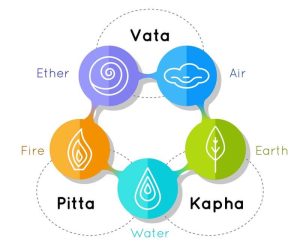
Vata, Pita & Kapha are the three Doshas of the body. Perfect balance of three Doshas leads to health, imbalance in Tridosha leads to diseases. “Dosha” is a central term in Ayurveda originating from Sanskrit, which can be translated as “that which can cause problems” (literally meaning “fault” or “defect”), and which refers to three categories or types of substances that are believed to be present in a person’s body and mind.


Normally, we break our day into THREE – Work Time | Our Time | Sleep Time. However,


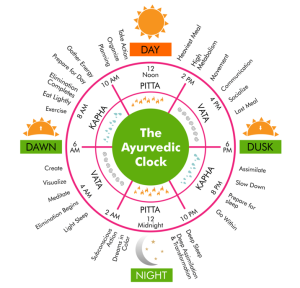
Ayurveda breaks a day into SIX Four-Hour Zones.

Day Starts: 6:00 a.m. to 10:00 a.m. – Kapha Time – Cool, Heavy & Earthy

Mid Day: 10:00 a.m. to 02:00 p.m. – Pitta Time – Hot, Sharp and fiery “High Digestive time”

Afternoon: 02:00 p.m. to 06:00 p.m. – Vata Time – Light, Dry & Airy

Then, the cycle continues: 06:00 p.m. to 10:00 p.m. – Kapha | 10:00 p.m. to 02:00 a.m. – Pitta | 02:00 a.m. to 06:00 a.m. – Vata.


To put it simple:

  • The rising (dawn) and falling (dusk) of the sun are connected to “Kapha”.
  • The peak of the day (midday) and the peak of the night (midnight) are related to “Pitta”.
  • The transition between night and day and between dusk and dawn is related to “Vata”.

Activities for Vata time: Vata dosha includes the elements of ether and air. This time is the best time to access the ether and spiritual connections (for those who believe in it), others can be with the nature.

02:00 a.m. – 06:00 a.m. | Cool, Heavy & Earthy

  • Body prepares to wake up and gets ready for elimination. | In India, we term “Brahma muhurta”, 96 minutes before sunrise, is the best time to wake up. Brahma means knowledge and this is the time to seek knowledge.
  • This is the auspicious and sacred time, the best time to meditate, visualize, and create.
  • It is also the ideal time to go out for a walk and do yoga.

02:00 p.m. – 06:00 p.m. | Light, Dry & Airy

Best time for communicating, socializing, and sharing creativity. At Dusk, practice Meditation & lighter exercises. | It is best to have the last meal before 6:00 p.m.

Activities for Pitta time: Pitta dosha includes the fire and water elements. Hence, the most productive part of the day.

10:00 a.m. – 02:00 p.m. | Hot, Sharp and fiery “High Digestive time”

Ayurveda also encourages us to eat our primary meal in the middle of the day, when the fire of pitta dominates. Pitta supports our ability to digest all things—food, thoughts, and feelings.

  • Pitta time is for planning, taking action, and organizing.
  • Plan and execute your most physical or analytical tasks during the Pitta day hours.

10:00 p.m. – 2:00 a.m. | Resist The Second Spell

  • Let’s allow body to repair itself. Hitting the bed before 10 p.m. helps the hormones such as serotonin and melatonin to do their tasks in our body. Best time when our mind is in a subconscious state, and when we experience colorful dreams.

Activities for Kapha time: Kapha dosha comprises earth and water elements. The nature is heavy and nourishment & It is a perfect time for self-care rituals.

06:00 a.m.  10:00 a.m. | Blissful Morning

  • Rise up in the Kapha hours so as to draw prana (life force) into the body.
  • Morning ablutions including full elimination should happen.
  • Practice Exercises or Yoga.
  • Break the Fast and get energetic and prepare for your day.

06:00 p.m.  10:00 p.m. | Winds Down Slowly

  • Slow down and assimilate your energy.
  • Be with loved ones.
  • If possible, a warm oil massage (Abhyanga) also adds to a feeling of heaviness that will relax your body and senses, and help you achieve deep rest.
  • IMPORTANTLY: Turn off your screens and get ready to hit the bed. No activities that can go deep into your mind to disturb your sleep.

Knowledge of this Ayurvedic routine has been around for thousands of years and it has been passed down through the sciences of yoga and Ayurveda. However, our modern lifestyle has made it difficult for us to comply with natural rhythms.

These rhythms are not rules invented by Ayurveda, they are the basic needs of our body and mind. By understanding your dosha and how it functions, you can better understand how the energy around you affects your constitution and inner being.

Let’s live healthily! Wishing you all good health, peace and prosperity!

In Gratitude – N.R.Rakesh Babu | Psychologist | PhD Research Scholar

Expertise Vs Experience

Experience (noun): Event(s) of which one is cognizant. Eg: “It was an experience he would not soon forget.”

Expertise (noun): Great skill or knowledge in a particular field or hobby. Eg: “The scientist has expertise in the field of nuclear fusion.”

It is understood that there are vast differences in Experience and Expertise. It is not necessary that an Experienced Person to be an Expert in the field he/she is associated with. However, an Expert need not to have decades of experiences though. In some places, it can be found that an Expert has decent experience as well.

Expertise comes from the drive towards learning the process. When an expert is in a team, he/she strives to share the knowledge. It will help the team to grow and he can inspire the whole team. This indeed can help the team members to grow personally and can be a significant contributors for the growth of the organization too.

An expertise of an individual is creating vibes all around him/her and they can be a beacon. Passion towards self-growth and new learning continuously helps one to become an expert and such expertise are helping the growth organically.

Experience in terms of “Years” without learning or passion cannot be counted for the better performance. People with sheer experience & greater passion can support well for their generation and also can preserve more memories for the next generation.

There are lot of examples and one such person is India’s Former President Late Dr.A.P.J.Abdul Kalam. He went through turbulent phases of life personally, socially and professionally. However, nothing changed him from being an Expert in his area of expertise.

In a conversation with one of my friends, I came to know the other end of the experts as well. He said that some experts never teaches what they learnt. They may think, why should I teach? I learnt it hard, let others also can gain the knowledge on their own. Listening to this view, I am little worried. If they can share the knowledge, it can be used effectively. At the end of the day, it is all about how everyone thinks to live. To EXIST or to LIVE. To just EXIST, they can proudly say that I have decades of EXPERIENCE. However, to LIVE, EXPERTISE will be exposed, explored by many and to emulate by the nextgen.

Let’s LIVE!

In Gratitude,

N.R.Rakesh Babu
Psychologist | PhD Research Scholar
www.rakeshbabu.com | www.rbac.in