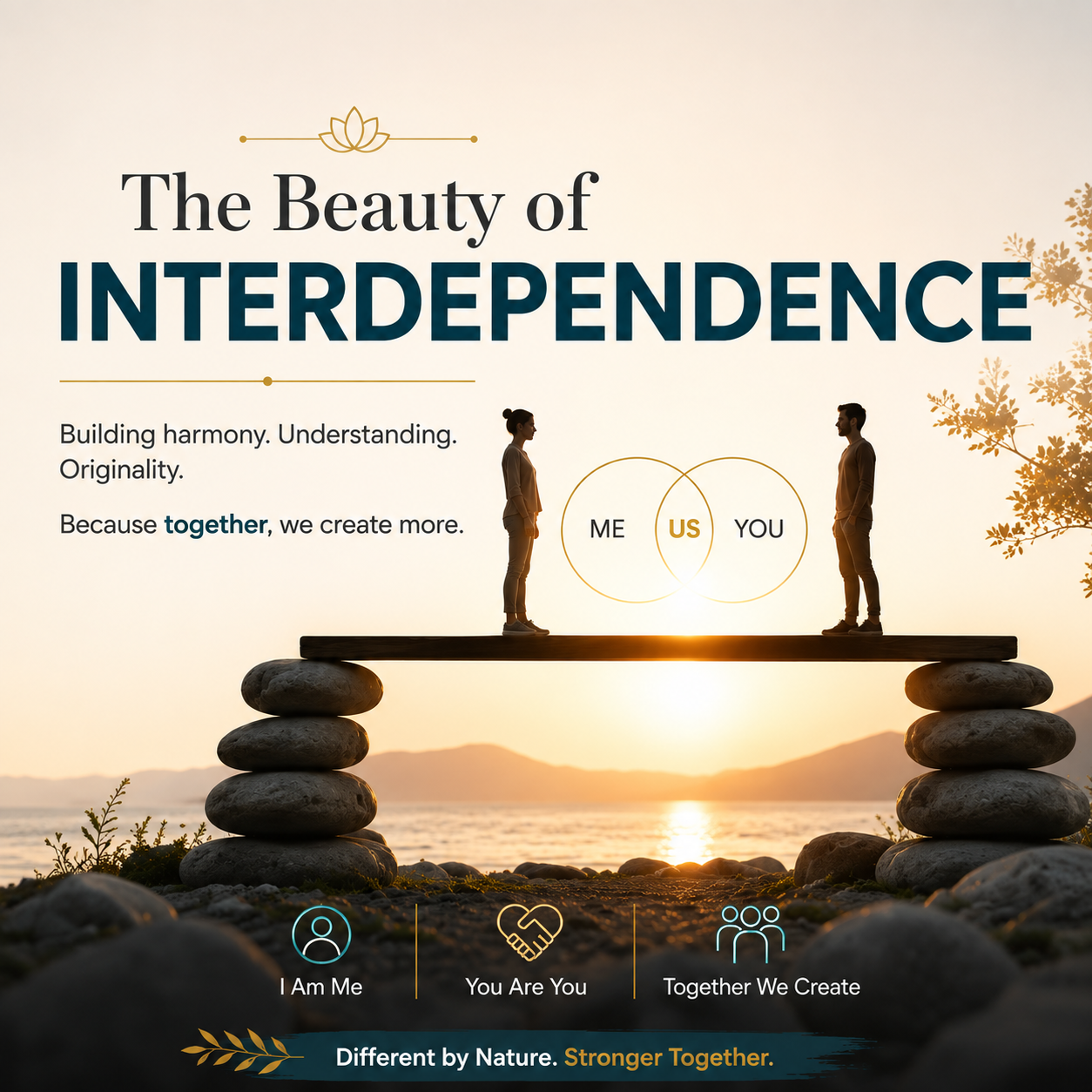
We are neither meant to live completely dependent nor completely independent.
We often celebrate independence.
“Stand on your own feet.” “Don’t depend on anyone.” “Be strong enough to manage everything yourself.”
Independence is important. It builds confidence, responsibility and self-reliance.
But there is another extreme—dependence.
“I cannot be happy without you.” “I need you to make everything right.” “I cannot manage without you.”
Dependence can create insecurity, while excessive independence can create distance. So, what lies between the two?
Interdependence. This is the Key!
“I can stand on my own—and I can still stand with you.”
Interdependence is not about needing someone because we are incapable. It is about choosing to be together because together we can create something greater.
That is where SYNERGY happens.
Two people don’t have to think alike, behave alike or contribute in the same way.
One may plan. Another may execute. One may be logical. Another may be intuitive. One may lead. Another may stabilise.
Different strengths don’t have to compete. They can complement each other.
The Spectrum of Connection
To understand where true relationship harmony begins, we must look at how we position ourselves relative to those we love:
[ Dependence ] —> One-way reliance (A needs B; B does not need A)
[ Independence ] —> Zero reliance (A and B function entirely separately)
[Interdependence ] —> Mutual reliance (A and B rely on each other to succeed)
When a relationship operates on dependence, a hierarchy naturally forms. One person carries the weight; the other relies on it. Over time, this dynamic, breeds quiet arrogance in the giver and subtle helplessness in the receiver.
When a relationship operates on hyper-independence, two people become parallel lines. They may share a house, a dinner table, or a surname, but their lives never truly intersect. They remain self-contained islands, missing the transformative magic of shared vulnerability.
Interdependence, however, changes the dynamic entirely. It acknowledges a simple truth: We are not meant to walk through this world entirely alone, nor are we meant to lean so heavily on another that they collapse under our weight.
A relationship is not a balance sheet.
One of the biggest problems in relationships begins when we start calculating:
Who sacrificed more? Who contributed more? Who does more for whom?
The moment a relationship becomes a scoreboard, someone has to become the winner—and someone the loser.
But relationships are not about who contributes more.
They are about what we create together.
No one needs to be the “prime contributor.”
In a beautiful relationship, both people bring something unique, both receive something meaningful, and both grow through the relationship.
Harmony doesn’t mean sameness.
True harmony allows two individuals to remain original while creating something shared.
I don’t have to become you.
You don’t have to become me.
We simply learn to understand, respect and complement each other.
And perhaps that is the real beauty of relationships:
I don’t lose myself in you. You don’t lose yourself in me. We create something that neither of us could create alone.
That is interdependence.
And perhaps the most powerful question we can ask in any relationship is not:
“Who contributes more?”
but:
“What becomes possible because we are together?”
Think….Contemplate….Live…
In Gratitude & Love, Rakesh Babu N.R