Blog

The Mentor Who Didn’t Give Answers

What if the greatest mentor was not the one who gave the right answers but the one who helped us discover the right questions?

When Arjuna stood on the battlefield of Kurukshetra, he was not lacking knowledge. He was overwhelmed by it.

He knew his duty, the consequences, and what was at stake. Yet, when the moment demanded action, he was confused, emotionally disturbed and unable to move forward.

Krishna did not simply tell him what to do. He mentored him and that distinction has enormous relevance to the contemporary world.

Krishna as a Mentor

What makes Krishna’s mentoring of Arjuna fascinating is that it was not merely about transferring knowledge. It was about transforming the way Arjuna saw himself, his situation and his responsibility.

Lord Krishna listened, questioned, challenged assumptions, and offered different perspectives.

He allowed Arjuna to reflect, and ultimately, he left the decision with Arjuna.

This is very different from the traditional idea of mentoring, where the experienced person says, “I have been through this before. Do what I tell you.” Krishna’s approach was closer to:

“Let me help you see clearly. The decision must become yours.”

That is powerful mentoring.

From Bhagavad Gita to the Contemporary Workplace

Today’s learner does not necessarily need more information.

We already live in an information-rich world.

What people increasingly need is clarity, perspective, self-awareness and the ability to make meaningful decisions.

This is where Krishna’s contemplative approach becomes relevant to Learning & Development.

A good trainer transfers knowledge.

Perfect coach facilitates discovery.

A great mentor helps a person see differently.

The shift is from:

Information → Reflection Instruction → Inquiry Dependency → Ownership Performance → Purpose

What Can L&D Learn From Krishna?

Imagine a leadership programme where the facilitator does not immediately provide solutions to every workplace challenge.

Instead, participants are invited to ask:

What am I seeing? What is within my control? Am I avoiding any responsibilities? What is the right action—not merely the convenient action?

Suddenly, training becomes more than a programme. It becomes a space for inner learning.

This is where contemplative philosophy can enrich contemporary coaching and leadership development.

Reflection can precede action.

Awareness can precede performance.

Purpose can precede goals and responsibility can replace blame.

The Mentor’s Real Work

Perhaps Krishna’s greatest lesson for mentors, coaches and L&D professionals is this:

Your job is not to create followers who depend on your wisdom. Your job is to develop people who can access their own wisdom.

That requires patience & listening.

It requires asking better questions.

Sometimes, it requires the courage to step back and allow the learner to struggle with a question rather than rushing to provide an answer.

The Kurukshetra may have been ancient. But the inner conflict is not.

Every leader, professional, student and human being eventually faces a moment when knowledge alone is not enough.

At that moment, perhaps what we need is not another instructor.

We need a Krishna or Mentor.

Perhaps, in the contemporary world, the real challenge for every mentor is to learn how to become one.

“Close your eyes and let what you just read run through your mind.”

Rakesh Babu | Psychologist | www.shreshtaminds.com

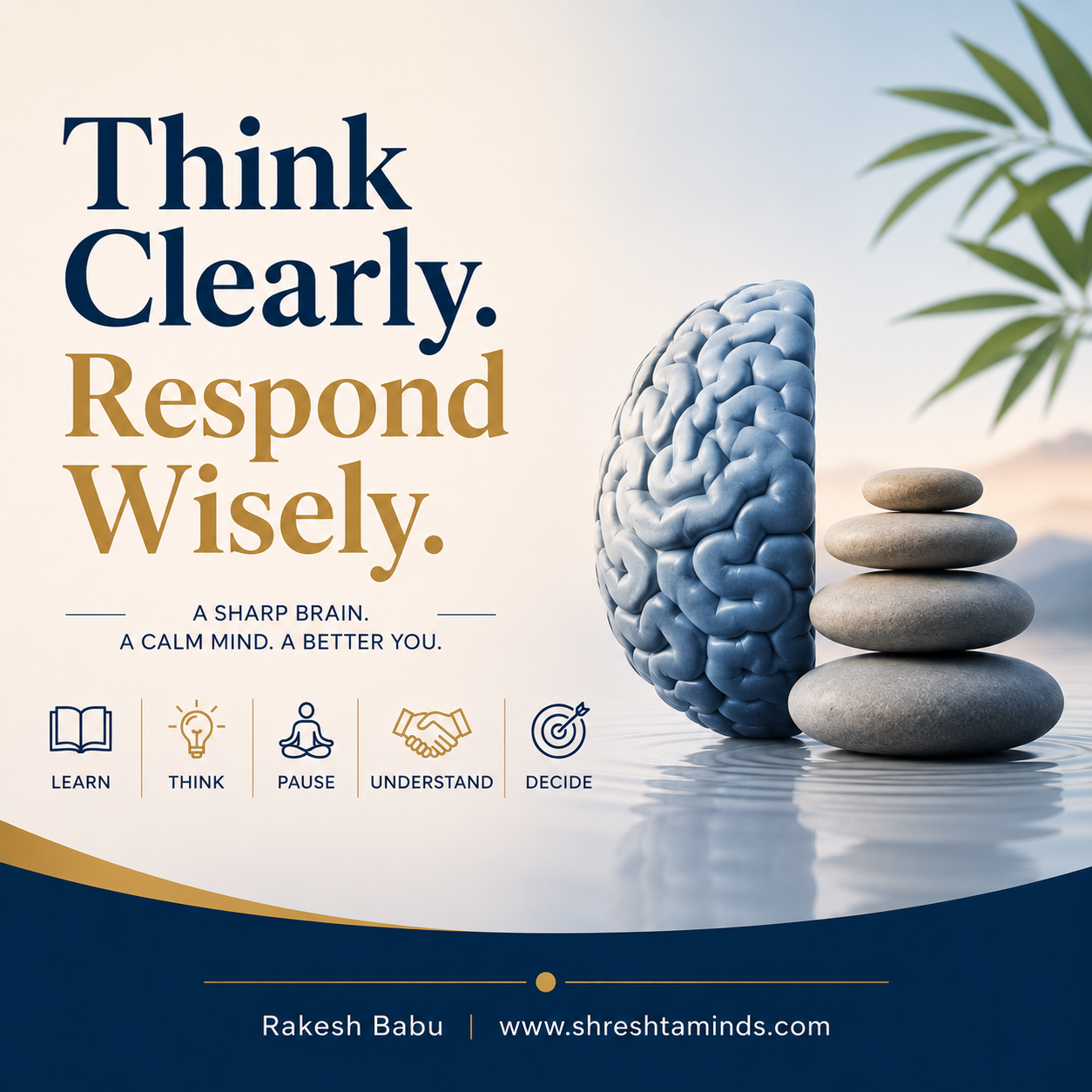
Think Clearly. Respond Wisely.

The quiet balance between a sharp brain and a calm mind

We often admire people who have a sharp brain. They learn quickly, understand things easily, solve problems and make decisions with confidence. We also admire people who have a calm mind—those who can remain composed when things go wrong, listen without immediately reacting and handle pressure with steadiness.

But a sharp brain and a calm mind are not the same thing.

A sharp brain helps us think, learn, analyse and solve. A calm mind helps us pause, regulate, listen and respond.

One helps us understand what is happening around us. The other helps us decide how we want to respond to it. And throughout life, we need both.

It Begins with Learning

For a student, a sharp brain can make learning easier. It helps in understanding concepts, connecting ideas, remembering information and solving problems. But intelligence alone does not guarantee good learning.

A student may understand a subject well and still struggle during an examination because of anxiety. Another may be capable of doing much better but become frustrated when something does not come easily.

This is where a calm mind makes a difference. It allows a student to stay with a difficult subject, accept mistakes and try again without immediately feeling defeated.

A sharp brain says, “I can understand this.”

A calm mind says, “Even if I don’t understand it yet, I can keep trying.”

That combination can make learning a much healthier experience.

As a Child, It Shapes Behaviour

Children are naturally curious. Their brains are constantly trying to understand people, situations and the world around them. But understanding something does not mean they can always control their reactions.

A child may know that hitting is wrong and still hit when angry. They may know that shouting is not appropriate and yet shout when frustrated.

We often tell children, “Don’t get angry,” or “Don’t react.” Perhaps what they really need is to learn what to do with the anger.

A calm mind does not mean that a child never becomes angry. It means that, gradually, the child learns to recognise the emotion, pause and express it in a healthier way.

That is not just good behaviour. It is the beginning of emotional maturity.

During the Teenage Years, It Creates Perspective

Teenage years bring a growing desire for independence. Young people want to make their own choices, question things and experience life for themselves. This is a natural and important part of growing up.

A sharp brain can help a teenager think ahead, question assumptions and consider consequences. But emotions, peer influence and the excitement of the moment can sometimes make a decision faster than thoughtful reasoning can catch up.

A calm mind creates that small space between feeling and action.

Someone sends an offensive message. The teenager can immediately respond—but pauses.

A friend suggests something risky. The teenager may be excited—but takes a moment to think about tomorrow.

That pause may take only a few seconds. Yet sometimes, those few seconds can prevent a decision that could take months or years to undo.

In Professional Life, it improves decision-making.

At work, a sharp brain is a valuable asset. We need to analyse information, solve problems, understand people, identify opportunities and make decisions.

But professional life also brings pressure, disagreement, deadlines, criticism and uncertainty.

A person may be highly intelligent and still make a poor decision when angry. Someone may have all the facts and yet allow fear to influence the choice. Another may have a good idea but struggle to communicate it because of insecurity.

A calm mind does not make us less ambitious or less decisive. It gives us the ability to think without allowing the pressure of the moment to take complete control.

The sharp brain asks, “What are my options?”

The calm mind asks, “Which option deserves my response?”

That distinction becomes particularly important in leadership.

And Then Come Our Relationships

Perhaps this is where the balance becomes most meaningful.

When someone disagrees with us, our brain can quickly prepare a defence. We remember what they said yesterday, what happened last month and everything that supports our position.

We may win the argument and still lose something more valuable—the connection.

A sharp brain can help us understand another person’s words. A calm mind helps us listen to the person behind those words.

When a partner says, “You don’t spend enough time with me,” we can immediately explain why that isn’t true. Or we can pause and ask, “What is making you feel this way?”

When a child says something hurtful, we can react to the words—or become curious about the emotion behind them.

When a colleague reacts strongly, we can defend our intention—or first understand their experience.

Being calm does not mean agreeing with everyone. It simply gives us the ability to disagree without losing our balance.

Sometimes, the most intelligent thing we can do in a relationship is not respond immediately.

What Happens When One Is Missing?

A sharp brain without a calm mind can become restless. Thinking can turn into overthinking. Awareness can become constant worry. Intelligence can even become a tool for creating endless possibilities and problems.

On the other hand, calmness without enough mental engagement can sometimes become passivity. “Let it be” is not always wisdom. Some situations need us to think, decide and act.

So the goal is not to make the brain less active or the mind completely free of emotions. The goal is to let each do its work.

Keep the brain active. Keep the mind settled.

Read. Learn. Question. Solve problems. Explore new ideas. These keep the brain sharp.

And also pause. Breathe. Listen. Walk. Spend some time without constant stimulation. Give yourself a moment before reacting. These create space for the mind to settle.

None of this requires us to become a different person overnight. It is simply a practice of becoming more aware of how we think and how we respond.

The Balance We Can Carry Through Life

Student needs a sharp brain to learn and a calm mind to handle the challenges of learning.

Children needs a sharp brain to understand and a calm mind to regulate behaviour.

Teenager needs a sharp brain to think ahead and a calm mind to resist impulsive choices.

Professionals need a sharp brain to solve problems and a calm mind to make balanced decisions.

In relationships, all of us need a sharp brain to understand and a calm mind to respond with sensitivity.

Perhaps that is the balance we should strive for—not a life without problems, pressure or emotions, but the ability to meet them with the right combination of clarity and composure.

“A sharp brain helps us navigate the world. A calm mind helps us navigate ourselves.”

And when the two work together, we don’t simply become better at thinking.

We become better at living. So perhaps the question worth asking ourselves today is not only,

“How sharp is my brain?”

but also,

“How calm is my mind when my brain is at work?”

Because sometimes, the quality of our life depends not merely on how well we think, but on how wisely we respond.

I got this Gyan “Sharp Brain & Calm Mind” as a learning from the Spiritual Leader & Humanitarian Gurudev Sri Sri Ravi Shankar ji.

In Gratitude, Rakesh Babu | Psychologist | www.shreshtaminds.com

The Five Kleshas at Work

What is really getting in our way?

We often think workplace productivity is about time management, technology, skills and targets. But sometimes, the biggest obstacle is not the workload.

It is the mind carrying unnecessary psychological weight.

An ancient framework called Pancha Kleshas describes five patterns that can disturb our clarity. We don’t have to approach them academically or spiritually. Look at them through the lens of everyday corporate life, and they become surprisingly practical.

1. Avidya (Ignorance) — “Am I seeing this clearly?”

At work, it can be as simple as mistaking our interpretation for reality.

“My manager doesn’t value me.”

“The team isn’t committed.”

“She is deliberately ignoring me.”

“He doesn’t respect my ideas.”

But do we actually know that?

When assumptions become facts in our mind, our decisions follow those assumptions.

The shift: Before reacting, ask, “What are the facts, and what am I adding to them?”

Clarity improves when assumptions reduce.

2. Asmita (Asmita = Egoism) — “Am I taking this personally?”

Someone rejects our idea and sometimes corrects our work. A colleague gets the promotion we expected.

Why does it sometimes hurt so much?

Because somewhere, “my work” has become “me”.

Our designation, expertise, achievements and opinions can become part of our identity. Then feedback feels like criticism of our worth.

The shift: Separate who you are from what you did.

An idea can be wrong without making you incapable. A mistake can happen without making you a failure. When identity becomes less fragile, learning becomes easier.

3. Raga (Attachment) — “Do I need this outcome?”

We all have ambitions. A promotion. Recognition. A particular role. Appreciation. Success.

There is nothing wrong with wanting these things.

The problem begins when:

“I want this” becomes “I must have this.”

Now our peace depends on an external outcome. We become anxious when someone else succeeds. Frustrated when our plans change. Disappointed when recognition doesn’t come.

The shift: Give your best to the process, but don’t make your emotional well-being completely dependent on the result.

Ambition needs direction. Attachment needs awareness.

4. Dvesha (Aversion) — “Am I avoiding what I dislike?”

I don’t like working with that person. I hate presenting. I don’t want to learn this. This is not how we do things.

Sometimes our dislike is justified.

But sometimes, discomfort becomes a reason to stop growing.

We avoid difficult conversations and unfamiliar responsibilities. We avoid people who challenge us. And slowly, our comfort zone becomes our limitation.

The shift: Replace immediate rejection with curiosity.

Ask:

“What exactly am I uncomfortable with?”

Not everything uncomfortable is harmful.

Sometimes, discomfort is simply growth wearing an unfamiliar face.

5. Abhinivesha (Fear of Death/Losing) — “What am I afraid of losing?”

Traditionally, Abhinivesha is associated with a deep fear of death and clinging to life.

In professional life, we can recognise a related pattern in our fear of losing security, status, identity or familiarity.

Fear of failure, losing a job, becoming irrelevant, changing careers & taking a risk.

Sometimes we remain in a situation we have outgrown simply because the unknown feels more frightening than the familiar.

The shift: Instead of asking,

“What if I lose this?”

Ask:

“If things change, can I learn, adapt and find my way forward?”

That question builds a different kind of security — inner security.

So, How Do We Come Out of These Patterns?

Not by fighting ourselves, not by suppressing emotions, not by pretending to be unaffected.

Three simple practices can help.

Awareness

Notice before you react.

What is happening inside me right now?

Is it ego? Attachment? Aversion? Fear?

Abhyasa — Consistent Practice

Reflection, meditation, journaling and mindful observation are not merely personal wellness practices.

They train us to pause before reacting.

And that pause can improve decisions, relationships and leadership.

Vairagya — Healthy Detachment

Work sincerely. Aim high. Care deeply.

But don’t make your identity, happiness or self-worth completely dependent on outcomes.

Hold your goals firmly. Hold your identity lightly.

The Workplace Impact

The clearer we see, decision-making improves. Ego becomes lighter; learning improves. When attachment reduces, clarity improves. Aversion reduces; collaboration improves. The moment fear reduces, courage improves.

And when these improve, productivity often follows organically.

Perhaps professional growth is not always about adding more skills, more strategies or more pressure. Sometimes, it is about removing what is standing in the way.

Less assumption. Less ego. Less attachment. Less resistance. Less fear.

And more:

Awareness. Clarity. Adaptability. Confidence.

The next time something at work triggers a strong reaction, pause for a moment and ask:

“Is the situation creating my reaction — or is something within me adding to it?”

That one question can change the quality of our response.

And sometimes, changing our response is the beginning of changing our professional life.

Think…Contemplate…Live…

In Love & Gratitude, Rakesh Babu | Psychologist | www.shreshtaminds.com

From Capacities to Capabilities

What we have is potential. What we do with it is capability.

There was a young man who was often told, “You have great potential.”

He was intelligent. He learnt quickly. He had ideas others admired. He could see possibilities that many people missed.

But there was one problem.

Years passed, and very little changed.

His ideas remained ideas.
His knowledge remained knowledge.
His talent remained largely unused.

One day, someone who knew him well asked a simple question:

“You have so much. But what are you doing with what you have?”

The question stayed with him.

Because perhaps, for the first time, he realised something uncomfortable:

Having potential and using potential are not the same thing.

Capacity is not capability

All of us are born with capacities.

The capacity to learn.
The capacity to think.
The capacity to feel.
The capacity to create.
The capacity to adapt.
The capacity to love.
The capacity to lead.

Some of us may have more capacity in certain areas than others.

But capacity, by itself, is only possibility.

A person may have the capacity to communicate but struggle to have a meaningful conversation.

A person may have the capacity to lead but struggle to understand people.

A person may have the capacity to love but not know how to express it.

A person may have the capacity to learn but never apply what they learn.

A person may have the capacity to dream but never take the first step.

That is where capability begins.

Capacity is what we possess.
Capability is what we develop from what we possess.

The gap between “I can” and “I can do”

Think about a child learning to ride a bicycle.

The child may have the physical capacity to ride.

But capacity does not automatically produce balance.

The child falls.

Tries again.

Falls again.

Adjusts.

Practices.

Learns.

Eventually, something changes.

What was once only a possibility becomes an ability that can actually be used.

That is capability.

The same thing happens throughout life.

We don’t become capable merely because we have potential.

We become capable when potential meets practice, awareness, experience and action.

The psychology behind capability

There is a deeper psychological shift here.

Capability is not simply about knowing what to do.

It is about being able to translate what we know into action—especially when reality becomes difficult.

Someone may know how to communicate and still avoid a difficult conversation.

Someone may understand emotional regulation and still lose control when anger takes over.

Someone may know how to lead and become defensive when challenged.

Someone may know exactly what they should do and still hesitate because of fear, uncertainty or self-doubt.

This is why capability involves more than knowledge.

It involves agency—the willingness to act.

It involves self-belief—the growing sense that “I can handle this”.

It involves practice—the repeated experience of trying, failing, adjusting and trying again.

And it involves adaptability—the ability to change our response when the situation changes.

In that sense:

Capability is potential that remains available when reality becomes difficult.

Anyone can appear capable when everything is going according to plan.

The real test comes when the plan fails.

When someone disagrees.

When we are criticised.

When emotions are high.

When the outcome is uncertain.

A person may have the capacity for patience.

Capability is being patient when provoked.

A person may have the capacity for empathy.

Capability is remaining curious when someone hurts us.

A person may have the capacity for leadership.

Capability is leading when others are anxious.

That is where psychology meets potential.

We sometimes confuse knowing with becoming

This happens everywhere.

We attend courses.
We read books.
We listen to podcasts.
We watch inspiring videos.
We collect certificates.
We acquire information.

And we feel that we are growing.

But information is not transformation.

Knowing how to communicate is different from communicating with sensitivity.

Knowing about emotional regulation is different from regulating ourselves when we are angry.

Knowing about leadership is different from remaining calm when people disagree with us.

Knowing about relationships is different from becoming a better partner.

Knowledge can increase our capacity.

Practice turns capacity into capability.

And repeated practice does something even deeper.

It gradually changes our confidence in ourselves.

Every time we face something difficult, respond a little better, learn from it and try again, we build evidence:

“I can handle this.”

That is how capability becomes more reliable.

Eventually, we stop merely saying, “I am trying to become better at this.”

We begin to experience the following:

“This is who I am becoming.”

Capability slowly becomes part of identity.

But there is another question

Even capability is not the destination.

Imagine someone who becomes extremely capable.

They can build businesses.
They can influence people.
They can solve complex problems.
They can achieve impressive goals.

But then comes a deeper question:

For what purpose?

Because capability without direction can make us efficient—but not necessarily meaningful.

We can become very good at climbing the ladder and still discover that it was leaning against the wrong wall.

This is where purpose enters the journey.

Capacity gives us possibility.
Capability gives us effectiveness.
Purpose gives us direction.

And when capability is aligned with purpose, something beautiful happens.

Our abilities begin to become useful not only to us but also to others.

From potential to contribution

Perhaps this is the real journey of human development.

Not merely.

“How much do I have?”

But:

“What can I do with what I have?”

And eventually:

“Who can benefit from what I have developed?”

Your intelligence can become a solution.

Your experience can become guidance.

Your pain can become empathy.

Your learning can become wisdom.

Your leadership can become service.

Your success can create opportunities for others.

Your life experiences can become a source of strength for someone who is still struggling.

This is where capability becomes contribution.

And contribution gives potential a deeper meaning.

Perhaps we are asking the wrong question

We often ask children:

“What are you good at?”

We ask young people:

“What career do you want?”

We ask professionals:

“What skills do you have?”

All these questions are useful.

But perhaps we need another question:

“What are you becoming capable of doing with what you already have?”

Because life is not simply about discovering our capacities.

It is about cultivating them, directing them and using them consciously.

The greatest tragedy may not be that a person lacks potential.

It may be that they spend a lifetime without discovering what their potential could have become.

From Capacities to Capabilities

So perhaps the journey looks something like this:

CapacityI have the potential.

AwarenessI recognise what I have.

PracticeI consciously develop it.

CapabilityI can use it effectively, even when circumstances are difficult.

AdaptabilityI can change how I use it when circumstances change.

PurposeI know why I want to use it.

ContributionOthers benefit from how I use it.

That is when potential becomes meaningful.

Because ultimately, we are not here merely to carry capacities.

We are here to cultivate them.

Not merely to know.

But to become.

Not merely to become capable.

But to become useful.

And perhaps not merely to live a successful life—

but to leave something better because we lived it.

So, the next time you think about your potential, pause for a moment and ask yourself:

What capacities do I have?

Which of them am I actually developing?

What am I becoming capable of?

What happens to my capability when I am under pressure?

And where can those capabilities make a meaningful difference?

Because the real question may never have been the following:

“What do I have within me?”

It may be:

“What am I becoming through what I have within me?”

Think…Contemplate…Act

In Love & Gratitude

Rakesh Babu | www.shreshtaminds.com

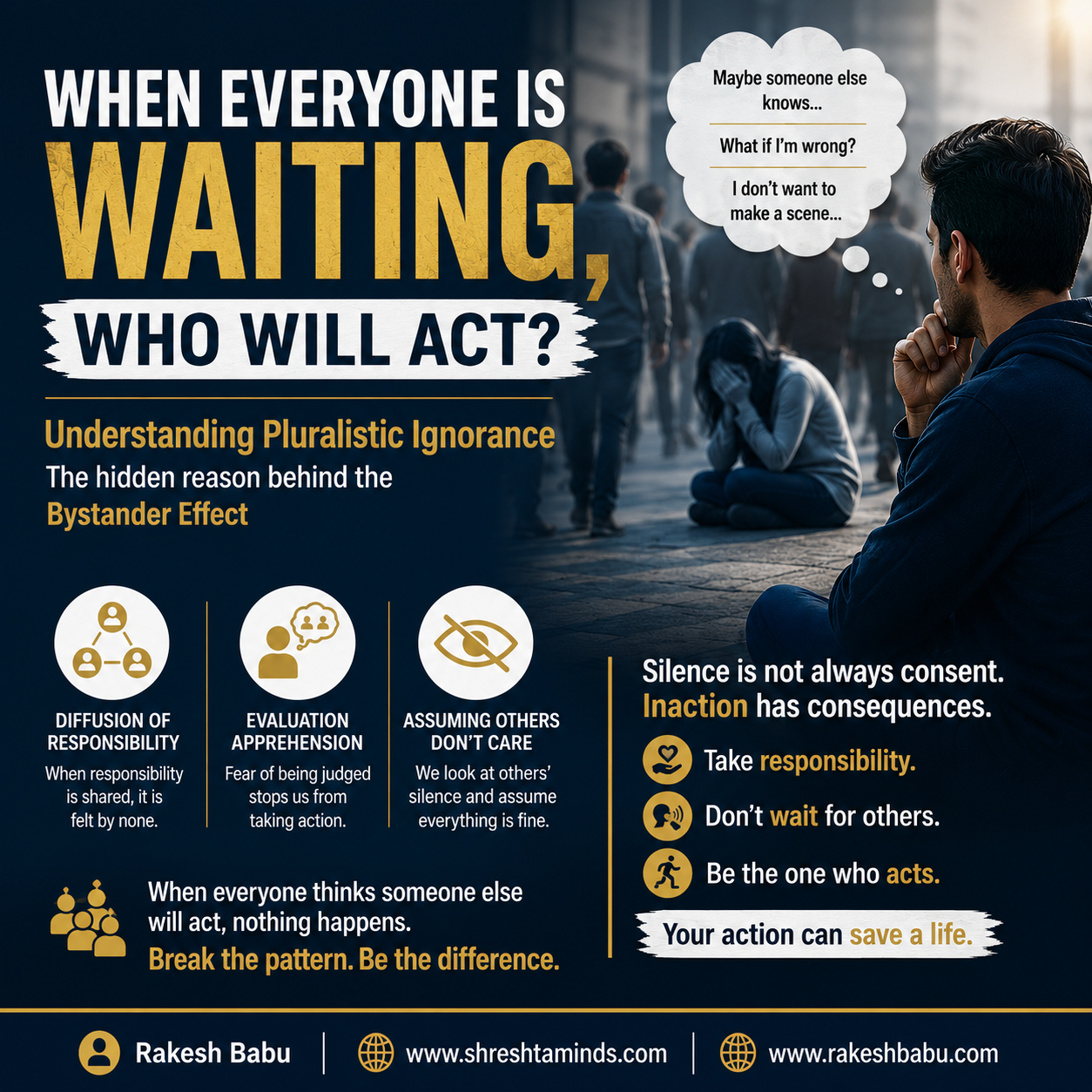
When Everyone Is Waiting: Who Will Act?

It was a busy evening.

People were walking in every direction. Vehicles were passing by. Conversations were happening around them.

Suddenly, a young man sitting near the roadside collapsed. For a few seconds, nobody moved. People noticed. One person looked at him. Another looked at the people around him.

Someone whispered, “Maybe he is drunk.” Another person said, “Someone will help.” A few people stopped and watched.

But nobody stepped forward. Not because they didn’t care. Not because they were cruel. They were simply waiting.

Waiting for someone else to decide whether this was really an emergency.

Finally, one person ran towards him and called for help. Something changed immediately. Two more people came forward. Someone called an ambulance. Another person moved the crowd away.

Within seconds, the situation changed from “Nobody is doing anything” to “Everyone is helping.”

What changed?

The emergency didn’t. One person simply broke the silence. And that small action gave everyone else permission to act.

What actually happened?

There is an interesting psychological idea behind this. It is called Pluralistic Ignorance.

It sounds complicated, but the idea is surprisingly simple. You see something happening. You are not quite sure what it means. So, naturally, you look around.

“What are others doing?”

If everyone else looks calm, you think:

“Maybe it’s not serious.” The person next to you does exactly the same thing. They look at you. You look at them.

Nobody acts.

And now everyone starts taking everyone else’s silence as proof that everything is probably okay.

That’s the trap. Everyone may actually be concerned. Everyone may simply be waiting for someone else to make the first move.

And then comes the “Bystander Effect”

This is where the Bystander Effect can come into play. The more people around us, the easier it can become to think.

“Surely somebody will handle it.” — That’s Diffusion of Responsibility.

The responsibility gets spread across the crowd. And strangely, when responsibility belongs to everyone, we can start feeling that it belongs to someone else.

Then there is another very human thought:

“If I’m wrong, what will happen?”

What if the person isn’t actually in trouble?

What if people think I’m interfering?

That’s Evaluation Apprehension — our hesitation because we worry about how our actions will be judged.

So we look around again. Nobody is moving. We don’t move either. And the cycle continues.

One person’s hesitation becomes another person’s reassurance.

This doesn’t happen only on the street

We see the same thing in everyday life.

A meeting where everyone disagrees—but nobody speaks.

A student who doesn’t understand—but assumes everyone else does.

A colleague who notices something wrong—but thinks someone senior will raise it.

An opportunity everyone quietly wants—but nobody is willing to pursue first.

The situation changes, but the thought remains the same: “If nobody else is doing it, maybe I shouldn’t either.”

The Dangerous Chain

Pluralistic ignorance can create a psychological chain reaction:

Something happens → I am uncertain → I look at others → Others appear calm → I assume it isn’t serious → I don’t act → Others see me not acting → They assume it isn’t serious → Nobody acts.

And suddenly, everyone’s inaction becomes the reason for everyone else’s inaction.

So, what can we do?

We don’t need to become heroes.

We don’t need to interfere in everything.

But we can become a little more conscious of that first instinct to look around and wait.

Pause.

Ask yourself:

“Am I choosing not to act—or am I simply following everyone else’s silence?”

If something genuinely needs attention, take the first small step.

Ask:

“Are you okay?”

“Does someone need help?”

“Is anyone taking responsibility for this?”

Sometimes, that’s all it takes. Because when one person acts, the crowd often changes. Someone else joins. Then another.

Suddenly, what looked like a crowd of indifferent people turns out to be a crowd of people who simply needed one person to go first.

Don’t wait for the crowd to give you permission

The next time you find yourself thinking,

“Someone else will do it.”

Pause | Look again | Ask yourself

“What if everyone is thinking exactly what I am thinking?”

Maybe nobody is indifferent. Maybe everyone is uncertain.

And maybe the person everyone is waiting for…

is you.

Take responsibility. Break the silence. Be the first to act.

Because sometimes, doing nothing is also a decision. And in an emergency, that decision could cost a life.

In everyday life, it could cost someone an opportunity, support, dignity—or a chance that may never come again.

Understanding pluralistic ignorance and the bystander effect is not about blaming people for failing to act. It is about becoming aware of how easily social situations can influence our decisions—and choosing to respond consciously rather than automatically following the crowd.

Let’s LIVE here and don’t just EXIST.

In Love, Rakesh Babu N.R | www.shreshtaminds.com | www.rakeshbabu.com

Right Practice Makes a Man Perfect

Practice alone doesn’t make us perfect. The right practice does.

We have all heard the saying:

“Practice makes a man perfect.”

But there is something important missing in this statement.

What if the practice is wrong?

If we keep repeating the wrong method, wrong habit or wrong approach, repetition will not make us perfect.

It will only make us better at doing the wrong thing.

That is why I believe:

“Right Practice Makes a Man Perfect.”

Practice Needs the Right Direction

A student can study for hours. But if the learning method is wrong, more hours may not produce better results.

A person can exercise every day. But if the technique is wrong, the effort may not give the desired benefit.

A professional can work long hours. But if the process is inefficient, more work does not necessarily mean more productivity.

So, before asking “How much do I practise?”, we should ask:

“Am I practising the right way?”

Right Practice Saves Energy

When we practise something correctly and consistently, it gradually becomes easier.

  • Think about learning to drive.
  • In the beginning, we consciously think about every action—clutch, gear, brake, accelerator, mirror and steering.
  • With practice, these actions become smoother and more natural.

The same happens with learning, exercise, communication, meditation and professional skills.

Right practice reduces unnecessary effort and helps us use our energy more effectively.

That saved energy can then be used for the next task, the next challenge and the next level of growth.

Practice Builds Endurance

  • Exercise is a simple example.
  • When we exercise regularly and correctly, our body gradually becomes stronger.
  • We develop stamina.
  • We can handle more physical effort.
  • We recover better.

The same principle applies to the mind.

When we regularly practise learning, discipline, mindfulness, emotional regulation or problem-solving, we build mental endurance.

We become better prepared to handle difficult situations.

Practice Builds Resilience

  • Life will not always be comfortable.
  • There will be failures, disappointments, uncertainty, pressure and unexpected challenges.
  • Right practice prepares us before these situations arrive.
  • A person who regularly exercises develops physical resilience.
  • A person who regularly learns develops intellectual resilience.
  • A person who practises emotional awareness develops emotional resilience.
  • A person who practises mindfulness develops the ability to pause and respond instead of reacting immediately.

Practice is like preparation for a future situation we cannot predict.

The Result May Not Come Every Day

This is where many people give up.

They practise today and expect a result today.

But growth doesn’t always work that way.

You may exercise for weeks without noticing a dramatic change.

You may learn something for months before suddenly becoming confident.

You may practise meditation every day without feeling different immediately.

You may develop a professional skill without seeing an immediate career benefit.

But that does not mean the practice is useless.

The benefit may simply be waiting for the right moment.

One day, life may place you in a situation where you suddenly realise:

“I have prepared for this.”

That is the power of consistent practice.

Practice Today. Use It Tomorrow.

A person who learns first aid may not use it every day.

But when an emergency occurs, that training suddenly becomes valuable.

A person who develops public speaking skills may not speak on a stage every day.

But when an important opportunity comes, the preparation matters.

A person who practises emotional regulation may not face a crisis every day.

But when a difficult situation arrives, that practice can change the way they respond.

We don’t practise only for today.

We practise for the day when life demands what we have learned.

Don’t Practise More. Practise Better.

Whether it is:

Exercise.
Yoga.
Meditation.
Education.
Professional upskilling.
Communication.
Leadership.
Emotional regulation.
A new skill.
A healthier habit.

The principle remains the same.

Don’t simply repeat.

Learn. Practise. Correct. Repeat. Improve.

And most importantly, make sure you are moving in the right direction.

Because:

Wrong practice can strengthen the wrong pattern.

Right practice can strengthen the right potential.

You may not see the result every day.

But every right practice is building something within you.

It is building skill, efficiency, endurance, confidence and resilience.

And when the right moment comes, you will be ready.

That is the magic of right practice.

Don’t just practise.
Practise right.
Practise regularly.
Practise consistently.
And let time do its work.

In Love & Gratitude, Rakesh Babu | www.shreshtaminds.com

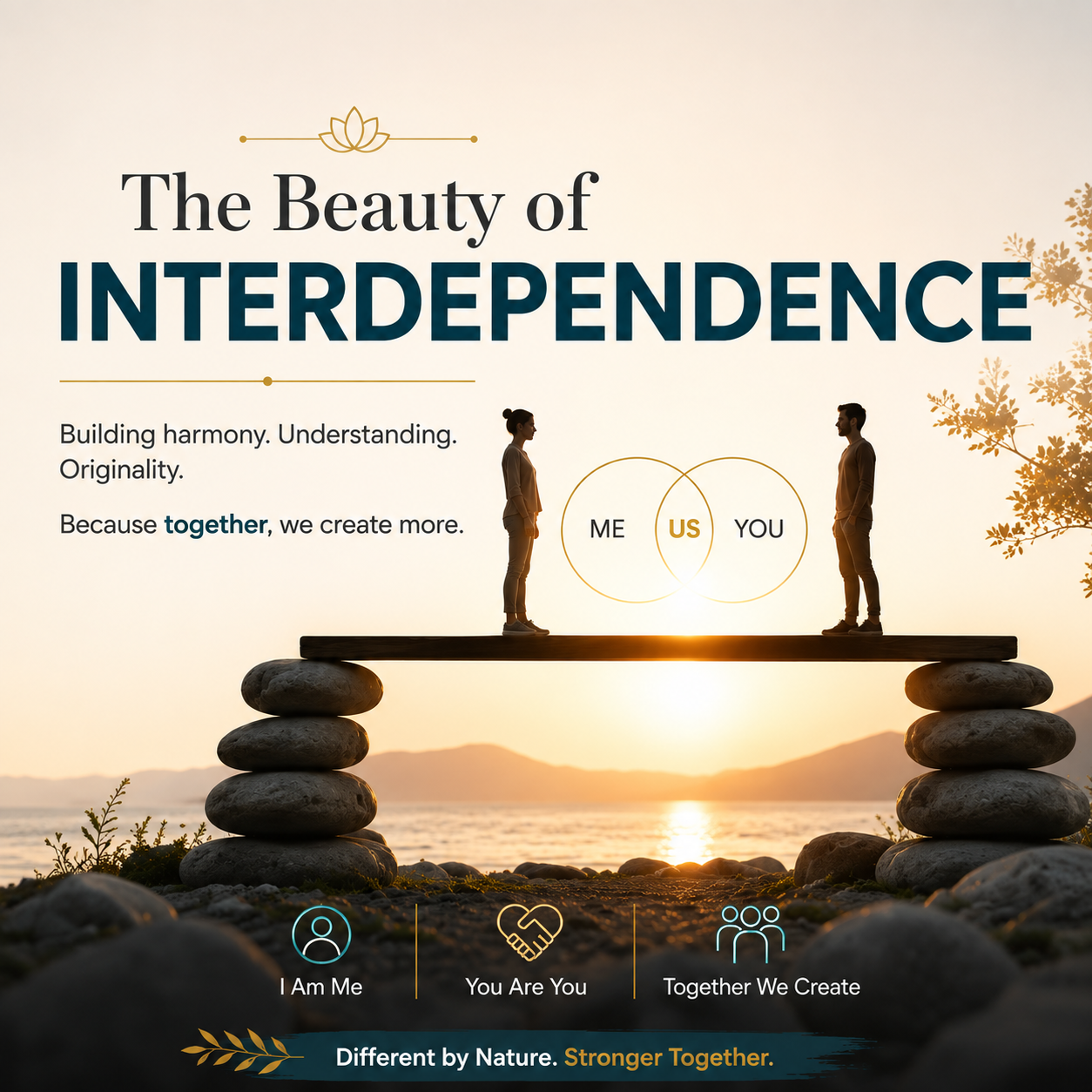
The Beauty of “Interdependence”

We are neither meant to live completely dependent nor completely independent.

We often celebrate independence.

“Stand on your own feet.” “Don’t depend on anyone.” “Be strong enough to manage everything yourself.”

Independence is important. It builds confidence, responsibility and self-reliance.

But there is another extreme—dependence.

“I cannot be happy without you.” “I need you to make everything right.” “I cannot manage without you.”

Dependence can create insecurity, while excessive independence can create distance. So, what lies between the two?

Interdependence. This is the Key!

“I can stand on my own—and I can still stand with you.”

Interdependence is not about needing someone because we are incapable. It is about choosing to be together because together we can create something greater.

That is where SYNERGY happens.

Two people don’t have to think alike, behave alike or contribute in the same way.

One may plan. Another may execute. One may be logical. Another may be intuitive. One may lead. Another may stabilise.

Different strengths don’t have to compete. They can complement each other.

The Spectrum of Connection

To understand where true relationship harmony begins, we must look at how we position ourselves relative to those we love:

[ Dependence ]       —>    One-way reliance (A needs B; B does not need A)

[ Independence ]    —>    Zero reliance (A and B function entirely separately)

[Interdependence ] —>   Mutual reliance (A and B rely on each other to succeed)

When a relationship operates on dependence, a hierarchy naturally forms. One person carries the weight; the other relies on it. Over time, this dynamic, breeds quiet arrogance in the giver and subtle helplessness in the receiver.

When a relationship operates on hyper-independence, two people become parallel lines. They may share a house, a dinner table, or a surname, but their lives never truly intersect. They remain self-contained islands, missing the transformative magic of shared vulnerability.

Interdependence, however, changes the dynamic entirely. It acknowledges a simple truth: We are not meant to walk through this world entirely alone, nor are we meant to lean so heavily on another that they collapse under our weight.

A relationship is not a balance sheet.

One of the biggest problems in relationships begins when we start calculating:

Who sacrificed more? Who contributed more? Who does more for whom?

The moment a relationship becomes a scoreboard, someone has to become the winner—and someone the loser.

But relationships are not about who contributes more.

They are about what we create together.

No one needs to be the “prime contributor.”

In a beautiful relationship, both people bring something unique, both receive something meaningful, and both grow through the relationship.

Harmony doesn’t mean sameness.

True harmony allows two individuals to remain original while creating something shared.

I don’t have to become you.

You don’t have to become me.

We simply learn to understand, respect and complement each other.

And perhaps that is the real beauty of relationships:

I don’t lose myself in you. You don’t lose yourself in me. We create something that neither of us could create alone.

That is interdependence.

And perhaps the most powerful question we can ask in any relationship is not:

“Who contributes more?”

but:

“What becomes possible because we are together?”

Think….Contemplate….Live…

In Gratitude & Love, Rakesh Babu N.R

While You Wait for Help, Someone Else Is Grabbing Your Opportunity!

While You Wait for Help, Someone Else Is Grabbing Your Opportunity!

Many youngsters today worry about not finding the right opportunities. But true opportunities will never land neatly on your dining table. While you wait around, others are diving deep, taking risks, and claiming the very chances meant for you. To win, you have to go out and search for them yourself.

Stop Waiting for Help—The World Won’t Wait for You

Waiting for someone to come along, guide you, or hand you a break is one of the biggest mistakes you can make. Expecting others to lift you up simply doesn’t work in a hyper-competitive world. The responsibility to change and elevate your life rests entirely on your shoulders.

What is Your Commitment and Effort Level?

Before you complain about missing out, ask yourself these hard questions:

  • How much dedicated effort and commitment have I actually put in to earn this opportunity?
  • How much time have I invested in upskilling to stay ahead of the competition?

If you aren’t constantly upskilling yourself, you are actively falling behind while others push ahead.

The Rule of the Universe: Your Effort Comes First

“Put in your absolute best effort, and the universe will align to support you.”
When you demonstrate genuine drive and action, people notice and step forward to support you. But that help only comes to those already in motion, never to those standing still. Your initiative is the mandatory first step.

Don’t Wait Until You “Know Everything”
Stop making excuses like “I don’t know enough yet” or “I don’t have the right resources.” Every day you delay is a day someone else moves closer to your goals. Start right where you are, using whatever tools and knowledge you currently have.

Small, consistent steps taken today build into an unshakeable empire tomorrow.

Remember: Doors don’t open automatically, and no one is going to open them for you. Knock on them now, or get comfortable watching others walk right through!

In Gratitude,

Rakesh Babu | Psychologist | Human Potential Strategist

https://www.shreshtaminds.com

வாய்ப்புகள் தேடி வராது… நீங்கள் தான் தேடிச் செல்ல வேண்டும்!

வாய்ப்புகள் தேடி வராது… நீங்கள் தான் தேடிச் செல்ல வேண்டும்!

இன்றைய இளைஞர்கள் பலரும் தங்களுக்குப் பொருத்தமான வாய்ப்புகள் கிடைக்கவில்லை என்று வருந்துகிறார்கள். ஆனால், உண்மையான வாய்ப்புகள் ஒருபோதும் உங்கள் வீட்டின் சாப்பாட்டு மேஜைக்குத் தேடி வராது. வாய்ப்புகளை அடைவதற்கு ஆழ்கடலில் முத்தெடுப்பது போல, நாம் தான் இறங்கித் தேட வேண்டும்.

சுயபரிசோதனை: நீங்கள் உண்மையிலேயே தேடுகிறீர்களா?

காலையில் எழுவது, உண்பது, பின் உறங்குவது… இதோடு உங்கள் நாட்கள் கடந்து கொண்டிருக்கின்றனவா? உங்களை நீங்களே அழுத்தமாகக் கேட்டுக்கொள்ளுங்கள்:

“நான் உண்மையிலேயே என் வாழ்க்கையை உயர்த்தும் வாய்ப்புகளைத் தேடுகிறேனா அல்லது தினசரி ரொட்டீனில் நேரத்தை வீணடித்துக் கொண்டிருக்கிறேனா?”

அறியாமையை ஒப்புக் கொள்ளுங்கள்… கேட்கத் தயங்காதீர்கள்!

உங்களுக்கு ஒரு விஷயம் தெரியவில்லை என்றால் அதில் எந்தத் தவறும் இல்லை. ஆனால், “எனக்குத் தெரியாத இந்த விஷயத்தை, தெரிந்த ஒருவரிடம் கேட்டுத் தெரிந்துகொள்ள நான் முயற்சி செய்தேனா?” என்பதே கேள்வி.

பல நேரங்களில் நம் வளர்ச்சிக்குத் தடையாய் இருப்பது நம்முடைய சுயகௌரவமும் அகந்தையும் (Ego) தான். “இவரிடம் போய்க் கேட்டால் தாழ்வாக நினைத்து விடுவார்களோ?” என்ற தலைக்கனம் உங்களை வளர விடாமல் தடுக்கிறது. உங்கள் முன்னேற்றத்தைத் தடுக்கும் அளவுக்கு உங்களிடம் எவ்வளவு அகந்தை இருக்கிறது என்பதைச் சிந்தித்துப் பாருங்கள். அகந்தையைத் தூக்கி எறிந்துவிட்டுக் கேட்கும் பழக்கத்தை வளர்த்துக் கொள்ளுங்கள்.

உதவிக்காகக் காத்திருக்காதீர்கள்!

யாராவது வந்து நமக்கு உதவி செய்வார்கள், வழிகாட்டுவார்கள் என்று காத்திருப்பது மிகத் தவறான எண்ணம். எந்த ஒரு காரியத்திலும் மற்றவர்கள் வந்து நம்மைத் தூக்கி விடுவார்கள் என்று எதிர்பார்ப்பது கை கொடுக்காது.

ஒரு வாய்ப்பைப் பெற முயலும் முன், உங்களை நீங்களே இந்த கேள்விகளைக் கேட்டுக்கொள்ளுங்கள்:

  • அந்த வாய்ப்பைப் பெற நான் எந்த அளவுக்கு அர்ப்பணிப்புடன் உழைத்திருக்கிறேன்?
  • அதற்குத் தேவையான தகுதிகளை வளர்த்துக்கொள்ள (Upskill) எவ்வளவு நேரத்தைச் செலவிட்டிருக்கிறேன்?

பிரபஞ்சத்தின் விதி: உங்கள் முயற்சியே முதல் படி

“நீங்கள் உங்கள் முழு முயற்சியைப் போடுங்கள்; இந்த பிரபஞ்சமே உங்களுக்கு உதவி செய்யத் தொடங்கும்.”

நீங்கள் உண்மையான உழைப்பைக் கொடுக்கும் போது தான், யாராவது ஒருவர் உங்களுக்கு உதவி செய்ய முன்வருவார்கள். அந்த உதவி கூட உங்கள் முயற்சியைப் பார்த்து தான் வருமே தவிர, சும்மா இருக்கும் போது வராது. பிறர் உதவி செய்வதற்குக் கூட உங்கள் முதற்கட்ட உழைப்பு கட்டாயமான ஒன்றாகும்.

இருக்கும் இடத்திலிருந்தே தொடங்குங்கள்!

“எனக்கு எதுவும் தெரியாது”, “என்னிடம் வசதிகள் இல்லை” என்று சாக்குப்போக்குகளைப் பேசாதீர்கள். நீங்கள் இப்போது எந்த நிலையில் இருக்கிறீர்களோ, உங்களிடம் என்ன இருக்கிறதோ, அங்கிருந்தே உங்கள் பயணத்தைத் தொடங்குங்கள்.

சிறிய அளவில் தொடங்கும் உங்கள் உழைப்பு, நாளடைவில் ஒரு மாபெரும் பேரரசாக (Empire) உருவெடுக்கும்.

நினைவில் வையுங்கள்: கதவுகள் தானாகத் திறக்காது. அதைத் தட்டுவதும், திறக்காத போது உடைத்துக்கொண்டு உள்ளே செல்வதும் உங்கள் கரங்களில் தான் உள்ளது!

அன்புடன், ராகேஷ் பாபு | இளைஞர் திறன் பகுப்பாய்வாளர் | உளவியல் நிபுணர்

Psychological Flexibility – Coping Tool for Resilient & Peaceful Life

Acceptance brings peace inside You! It helps in preventing the emotional damages. When the practicality is accepted, it is easy to undergo any phase of challenging situations in life.

A phrase goes, “Expectation Hurts.” An intriguing psychological lesson came from an old Tamil (one of the oldest languages in the world and a regional language of southern India) film. I saw it twenty years ago. It reads, “Depression is caused by unrealistic expectations from the wrong people or places.”

Accepting the reality is wise. Expecting the practicality is wiser.

Resilience and balance are aided by “psychological flexibility.” A basic comprehension of this idea can help someone act and think more effectively in any circumstance.

Psychological Flexibility could be reflected by how a person:

  1. Adapts to fluctuating situational demands
  2. Reconfigures mental resources
  3. Shifts perspective
  4. Balances competing desires, needs, and life domains.

From my understanding Acceptance or Flexibility are fundamental aspect of Mental Wellness. It is a protective shield when we deal with any challenging phases of life. A research in 2011 says “When experiencing stressful life events psychological flexibility is protective against negative feelings and can promote positive mental health”.

In 2017, another research says that psychological flexibility can act as a buffer between stress and negative psychological outcomes. Psychological Flexibility is the core concept of Acceptance & Commitment Therapy – ACT.

Psychological Flexibility promotes emotional equilibrium and creates space for deliberate action rather than emotions in a reactive setting. When a person is psychologically flexible, their decisions are based more on their long-term values than on their current feelings.

Psychological acceptance can fill up some gaps for a more psychologically flexible personality. Acceptance entails accepting a situation as it is and not focusing on why it shouldn’t be that way. With this attitude, we are able to let go of feelings of guilt or unfairness as well as the frequently harsh judgments of ourselves.

How to develop psychological flexibility

  1. The Psychological Flexibility Model.
  2. Present moment: Live in the “now”.
  3. Acceptance: Embracing your thoughts.
  4. Values: Staying true to yourself.
  5. Cognitive Defusion: Separate yourself from your thoughts.
  6. Self-as-context: Practice mindful reframing.


What are the benefits of Psychological Flexibility?

  1. Helps to take proactive decision instead of reactive.
  2. Balanced Emotions
  3. Emotional Resilience
  4. Stress Free and reduced anxiety & depression
  5. Better Inter-personal relationships.
  6. Promotes Healthy Behavioral Changes
  7. Improved Coping mechanism
  8. Keeps Focused despite setbacks and challenges

According to Bond in 2011, “Psychological Inflexibility” is defined as “the rigid dominance of psychological reactions over chosen values and contingencies in guiding action

What are the effects of Psychological Inflexibility?

  1. Behavioral Issues
  2. Lack of values
  3. Persistent inaction and avoidance
  4. Attachment to conceptualized self.
  5. Weak Self Knowledge

A necessary acquired talent to handle any stressful event in life is psychological flexibility. A person can live happily and with a greater grasp of world events by learning and using this ability. The individual may be in a better position to comprehend themselves and others as a result.

Being flexible is not naïve!

How we accept other people and our circumstances determines how happy we are. Your happiness shouldn’t, in any event, be dependent on other people. Life will be beautiful if you learn to accept other people as they are and to be flexible in even the most trying circumstances.

Wishing you all a happy and stress-free life.

In Gratitude,

N.R.Rakesh Babu
Psychologist | Doctoral Researcher
www.rakeshbabu.com | www.rbac.in